1. Introduction to Euro NCAP knee mapping
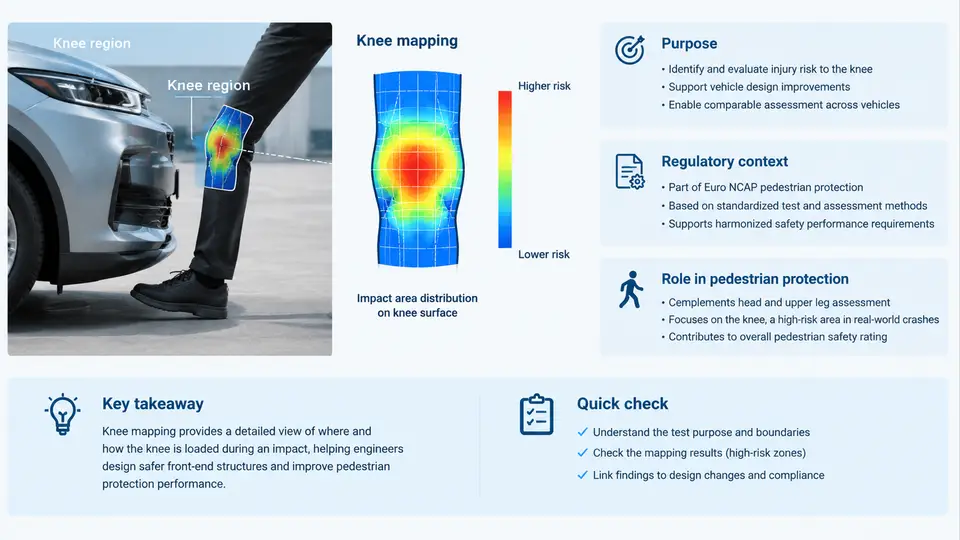
Knee mapping is one of the more specialized procedures in the Euro NCAP pedestrian protection test protocol. Its name is slightly misleading: the test does not evaluate the knee joint itself, nor does it produce a pass/fail score in the way that a legform impact test does. Instead, knee mapping is a geometric survey procedure whose purpose is to identify, on the front structure of a vehicle, the specific impact points at which the upper legform (ULF) and lower legform (LLF) impactors must be fired during the subsequent pedestrian protection tests. In other words, knee mapping answers a deceptively simple question before any dynamic test begins: where exactly on this bumper and bonnet does the legform hit?
The procedure exists because modern vehicle front ends are geometrically complex. Bumper fascias curve in plan view, grilles and air intakes interrupt the surface, bonnet leading edges vary in height across the vehicle width, and styling features such as splitter lips, tow-hook covers, and sensor apertures create local discontinuities. A single nominal impact height or a fixed lateral offset cannot represent this geometry faithfully. Knee mapping replaces assumptions with measurement: the vehicle is placed in a defined reference condition, a physical mapping tool is swept across the front end, and the resulting contact points are recorded and used to define the impact locations for the legform tests.
Regulatory and assessment context
Euro NCAP's pedestrian protection assessment has historically been structured around the EEVC WG17 test methods, which divide the pedestrian body into three impact zones: the lower leg (bumper), the upper leg (bonnet leading edge), and the head (bonnet and windscreen area). The legform tests address injuries to the lower and upper leg, including tibia fractures, knee ligament damage, and femur/pelvis injuries. Knee mapping is the preparatory step that makes those legform tests geometrically valid.
Two contextual points matter for planning. First, knee mapping is a prerequisite, not an optional extra: if the mapping is performed incorrectly, every downstream legform impact point inherits the error, and the resulting test data may be rejected or may misrepresent the vehicle's performance. Second, the procedure is tightly specified. The mapping tool geometry, the vehicle's loading condition, the vertical and lateral sweep paths, and the recording of results are all defined by the protocol. Planning therefore begins with obtaining the current version of the Euro NCAP pedestrian testing protocol and confirming which amendment applies to the assessment year in question, because tool dimensions and grid definitions have been revised across protocol versions.
What knee mapping actually produces
The output of the procedure is a set of recorded impact points, typically expressed as coordinates in the vehicle's own reference system, together with the corresponding test conditions (impact height, impact angle, and impactor type). These points are then used to programme the linear impactor or sled arrangement for the ULF and LLF tests. The mapping therefore sits at the interface between vehicle geometry and test execution, as the diagram below illustrates.
The diagram makes the dependency explicit: knee mapping is not an isolated measurement but the geometric input to two dynamic test series. An error at the mapping stage does not stay local. If a bumper contact point is recorded 15 mm too high, the lower legform is fired at the wrong height, the bending moment and shear displacement readings correspond to a different part of the bumper structure, and the assessment no longer reflects the vehicle as tested. This propagation is the main reason the procedure receives disproportionate planning attention relative to its apparent simplicity.
Why the procedure is specified so tightly
Repeatability is the governing concern. Pedestrian protection results are compared across laboratories, across vehicle variants, and across assessment years. If each laboratory were free to choose its own mapping height or sweep pattern, legform impact points would differ between facilities and the comparability of results would collapse. The protocol therefore fixes the mapping tool's contact geometry, the reference plane and vehicle condition, the lateral positions at which sweeps are made, and the way contact points are projected onto the vehicle. The planner's job is not to reinterpret these rules but to reproduce them exactly and to document that reproduction.
A practical consequence is that knee mapping is a fixture-and-tooling discipline as much as a measurement one. The vehicle must be presented in the specified load condition, which typically means kerb mass with fluids at specified levels and tyres at the specified pressure; the ground reference must be established and maintained; and the mapping tool must be verified against its nominal dimensions before use. A tool that has been dropped, or a vehicle whose tyre pressures have drifted after standing, will bias every point recorded.
Where knee mapping fits in the test plan
In a well-ordered programme, knee mapping occupies a defined slot: after the vehicle has been received, documented, and brought to reference condition, but before any legform or headform impact. The mapping results are reviewed and signed off before impactor firing begins, because once a legform has been fired at a point, that point is consumed. The planning deliverables that follow from this chapter are therefore modest but consequential: a confirmed protocol revision, a verified mapping tool, a documented vehicle reference condition, and a recording format that captures each contact point with its coordinates and the conditions under which it was obtained.
It is also worth noting what knee mapping is not. It is not a compliance test in its own right, it does not generate a score, and it does not assess injury risk. Its value is entirely instrumental: it converts a complex three-dimensional front-end geometry into a small, defensible set of impact locations. Judged on that basis, the measure of a good knee mapping exercise is not the elegance of the recorded points but their reproducibility — a second operator, following the same protocol with the same tool on the same vehicle, should arrive at the same points within the tolerance the protocol allows. Everything in the following chapters on tooling, vehicle preparation, sweep execution, and point recording serves that single objective.