1. Regulatory and scoring framework overvie
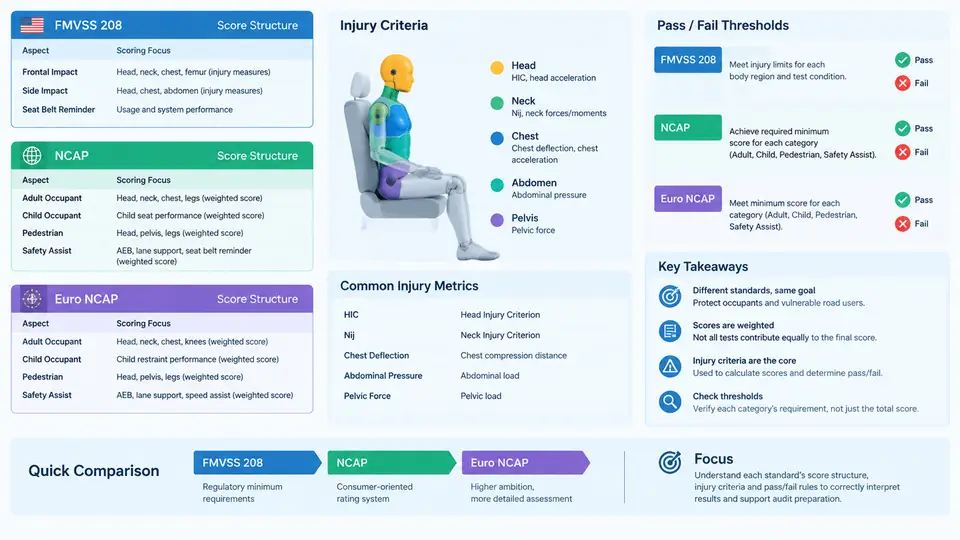
Crash test score recalculation is only meaningful when the underlying scoring framework is understood precisely. A recalculation is not a re-run of the test; it is a re-derivation of scores from recorded physical measurements — accelerations, forces, displacements, and timing — using a defined set of injury criteria and threshold rules. Before any audit trail can be prepared, the analyst must be able to answer three questions for every score being recalculated: which regulation or protocol governs it, which injury criterion produces the numeric value, and which threshold converts that value into a pass/fail or star rating. This chapter establishes that foundation across the three frameworks most commonly encountered in occupant protection work: FMVSS 208, US NCAP, and Euro NCAP.
FMVSS 208: The Regulatory Baseline
FMVSS 208 (Occupant Crash Protection) is a regulatory standard: compliance is mandatory for vehicles sold in the United States, and the output is binary — pass or fail. It does not produce stars or points. The standard defines frontal barrier tests at 56 km/h (35 mph) into a rigid barrier, plus optional unbelted and offset conditions depending on the compliance option chosen by the manufacturer. Because the result is pass/fail, recalculation under FMVSS 208 is fundamentally a threshold re-evaluation: the analyst recomputes each injury criterion from the filtered channel data and compares it against the regulatory limit.
The core injury criteria and their limits are the reference values that every recalculation must reproduce exactly:
| Criterion | Measurement basis | FMVSS 208 limit |
|---|---|---|
| HIC36 / HIC15 | Resultant head acceleration, 36 ms or 15 ms window | HIC ≤ 700 (HIC36) for driver/passenger in belted config. |
| Chest deflection | Rib deflection (Hybrid III 50th) | ≤ 63 mm (driver), ≤ 63 mm (passenger) |
| Femur axial force | Axial load per femur | ≤ 10 kN per femur |
| Neck injury (Nij) | Neck axial force + bending moment | Nij ≤ 1.0 |
Two details matter enormously during recalculation. First, HIC is window-dependent: HIC36 and HIC15 are computed over different integration windows and will not agree. The analyst must confirm which window the original certification used before recomputing. Second, the acceleration channel must be filtered per the regulation (CFC 1000 for head acceleration in FMVSS 208) before integration; applying a different filter class changes the HIC value and invalidates the comparison. These are the two most common sources of discrepancy in audit findings.
US NCAP: Points, Stars, and Weighted Scoring
US NCAP (the New Car Assessment Program administered by NHTSA) is a consumer information program, not a regulation. It converts physical measurements into points, then into a five-star rating. The scoring structure is more layered than FMVSS 208 and therefore more sensitive to recalculation errors. In the frontal crash component, US NCAP evaluates the driver and front passenger separately, assigns points per body region based on injury criteria, and combines them into a vehicle-level score.
The injury criteria used in US NCAP frontal scoring include HIC15, chest deflection, chest acceleration (3 ms clip), Nij, and femur forces. Each criterion maps to a point value through a piecewise function: full points below a lower threshold, zero points above an upper threshold, and linear interpolation between them. For example, a HIC15 of 560 might earn full points while a HIC15 of 700 earns zero, with intermediate values interpolated. The exact breakpoints are defined in the NCAP test procedures and must be taken from the version in force at the time of the original test — a critical audit consideration, because NCAP procedures are revised periodically and a recalculation using the wrong procedure version will produce a defensible-looking but incorrect score.
Euro NCAP: Weighted Sub-Scores and Star Bands
Euro NCAP differs structurally from both of the above. It is a consumer rating programme organized into four assessment areas — Adult Occupant Protection (AOP), Child Occupant Protection (COP), Vulnerable Road User (VRU) protection, and Safety Assist — each contributing a weighted percentage to a total score. The total score is then mapped to a star rating through defined bands. Within AOP, frontal impact is one of several sub-tests (alongside side impact, pole, and whiplash), and each sub-test contributes points that are normalized to the AOP maximum.
The injury criteria in Euro NCAP frontal assessment are similar in kind to US NCAP — HIC, chest deflection, Nij, femur force — but the thresholds and point allocations differ, and Euro NCAP applies a "modifier" concept: a body region can be scored as "good," "adequate," "marginal," "weak," or "poor," with capping rules that limit the total score if any region is poor. This capping behavior is the single most important feature for recalculation, because a small change in one criterion near a band boundary can trigger a cap that changes the overall star rating far more than the raw point delta would suggest.
Why the Framework Determines the Recalculation Method
The three frameworks above are not interchangeable, and the recalculation procedure must follow the framework that produced the original score. Under FMVSS 208, the recalculation is a direct threshold comparison and the audit trail needs only the filtered channel, the computed criterion, and the limit. Under US NCAP, the recalculation must reproduce the piecewise point mapping, which means the audit trail must record the breakpoints and the interpolation result for each criterion. Under Euro NCAP, the recalculation must additionally reproduce the region rating and the capping logic, so the audit trail must document not just the numeric score but the rating assignment and whether any cap was active.
A practical example illustrates the difference. Suppose a recorded HIC15 channel yields 640 after correct filtering. Under FMVSS 208 with a 700 limit, this is a pass with margin. Under US NCAP, 640 might fall in the interpolated region between full points and zero, producing a partial point value that depends on the exact breakpoints. Under Euro NCAP, 640 might place the head region in "marginal," which could trigger a cap on the AOP sub-score. The same physical measurement produces three different outcomes because the scoring logic differs. A recalculation that applies the wrong framework's logic will produce a number that looks plausible but is indefensible in audit.
Establishing the Reference Set Before Recalculation
Before touching any data, the analyst should assemble a reference set that pins every parameter the recalculation depends on. This is the foundation of the audit trail and should be created as a structured record, not scattered notes. A workable reference set contains, at minimum: the governing framework and its version or effective date; the test configuration (barrier type, impact speed, occupant position, belt status); the channel list with sensor identifiers and units; the filter class applied per channel; the criterion definitions including integration windows; the threshold or breakpoint table; and the capping or weighting rules where applicable.
For a concrete example, a reference set for a US NCAP frontal recalculation might record: procedure version "MY2024 NCAP Frontal," impact speed 56 km/h, driver and passenger Hybrid III 50th, head acceleration filtered CFC 1000, HIC15 window 15 ms, chest deflection in mm, Nij computed per the procedure's neck formula, and the point breakpoint table from the procedure appendix. With this set fixed, the recalculation becomes a deterministic transformation from channel data to score, and any auditor can reproduce it independently.
With the framework, criteria, and reference set established, the remaining work of this course — channel verification, criterion recomputation, score assembly, and audit trail documentation — becomes a controlled process rather than an exercise in guesswork. The next step is to examine how raw measurement channels are validated before they are used in any recalculation.