1. Regulatory and rating frameworks
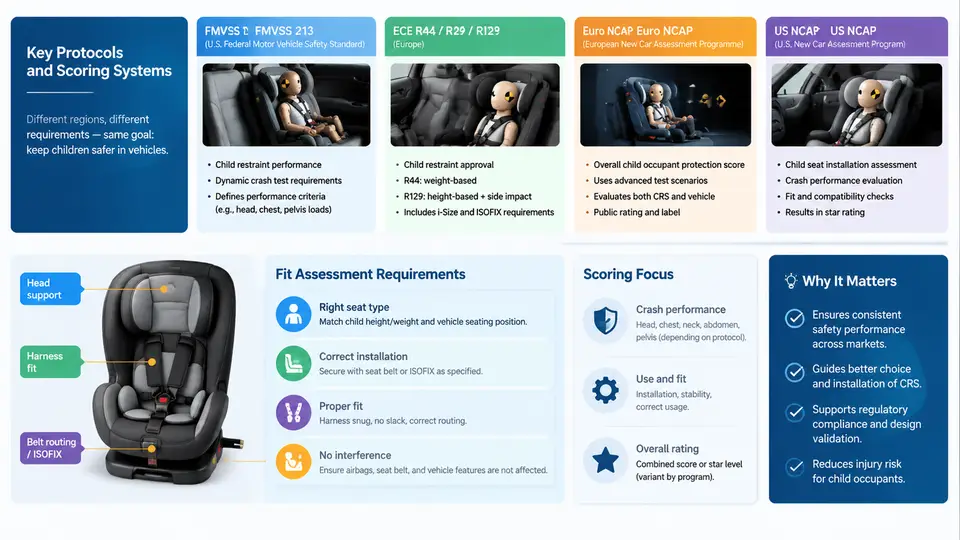
Child occupant protection is governed by two distinct but interacting layers of requirements. The first layer is regulation: mandatory legal instruments that define whether a child restraint system (CRS) may be sold and used in a given market. The second layer is consumer rating: voluntary assessment programmes that publish comparative performance information and increasingly drive product design. A practitioner working on CRS fit assessment must understand both layers, because a restraint that is fully compliant with a regulation may still score poorly in a rating programme, and a high rating score does not by itself establish legal conformity.
The two dominant regulatory regimes are the United States Federal Motor Vehicle Safety Standard FMVSS 213 and the United Nations Economic Commission for Europe regulations ECE R44 and ECE R129. They differ in test philosophy, dummy families, loading conditions, and — most importantly for this course — in how they define and verify the interface between the CRS and the vehicle seat.
FMVSS 213: performance-based compliance with a defined test bench
FMVSS 213, "Child Restraint Systems," applies to restraints for children weighing up to 80 lb (approximately 36 kg) in the US market. Its core logic is performance-based: the CRS is mounted on a standardized sled bench that represents a vehicle rear seat, instrumented with a specific seat cushion geometry and belt anchorage locations, and subjected to a frontal deceleration pulse. Compliance is judged against injury-risk criteria measured on anthropomorphic test devices (ATDs) — principally head injury criteria (HIC), chest resultant acceleration, and head excursion limits.
The fit-relevant requirements in FMVSS 213 are concrete and testable. The standard specifies a seat cushion angle and a belt geometry that the CRS must accommodate, and it requires that the restraint be installable using the vehicle's lap and shoulder belt or, where applicable, the lower anchorages and tether defined by FMVSS 225. A CRS that cannot be installed within the specified belt path geometry on the standard bench fails regardless of its crash performance. FMVSS 213 also mandates a label and instruction set that states the size range, installation method, and any vehicle-specific limitations — the practical starting point for any fit assessment.
For the practitioner, the key takeaway is that FMVSS 213 compliance is demonstrated on a fixed surrogate seat, not on the actual vehicle. The standard therefore defines the boundary conditions a CRS must tolerate, but it does not certify that the CRS fits any particular vehicle. That gap is precisely where fit assessment and rating programmes operate.
ECE R44 and R129: approval by type, with a defined installation envelope
The European framework uses type approval: a CRS is approved as a product against a regulation, and the approval mark (the E-mark) identifies the regulation, the category, and the mass or stature group. ECE R44 classifies restraints into groups by child mass (Group 0 up to 10 kg, Group 0+ up to 13 kg, Group I 9–18 kg, Group II 15–25 kg, Group III 22–36 kg) and tests on a sled with a defined seat and belt geometry. ECE R129 (the "i-Size" regulation) replaces mass-based groups with stature-based classification, mandates ISOFIX as the primary attachment for most categories, requires side-impact testing, and — significantly for fit — introduces a vehicle-specific compatibility list concept: for i-Size universal restraints, the CRS must be shown to fit the vehicle seating positions listed by the vehicle manufacturer.
R129's ISOFIX requirement changes the fit problem from a belt-routing problem to a hard-point engagement problem. The CRS connector arms must engage the vehicle's ISOFIX anchorages, the support leg or top tether must find a load path, and the CRS body must not foul the seat cushion or backrest. R129 also defines a fixture-based installation check using the ISOFIX reference fixture, which gives assessors a repeatable geometric standard against which real vehicle seats can be compared.
Rating programmes: Euro NCAP and US NCAP
Consumer rating programmes convert regulatory compliance into comparative scores. Euro NCAP assesses child occupant protection in two parts: CRS-based assessment, where the vehicle is tested with specific child restraints installed, and vehicle-based assessment, which evaluates the vehicle's ISOFIX anchorages, i-Size compatibility, installation instructions, and the ability to disable the front passenger airbag. Euro NCAP publishes a CRS fit list per vehicle, and its protocols reward vehicles that accommodate a wide range of restraints and provide clear, correct installation guidance. The programme also scores installation ease and correctness, which is directly a fit-assessment activity.
US NCAP (the NHTSA New Car Assessment Program) has historically focused on frontal and side crashworthiness and rollover, with child occupant protection addressed through the agency's separate CRS ease-of-use rating and the LATCH (Lower Anchors and Tethers for Children) usability assessment. The US approach therefore distributes child protection across several instruments rather than a single consolidated child score, and the fit-relevant information appears in the ease-of-use ratings and the vehicle owner's manual LATCH guidance.
The table below summarizes how the four frameworks treat the fit question.
| Framework | Status | Attachment basis | Fit-relevant requirement |
|---|---|---|---|
| FMVSS 213 | Mandatory (US) | Vehicle belt; LATCH per FMVSS 225 | Installable on standardized sled bench; label/instruction content |
| ECE R44 | Mandatory (UNECE markets) | Belt and ISOFIX variants by group | Type approval on defined seat; group-based mass range |
| ECE R129 | Mandatory (phasing in) | ISOFIX primary; support leg/top tether | Stature-based; vehicle compatibility list; side impact |
| Euro NCAP | Voluntary rating | ISOFIX and belt, per protocol | CRS fit list; installation ease and correctness scoring |
| US NCAP | Voluntary rating | LATCH and belt | CRS ease-of-use rating; LATCH usability assessment |
How the frameworks interact in a fit assessment
In practice, a fit assessment starts from the CRS approval and works outward to the vehicle. The approval tells you the CRS category, the child size range, the permitted attachment methods, and any conditions (for example, "ISOFIX only," or "belt-installed with top tether"). The vehicle tells you the seating position geometry, the ISOFIX anchorage locations, the available tether anchorages, the seat cushion angle, and any manufacturer restrictions. The rating programme tells you whether the combination has been independently assessed and how it scored.
The diagram below shows this relationship as a signal chain from regulatory approval through vehicle interface to the fit decision, with the rating programme acting as an independent verification layer.
Practical implications for the assessor
Three practical rules follow from this framework overview. First, never treat an approval mark as a fit statement. An ECE R129 i-Size approval means the CRS meets the regulation's performance and attachment requirements; it does not mean the CRS fits a given vehicle unless the vehicle is on the manufacturer's compatibility list or the combination has been verified. Second, read the CRS instructions before the vehicle manual, because the CRS defines the permitted installation methods and the vehicle manual defines the available anchorage geometry; conflicts between the two are a common source of incorrect installation. Third, use the rating programme's fit list as a screening tool, not a verdict: a listed combination has been assessed under controlled conditions, but seat cushion wear, aftermarket seat covers, and accessory mats can change the real interface.
A concrete example illustrates the interaction. Consider an i-Size CRS approved to R129 with ISOFIX and a support leg, assessed for a vehicle whose rear seat has ISOFIX anchorages but a deep cushion and a storage compartment under the floor. The approval confirms the CRS category and attachment method; the vehicle interface check reveals that the support leg cannot reach the floor pan because of the storage compartment, and the vehicle manufacturer's list does not include this seating position. The fit decision is therefore "not compatible at this position," even though both the CRS and the vehicle are individually compliant. The rating programme's fit list, if it lists the vehicle, would typically flag the same limitation — which is why the three layers are read together rather than in isolation.
With this framework established, subsequent chapters can treat the individual protocols in detail: the specific test pulses and injury criteria, the ISOFIX and LATCH geometry definitions, the installation-check procedures, and the scoring rubrics used by the rating programmes. The essential point to carry forward is that child occupant protection scoring is a layered system, and fit assessment is the activity that connects a legally approved product to a specific vehicle seating position under real-world constraints.