1. Modifier fundamentals in adult occupant
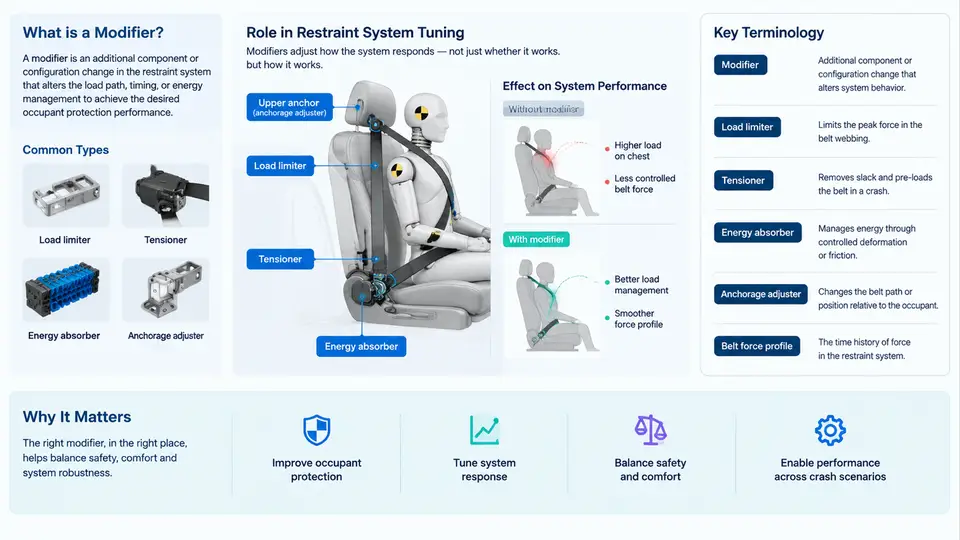
In adult occupant protection (AOP), a modifier is a calibrated adjustment applied to a baseline restraint control strategy so that the deployment of airbags, seat-belt pretensioners, and load limiters better matches the actual occupant and crash condition. The term is deliberately neutral: a modifier does not create a new restraint function, it modulates an existing one. In practice, modifiers appear as multiplicative factors, additive offsets, threshold shifts, or stage-selection overrides inside the restraint control algorithm. Understanding them is the prerequisite for every case study that follows, because most field-tuning decisions in AOP are, at bottom, decisions about which modifier to move, by how much, and under what enabling conditions.
Definition and position in the restraint control chain
A useful working definition is: a modifier is a bounded, condition-gated parameter set that transforms a nominal restraint output into a tailored output for a specific occupant–crash state. Three words carry the weight. Bounded means every modifier has an engineering range and a default of 1.0 (multiplicative) or 0 (additive); outside that range the calibration is invalid. Condition-gated means the modifier only becomes active when its enable logic is satisfied — for example, a belt-usage flag, an occupant-classification output, or a crash-severity band. Tailored means the output is still the same physical actuator command, just shaped differently.
The modifier sits between sensing/classification and actuator command generation. Upstream, the crash ECU produces a severity estimate and an occupant state (belted/unbelted, position, size class). Downstream, the restraint algorithm issues stage commands and timing. The modifier is the layer that maps "who and how hard" onto "which stage, when, and with what intensity." This position explains why modifier work is never isolated: changing a modifier changes the timing margin against the next event in the crash pulse.
Role in restraint system tuning
Modifiers exist because a single nominal calibration cannot satisfy the full occupant matrix. A 50th-percentile belted male in a 40 km/h full-frontal barrier is the reference case, but the same vehicle must also protect a small female, an unbelted large male, and occupants in offset or oblique impacts. Rather than build separate restraint maps for every combination, engineers keep one baseline map and apply modifiers to shift it. The practical roles are:
- Severity scaling. A severity modifier scales deployment aggressiveness across crash-speed bands, so a low-speed event does not fire a full-power stage.
- Occupant adaptation. Belt-status and occupant-class modifiers adjust pretensioner force and airbag stage selection for belted versus unbelted and for size class.
- Position compensation. Out-of-position (OOP) modifiers suppress or delay deployment when the occupant is close to the module, protecting against deployment-induced injury.
- Robustness trimming. Small modifiers absorb build variation and sensor tolerance without re-running the whole calibration.
The tuning workflow is therefore iterative: establish the baseline, identify the occupant–crash cell that fails a criterion (for example, chest deflection or head injury criterion), then adjust the smallest set of modifiers that corrects that cell without regressing adjacent cells. Because modifiers interact, a change to the unbelted severity modifier can shift the belted low-speed margin; the calibration must be re-verified across the matrix, not just at the failing point.
Key terminology
The vocabulary below is used consistently throughout the case studies. Where a term has a sign or reference convention, the convention is stated so that later figures and tables remain unambiguous.
| Term | Meaning in this course | Convention / note |
|---|---|---|
| Baseline calibration | Nominal restraint map before any modifier is applied | Modifier default = 1.0 (multiplicative) or 0 (additive) |
| Modifier gain | Multiplicative factor applied to a nominal output | >1 increases aggressiveness; <1 reduces it |
| Offset | Additive shift applied to a threshold or timing value | Positive offset delays or raises the threshold |
| Enable condition | Logic predicate that gates modifier activation | Must be true for the modifier to take effect |
| Occupant class | Size/position category from occupant classification | e.g. small female, 50th male, large male |
| Belt status | Belted / unbelted flag from buckle and belt-tension sensing | Drives pretensioner and stage selection |
| Severity band | Crash-severity bin derived from delta-v and pulse shape | Bands are contiguous and non-overlapping |
| Stage command | Actuator firing decision (stage 1 / stage 2 / none) | Timing referenced to crash pulse t0 |
| OOP | Out-of-position occupant state | Triggers suppression or delay modifiers |
| Regression cell | Occupant–crash combination re-checked after a change | Any cell whose criterion worsens is a regression |
How a modifier is applied — a worked example
Consider a baseline strategy in which the stage-1 airbag command is issued at a fixed time after t0, and the pretensioner force is a nominal value. Suppose the calibration team finds that the unbelted 50th-male cell in the 40 km/h band shows excessive chest deflection, while the belted cell is acceptable. The correction is not to change the baseline timing — that would regress the belted cell — but to introduce a belt-status modifier that reduces pretensioner force and advances stage-1 timing only when the unbelted flag is set and the severity band is the 40 km/h band.
# Illustrative modifier block (values are teaching examples, not measured data)
modifier: pretension_force_gain
  default: 1.00
  enable: belt_status == UNBELTED and severity_band == B40
  value: 0.85          # reduce force for unbelted occupant
  range: [0.80, 1.00]

modifier: stage1_timing_offset_ms
  default: 0
  enable: belt_status == UNBELTED and severity_band == B40
  value: -4            # negative offset advances stage-1 command
  range: [-8, 0]
After applying the block, the engineer re-runs the regression cells: the unbelted 40 km/h cell should improve, and the belted 40 km/h cell must remain unchanged because its enable condition is false. If the belted cell moves, the gate is leaking — a common failure mode caused by a mis-set flag or a band boundary that overlaps. The observable verification is therefore twofold: the target cell's criterion improves, and every non-target cell is bit-identical to the baseline. That "no collateral change" check is the practical definition of a clean modifier application.
Reading the modifier map
The figure below shows how the modifier layer sits between occupant/crash state and actuator commands, and how a single enable condition routes a state to the correct modifier branch. Use it as the mental model for the case studies: every case will identify the state inputs, the active modifier, the transformed command, and the regression cells that must be checked.
The map makes the central discipline visible: the modifier layer is a gate, not a switch. When the enable condition is false, the layer must pass the baseline through untouched; when it is true, the layer applies a bounded gain or offset and clamps to its validated range. The regression band at the bottom is not an afterthought — it is the step that distinguishes a controlled calibration change from an uncontrolled one. In the case studies that follow, each scenario will be read against this map: identify the state inputs, name the active modifier and its gate, state the transformed command, and list the regression cells that must remain unchanged.