3. Migration drivers and constraints
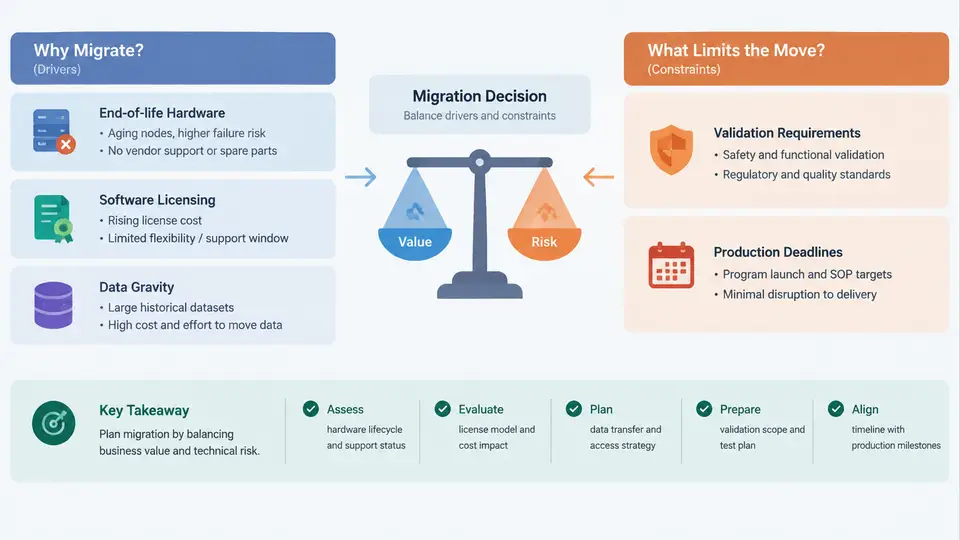
A CAE cluster migration is never triggered by a single cause. In practice, it is the convergence of several independent pressures — hardware that can no longer be maintained, software that can no longer be licensed on the old platform, datasets that have grown too large to move cheaply, validation obligations that must be re-satisfied on new silicon, and a production calendar that does not pause for infrastructure work. Understanding these drivers and constraints as a coupled system, rather than a checklist, is what separates a migration that completes on schedule from one that stalls halfway.
End-of-life hardware as the primary forcing function
The most common trigger is the withdrawal of vendor support for compute, interconnect, or storage components. A representative case: a cluster built on a generation of InfiniBand HDR fabric and a processor family whose vendor has announced end-of-support (EOS) for firmware and field-replaceable units. Once EOS is reached, a single failed leaf switch or HCA can take an entire rack offline with no replacement path. The risk is not gradual degradation — it is a step change in availability.
Quantify this before committing to a timeline. For each hardware tier, record the vendor's end-of-sale (EOS), end-of-support (EOSL), and last-firmware-release dates. A practical rule: if any tier reaches EOSL within the planned migration window plus a 6-month buffer, that tier becomes a hard constraint on the schedule, not a soft preference.
Software licensing and platform coupling
Solver and pre/post-processing licenses are frequently tied to specific architectures, operating system versions, or even specific CPU instruction sets. A license server that authorizes 512 HPC tokens on the current platform may not authorize the same token count on a new architecture without a contract amendment. Two failure modes are common:
- Token re-hosting: the license daemon must be re-hosted on the new cluster, and the vendor's host ID binding (MAC address, dongle, or cloud-based entitlement) must be reissued. This is a procurement action with lead time, not a configuration step.
- Feature gating: certain solver features (e.g., GPU acceleration, distributed memory parallelism beyond a node count) are licensed separately and may not be available on the target platform at the same price tier.
Build a license inventory table before migration design begins. For each product, capture: product name, version, license model (node-locked, floating, token-based), current host binding, target platform compatibility, and renewal or amendment lead time. This table directly feeds the migration schedule.
Data gravity and movement cost
CAE datasets are large and often have long retention requirements driven by validation and traceability. A single full-vehicle crash simulation campaign can produce 20–80 TB of results, and a year of production work can exceed 1 PB. Data gravity means that moving the compute without moving the data — or moving the data without a plan for incremental sync — creates a bottleneck that can dominate the entire migration.
Estimate transfer time explicitly. For a 200 TB dataset over a 10 Gb/s link with realistic 70% utilization:
200 TB = 200 × 1024 × 1024 MB = 209,715,200 MB
Effective throughput = 10 Gb/s × 0.70 = 7 Gb/s = 0.875 GB/s
Transfer time = 209,715,200 MB / (0.875 × 1024 MB/s) ≈ 234,000 s ≈ 65 hours
That is 65 hours of continuous transfer for one dataset, assuming no retries, no contention, and no verification pass. In practice, plan for 2–3× that figure when checksum verification and incremental re-sync are included. If the migration window is shorter than the transfer time, you need a staged approach: seed the new storage with a bulk copy weeks in advance, then run a final incremental sync during the cutover window.
Validation requirements
Moving to new hardware or a new software stack invalidates prior validation evidence. In regulated industries (automotive safety, aerospace), this is not optional. The migration must include a validation plan that re-establishes confidence in results on the target platform. Typical validation activities include:
- Regression suite execution: run a defined set of models with known results and compare key outputs (e.g., peak acceleration, intrusion, energy balance) against baseline within a tolerance band.
- Numerical reproducibility checks: verify that solver settings, compiler flags, and library versions produce results within acceptable drift. Bit-for-bit reproducibility is rarely achievable across architectures; define an acceptable tolerance (e.g., <2% deviation on primary responses).
- Performance benchmarking: measure wall-clock time and scaling efficiency on the new platform for representative models. A migration that is functionally correct but 40% slower may be unacceptable for production deadlines.
The validation plan should be written before migration begins, with pass/fail criteria agreed upon by engineering and quality stakeholders. Without pre-agreed criteria, validation becomes an open-ended negotiation that delays cutover.
Production deadlines and the migration window
CAE clusters support production programs with fixed milestones — design freezes, physical test correlations, regulatory submissions. The migration must fit into a window that does not jeopardize these milestones. Two strategies are common:
- Parallel run: operate old and new clusters simultaneously for a defined period, routing non-critical jobs to the new cluster while critical-path work remains on the old. This reduces risk but increases cost and operational complexity.
- Hard cutover: migrate all production work at a scheduled downtime. This is faster and cheaper but leaves no fallback if validation fails.
The choice depends on the risk tolerance of the production program and the maturity of the validation evidence. A hybrid approach — parallel run for validation, hard cutover for production — is often the most practical compromise.
Putting it together: a constraint-driven schedule
The practical output of this analysis is a migration schedule driven by the tightest constraint, not by the most visible driver. A worked example:
| Item | Driver / Constraint | Lead time or limit | Schedule impact |
|---|---|---|---|
| Compute nodes EOSL | Driver | 14 months | Migration must complete before month 14 |
| Solver license amendment | Constraint | 10 weeks | Must initiate by month 11 at latest |
| 200 TB dataset transfer | Constraint | ~65 h continuous (ideal) | Requires staged seed + incremental sync |
| Regression validation | Constraint | 6 weeks | Must complete before production cutover |
| Production milestone freeze | Constraint | Month 12 | Cutover must avoid month 12 |
In this example, the binding constraint is the production milestone freeze at month 12 combined with the 6-week validation window, which pushes the validation start to month 10. The license amendment must be initiated by month 11, and the data seed must begin by month 9 to allow for incremental sync. The EOSL at month 14 is the ultimate deadline, but the schedule is actually driven by the validation and production constraints — a common pattern in real migrations.
Finally, document the drivers and constraints in a single register that is reviewed at each project gate. This register becomes the reference point for scope decisions, risk assessments, and stakeholder communication throughout the migration. Without it, the project is vulnerable to shifting assumptions and unmanaged dependencies — the most common causes of migration delays in CAE environments.