1. CAE analytics APIs and production data s
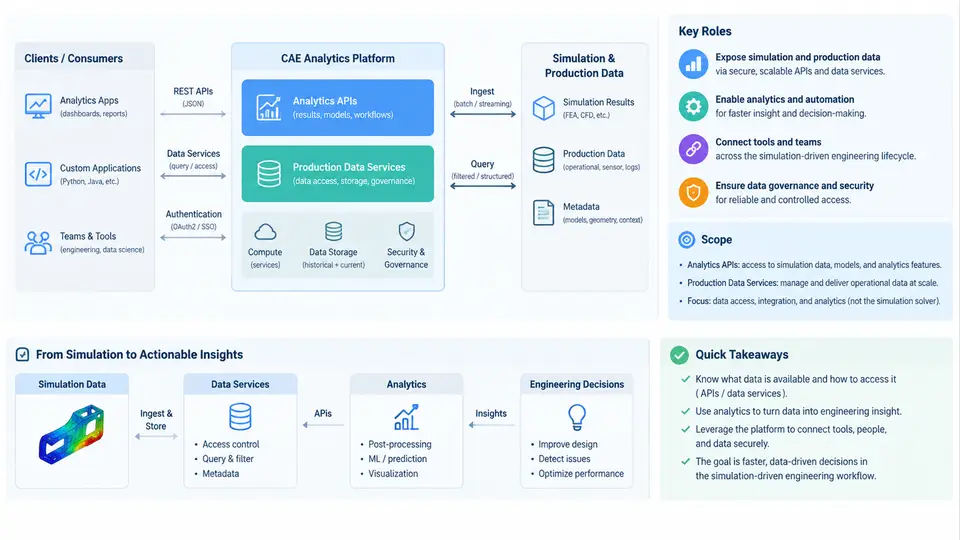
Computer-aided engineering (CAE) has matured from a desktop activity performed by individual analysts into a shared, service-oriented capability that underpins design decisions across an entire organization. As simulation models grow larger and result datasets grow denser, the bottleneck is rarely the solver itself. It is the movement, governance, and interpretation of simulation data. CAE analytics APIs and production data services are the layer that turns raw solver output into queryable, governed, and reusable engineering information. This chapter establishes the scope of that layer, describes its reference architecture, and explains why it has become a first-class concern in simulation-driven engineering.
What the Scope Actually Covers
It is tempting to reduce "CAE analytics" to post-processing plots. In production, the scope is broader and can be grouped into four functional domains:
- Result ingestion and normalization — reading native solver formats (for example,
.op2,.odb,.rst,.h3d,.unv), extracting fields, and mapping them onto a consistent model topology so that results from different solvers can be compared. - Metadata and lineage — capturing what was simulated: solver version, deck revision, material cards, boundary conditions, mesh checksum, and the identity of the input CAD or geometry revision.
- Analytics and query — exposing derived quantities such as peak stress, fatigue life, modal frequencies, mass, or safety factors through stable APIs rather than ad-hoc scripts.
- Governance and access — authentication, authorization, retention, audit trails, and reproducibility guarantees for regulated or safety-critical programs.
The distinction between an analytics API and a production data service is one of responsibility. The API defines the contract: endpoints, schemas, units, and error semantics. The data service is the running system that fulfills that contract — storage, indexing, caching, compute workers, and observability. A well-designed program treats the API as the product and the service as its implementation.
Reference Architecture
A practical deployment separates concerns into five tiers. The diagram below shows the flow from solver output to consuming applications, with the metadata store and object store acting as the durable backbone.
The architecture is deliberately layered so that each tier can evolve independently. Ingestion workers can add a new solver reader without touching the API contract. The metadata database can migrate from a relational engine to a graph store without changing how consumers query peak stress. This separation is what makes the system production rather than a collection of scripts.
Why This Layer Matters in Simulation-Driven Engineering
When simulation is used only to answer a single design question, a script and a plot are sufficient. When simulation becomes the primary evidence for design release, three requirements emerge that ad-hoc workflows cannot satisfy:
- Traceability. A reported safety factor must be traceable to a specific solver run, a specific mesh, and a specific material card. Without lineage, a result cannot be defended in a design review or a regulatory submission.
- Comparability. Design iterations must be compared on a consistent basis. If one run reports stress in MPa and another in psi, or if one uses a different mesh density, the comparison is meaningless. Normalization at ingestion solves this once, centrally.
- Automation. Optimization loops, DOE studies, and ML feature extraction all require programmatic access to results. A stable API turns simulation output into a queryable dataset, enabling hundreds of runs to be analyzed without manual intervention.
In practice, the return on investment appears quickly. A team that previously spent two days per design review manually extracting and reformatting results can reduce that to minutes by querying a single endpoint. More importantly, the results become consistent across reviewers, which reduces the risk of a design decision being based on a misread plot.
A Concrete API Interaction
Consider a service that exposes peak von Mises stress for a given load case. A typical request and response might look like this:
GET /v1/models/{modelId}/runs/{runId}/results/peak-stress?loadCase=LC3
Authorization: Bearer <token>

200 OK
{
  "modelId": "wingbox-2024-r7",
  "runId": "nastran-sol101-0042",
  "loadCase": "LC3",
  "field": "von_mises",
  "unit": "MPa",
  "peak": 412.7,
  "location": { "nodeId": 18422, "x": 1.24, "y": 0.87, "z": 3.10 },
  "solver": { "name": "MSC Nastran", "version": "2023.4" },
  "meshChecksum": "a3f9c1e8",
  "ingestedAt": "2024-11-05T09:14:22Z"
}
Several design decisions are embedded in this small example. The unit is explicit, so no consumer has to guess. The location is given as both a node ID and coordinates, so the result can be visualized or cross-referenced. The mesh checksum and solver version make the result reproducible. The ingestedAt timestamp supports retention and audit queries. None of these fields are decorative; each one addresses a failure mode observed in real CAE data workflows.
Common Failure Modes and How to Recognize Them
Production CAE data services fail in characteristic ways. Recognizing the symptoms early saves significant debugging time.
| Symptom | Likely Cause | First Check |
|---|---|---|
| Peak stress differs between two runs of the same model | Mesh or material card changed without a new model revision | Compare meshChecksum and material card hash |
| API returns 404 for a run that exists on disk | Ingestion worker failed silently; run not registered | Check ingestion queue depth and worker logs |
| Units appear inconsistent across results | Normalization step skipped for a new solver reader | Verify the reader's unit mapping table |
| Query latency grows over time | Missing index on modelId or runId |
Inspect query plan and index coverage |
These are not hypothetical. They are the everyday issues that separate a working prototype from a service that a design team can rely on. The architecture described above is designed to make each of these failures detectable and correctable without disrupting consumers.
What to Take Forward
The scope of CAE analytics APIs and production data services is the governed, programmatic access to simulation results. The architecture separates ingestion, storage, API, and consumers, with governance applied across all tiers. The role in simulation-driven engineering is to make results traceable, comparable, and automatable — three properties that manual workflows cannot provide at scale. As you proceed through this course, each subsequent chapter will deepen one part of this picture, from schema design and solver readers to authentication, performance tuning, and integration with optimization and machine learning pipelines.