1. Occupant CAE workflow and surrogate mode
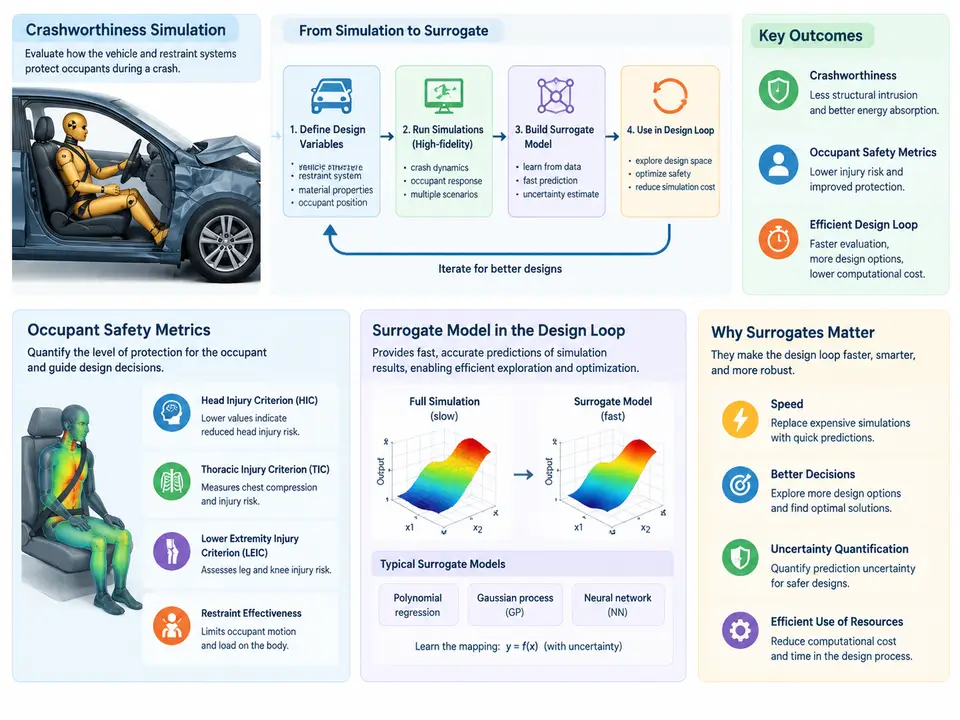
Occupant CAE sits at the intersection of crashworthiness simulation and occupant safety assessment. The workflow begins with a validated finite element (FE) model of the vehicle body, restraint systems, and a crash test dummy, and ends with a set of injury metrics that must satisfy regulatory and consumer-rating targets. Because each full-frontal or side-impact run can take hours to days on a high-performance cluster, and because design teams must explore dozens of restraint and structure variants, the loop between design change and safety verdict is expensive. Surrogate models — fast statistical approximations trained on a limited set of FE runs — are the standard mechanism for closing that loop efficiently.
From Crash Pulse to Injury Metric
A typical occupant safety simulation is a chain of physical events. The vehicle structure deforms against a barrier, generating a deceleration pulse at the occupant compartment. That pulse propagates through the seat and floor into the dummy, whose interaction with the seat belt, airbag, and knee bolster determines the kinematics. The output is a time history of accelerations, forces, and displacements at instrumented locations, from which scalar injury criteria are computed.
The most common metrics in frontal and side impact work are:
- HIC36 / HIC15 — Head Injury Criterion, computed from the resultant head acceleration over a 36 ms or 15 ms window; regulatory limits are typically 700–1000 depending on the load case.
- BrIC — Brain Injury Criterion, based on rotational head velocity, increasingly used in oblique and side impacts.
- Nij — Neck Injury Criterion, combining axial force and bending moment.
- Chest deflection and V*C — chest compression and viscous criterion, both tied to rib fracture risk.
- Femur force — axial load in the upper leg, relevant to lower-extremity injury.
Each metric is a nonlinear function of the full time history, not a simple peak value. This matters for surrogate modeling: the response we want to predict is often a scalar extracted from a transient signal, and small changes in pulse shape can shift the timing of the peak without changing its magnitude. A surrogate trained only on peak values may therefore miss the sensitivity that drives design decisions.
Where Surrogates Enter the Design Loop
The design loop for an occupant restraint system typically involves five to fifteen design variables: belt anchor positions, pretensioner force level, airbag vent size and inflator output, seat pan angle, and structural stiffness parameters. A full factorial or even a Latin hypercube design over this space requires hundreds of FE runs. Surrogate modeling replaces the FE solver with a cheap response surface — a Gaussian process, polynomial chaos expansion, or neural network — trained on a carefully chosen subset of runs, typically 30 to 100 for a moderate-dimensional problem.
The surrogate is then used in three distinct ways. First, for design space exploration: evaluating thousands of candidate designs in seconds to identify promising regions. Second, for optimization: coupling the surrogate to an optimizer to minimize HIC or chest deflection subject to packaging constraints. Third, for uncertainty quantification: propagating variability in belt friction, inflator output, and occupant position through the surrogate to estimate the probability of exceeding an injury threshold.
Workflow Structure
The diagram below shows how the FE solver, the design-of-experiments sampler, the surrogate, and the downstream consumers (optimizer, UQ engine, robustness assessment) connect. Note that the surrogate does not replace the FE model; it sits alongside it, and the final candidate designs are always re-verified with full FE runs before sign-off.
Practical Considerations for the First Iteration
When setting up a surrogate study for the first time, three decisions dominate the outcome. The first is the choice of design variables and their ranges. Ranges that are too wide produce a surrogate that averages over physically distinct regimes (for example, airbag deployment before versus after the dummy has moved forward); ranges that are too narrow produce a surrogate that cannot support optimization. A useful check is to run a small screening DoE — 12 to 16 runs — and inspect the main effects before committing to the full sample.
The second is the choice of response. Predicting HIC directly is common, but HIC is a maximum over a sliding window and is therefore non-smooth in the design variables. A surrogate trained on HIC may show spurious oscillations. An alternative is to predict the head acceleration time history at a reduced set of time points and compute HIC from the predicted history; this preserves smoothness and gives the UQ engine more information.
The third is validation. A surrogate should be assessed with a hold-out set of at least 10 FE runs not used in training, and the error metric should be reported in the units that matter — for example, a root-mean-square error of 40 in HIC against a limit of 700 is a 6% error, which may or may not be acceptable depending on the margin. Cross-validation on the training set alone is not sufficient, because it does not detect extrapolation failure.
What the Surrogate Buys You
In a representative frontal-impact restraint study with eight design variables, a 60-run Latin hypercube plus a Gaussian process surrogate can reduce the time to identify a feasible optimum from roughly three weeks of cluster time to about four days, with the remaining time spent on verification runs. The larger benefit, however, is not speed but the ability to ask questions that a pure FE loop cannot answer: what is the probability that HIC exceeds 700 given the observed scatter in belt friction and inflator output? Which design variable contributes most to that probability? These are uncertainty-quantification questions, and they are the subject of the chapters that follow.