1. DFMEA fundamentals for seatbelt retracto
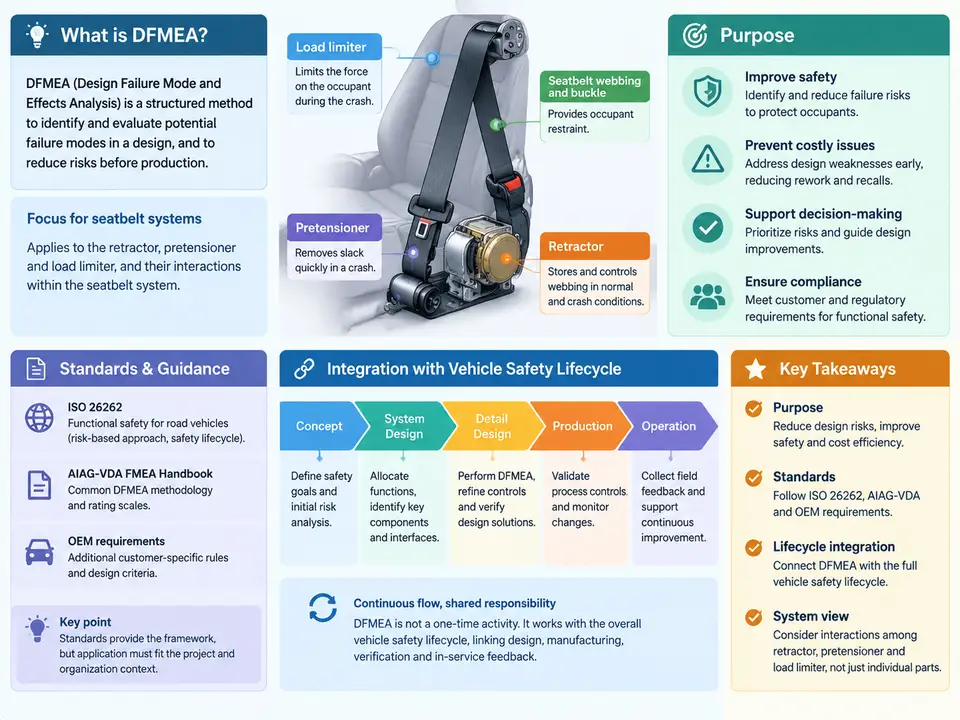
A seatbelt retractor pretensioner and load limiter assembly is one of the few safety systems in a vehicle that must remain dormant for years, then perform a pyrotechnic or mechanical actuation within milliseconds of a crash, and finally manage occupant energy through a controlled force–displacement profile. Because the function is irreversible and the failure consequence is severe, Design Failure Mode and Effects Analysis (DFMEA) is not a documentation exercise for this subsystem — it is the primary structured reasoning tool that connects design intent, potential failure physics, and verification evidence across the vehicle safety lifecycle.
What DFMEA Actually Does in This Subsystem
DFMEA is a bottom-up, function-oriented risk analysis defined by the AIAG & VDA FMEA Handbook (and, in earlier programs, SAE J1739). For a pretensioner/load limiter, the analysis starts from the functions the design must deliver and asks, for each function, how it could fail, what the effect would be at the vehicle level, what design characteristics cause or allow the failure, and what prevention and detection controls exist. The output is a structured set of failure modes, effects, causes, and controls, scored with Severity (S), Occurrence (O), and Detection (D), producing an Action Priority (AP) in the current handbook rather than the legacy RPN.
Three function families dominate the analysis and should be separated explicitly, because their failure physics differ:
- Restraint coupling function — the retractor must lock the webbing and the pretensioner must remove slack (typically 60–120 mm of webbing pull-in within 10–20 ms) so the occupant couples to the restraint early in the crash pulse.
- Energy management function — the load limiter (torsion bar, pyrotechnic switchable limiter, or motorized reversible limiter) must allow controlled webbing payout at a defined force plateau, commonly 3–6 kN at the retractor, to cap chest loading.
- Deployment and non-deployment function — the system must fire when commanded and must not fire when not commanded, including during handling, shipping, and low-severity events.
A frequent early mistake is to write a single function statement such as "restrain occupant." That collapses three different physics domains — pyrotechnic actuation, mechanical locking, and plastic deformation — into one line and makes cause analysis impossible. A well-formed DFMEA structure separates them at the function level and lets each failure mode inherit its own severity rationale.
Severity, Occurrence, and Detection in a Safety-Critical Context
Severity for this subsystem is almost always anchored at the vehicle level, not the component level. A pretensioner that fails to fire may still allow the baseline restraint to work, but the occupant's forward excursion increases and chest/head injury criteria may exceed targets in specific crash modes. Severity should therefore be assigned against the injury outcome in the relevant crash configuration (frontal 56 km/h rigid barrier, 64 km/h ODB, pole, etc.), not against "part does not function." In practice, most non-deployment and unintended-deployment modes land at S = 9 or S = 10, which means the analysis must lean heavily on prevention controls rather than detection, because detection cannot reduce severity.
Occurrence must be grounded in the actual process and design physics: pyrotechnic charge weight tolerance, initiator sensitivity, torsion bar material and heat treatment, webbing stitch pattern, locking pawl engagement geometry, and the manufacturing and supplier history. Detection should reflect what the design and its verification plan can actually reveal before the vehicle leaves the plant — end-of-line functional tests, lot sampling, and in-process gauging — not what a crash test would reveal, because a crash test is not a production detection control.
Standards and the Regulatory Frame
DFMEA content for this subsystem is shaped by several external references that should be cited in the analysis where they drive a requirement:
| Reference | What it constrains in the DFMEA |
|---|---|
| AIAG & VDA FMEA Handbook (7-step approach) | Structure, scoring scales, AP logic, and the linkage from structure analysis to optimization |
| ISO 26262 (functional safety) | ASIL allocation for unintended deployment and non-deployment; safety goals become high-severity failure effects |
| FMVSS 208 / FMVSS 209, UN R16, GB 14166 | Performance and labeling requirements that define the "no failure" baseline for restraint function |
| USCAR-28 / OEM pyrotechnic device specifications | Environmental and abuse requirements (thermal, vibration, ESD) that become cause categories |
| IATF 16949 / PPAP | Links DFMEA outputs to control plans and special characteristics |
The ISO 26262 relationship deserves emphasis. If the program assigns an ASIL to unintended deployment, the DFMEA must be consistent with the safety concept: the failure modes, their causes, and the diagnostic coverage claimed in the technical safety concept should map one-to-one onto DFMEA rows. A DFMEA that ignores the safety concept will fail the functional safety assessment even if the scoring is internally consistent.
Integration Across the Vehicle Safety Lifecycle
DFMEA is a living artifact that must be re-entered at defined lifecycle gates, not written once at design freeze. The diagram below shows how the pretensioner/load limiter DFMEA sits inside the safety lifecycle and what flows in and out at each stage.
Two integration points are routinely under-managed. First, the DFMEA must feed the Design Verification Plan: every high-AP row should map to a specific test, and every test should trace back to a row. If a sled test exists with no DFMEA row behind it, either the analysis missed a failure mode or the test is redundant. Second, the DFMEA must feed the control plan through special characteristics — for example, torsion bar hardness, pyrotechnic charge mass, and locking pawl engagement depth should appear as special characteristics in the control plan with the same rationale recorded in the DFMEA.
A Worked Structure for the First Pass
A practical first pass uses the 7-step structure but keeps the row count manageable. For a retractor with a pyrotechnic pretensioner and a torsion-bar load limiter, a reasonable scope is 25–40 rows covering: non-deployment, delayed deployment, unintended deployment, insufficient pull-in, excessive pull-in, locking failure, load limiter force too high, load limiter force too low, webbing stitch failure, and housing/structural failure. Each row should carry a cause that is specific enough to be actionable — "torsion bar hardness out of specification" is actionable; "material problem" is not.
The measure of a good DFMEA here is not the score it produces but the design decisions it changes: a tightened supplier SPC limit, an added end-of-line pull-in measurement, a revised stitch pattern, or a re-run sled test. If the analysis produces no design or verification change, it has not yet done its job.