1. Injury criteria landscape
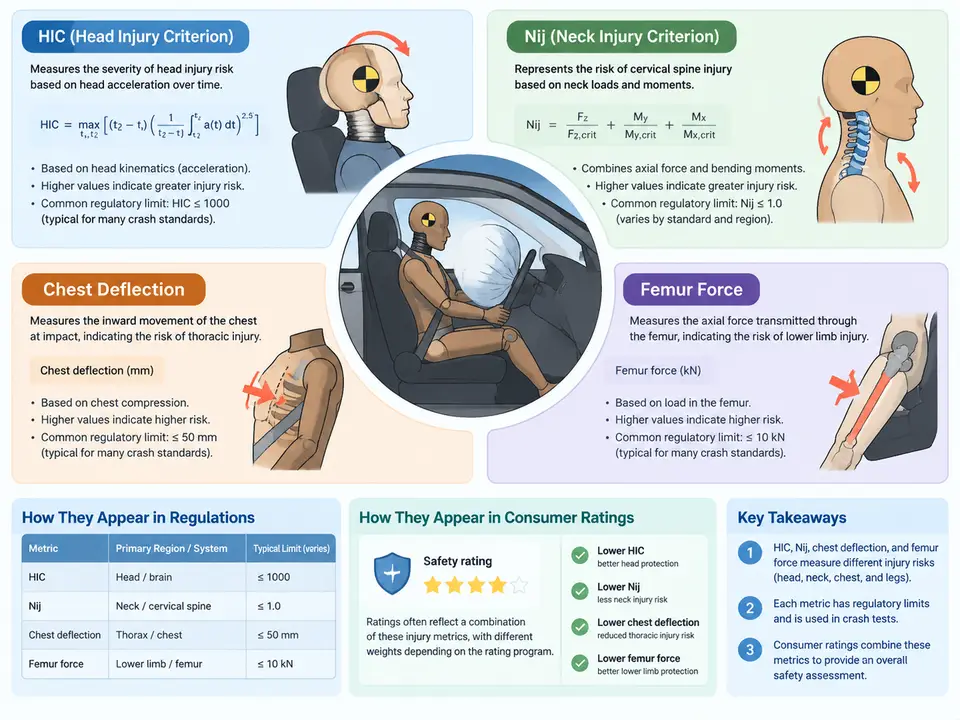
Multi-objective optimization of occupant protection begins with a clear understanding of what is being optimized. In crash safety, the "objectives" are injury criteria — quantitative surrogates that translate complex biomechanical loading into numbers a regulator, rating program, or CAE engineer can compare against a threshold. Four criteria dominate frontal and side impact assessment of the head, neck, thorax, and lower extremities: HIC (Head Injury Criterion), Nij (normalized neck injury criterion), chest deflection, and femur force. Each has its own physical basis, its own regulatory and consumer-rating thresholds, and its own sensitivity to restraint design. Because these criteria respond differently — sometimes oppositely — to the same design change, they form the natural objective set for a multi-objective optimization problem.
HIC: Head Injury Criterion
HIC is defined over the resultant translational acceleration at the head center of gravity, measured in units of g:
HIC = max over t1,t2 of [ (t2 - t1) * ( (1/(t2-t1)) * ∫ a(t) dt )^2.5 ]
subject to t2 - t1 ≤ 15 ms
In practice the integral is evaluated over a sliding window, and the reported value is the maximum over all windows up to 15 ms (HIC15) or 36 ms (HIC36). The 2.5 exponent makes HIC strongly nonlinear: a 20% reduction in average acceleration over the window reduces HIC by roughly 1.22.5 ≈ 1.57, i.e. about 36%. This nonlinearity is why HIC is so sensitive to the shape of the acceleration pulse — spreading the same momentum change over a longer, flatter pulse is far more effective than shaving the peak alone.
Regulatory context: FMVSS 208 sets a HIC15 limit of 700 for the driver and passenger in frontal rigid-barrier and offset tests. Euro NCAP and other consumer programs use HIC15 = 650 as the "good" boundary and 700 as the limit, with points awarded on a sliding scale. In side impact, FMVSS 214 and Euro NCAP side protocols apply HIC36 = 1000 as the limit, reflecting the shorter, sharper loading typical of lateral crashes.
Nij: Normalized Neck Injury Criterion
Nij combines the axial force and bending moment at the occipital condyle into a single normalized value:
Nij = Fz / Fzc + My / Mycwhere Fz is the axial force (tension positive, compression negative), My is the flexion/extension moment, and Fzc and Myc are the corresponding critical values. The criterion is evaluated in four modes — NTE (tension-extension), NTF (tension-flexion), NCE (compression-extension), and NCF (compression-flexion) — and the reported Nij is the maximum across modes. FMVSS 208 requires Nij ≤ 1.0; Euro NCAP awards full points below 0.4 and zero above 1.0. Because Nij is a linear sum of normalized force and moment, it is sensitive to both the magnitude and the phase relationship of the two signals: a neck that is loaded in compression while flexing can reach Nij = 1.0 at lower individual peaks than one loaded in pure tension.
Chest Deflection
Chest deflection is the peak inward displacement of the sternum relative to the spine, measured by a chest band or IR-TRACC in the dummy. FMVSS 208 limits deflection to 63 mm for the 50th-percentile male; Euro NCAP uses a sliding scale with full points below 22 mm and zero above 50 mm. Deflection is a direct measure of thoracic compression and correlates with rib fracture and internal organ injury. It is strongly coupled to restraint stiffness: a stiffer belt or a more aggressive load limiter reduces excursion but raises belt force and can increase deflection in the lower chest, while a softer system reduces peak deflection at the cost of greater forward excursion and higher HIC risk from secondary contact.
Femur Force
Femur force is the axial compressive load measured at the knee-thigh-hip joint, typically via load cells in the dummy's upper legs. FMVSS 208 limits femur force to 10 kN per leg; Euro NCAP uses 3.8 kN as the "good" boundary and 9.07 kN as the limit. Femur force is driven by knee contact with the instrument panel and by belt routing across the pelvis. It is the criterion most sensitive to knee bolster stiffness and to the position of the lap belt: a belt that rides high on the abdomen rather than across the pelvis can concentrate load and raise femur force even as it improves chest deflection.
Regulatory vs. Consumer Rating Thresholds
The same physical quantity is judged differently by regulation and by consumer programs. Regulation sets a pass/fail limit; consumer ratings award points on a continuous scale, which means the marginal value of improving a criterion near the "good" boundary is high, while improving it beyond that boundary yields no additional points. This distinction matters for optimization: a design that pushes HIC from 700 to 650 gains regulatory margin but may gain no Euro NCAP points if the "good" boundary is already met, whereas a design that pushes chest deflection from 30 mm to 22 mm may gain several points. The objective function should reflect the rating scheme actually being targeted.
Reading the Landscape as an Optimization Engineer
The figure above makes the central point of this chapter visible: the four criteria are attached to different body regions, judged against different thresholds, and driven by overlapping design variables. When you set up a multi-objective optimization, you are not tuning four independent knobs. You are choosing a point on a Pareto surface whose shape is determined by the coupling structure shown in the dashed lines.
A practical consequence: before running any optimizer, establish the baseline values of all four criteria for the current design, and record which criterion is closest to its limit. That criterion is the binding constraint and will dominate the early iterations. In a typical frontal 50 km/h rigid-barrier model with a 50th-percentile male Hybrid III, a baseline might read HIC15 = 680, Nij = 0.85, chest deflection = 38 mm, and femur force = 6.2 kN. Here HIC and Nij are both near their FMVSS limits, chest deflection is mid-range, and femur force has margin. An optimizer that reduces HIC by softening the belt will likely raise chest deflection and femur force; one that reduces Nij by adding pretensioner force will likely raise chest deflection. The Pareto front will show these trade-offs explicitly, and the engineer's job is to select a design point that satisfies all regulatory limits while maximizing the consumer-rating score — not to minimize any single criterion in isolation.
With this landscape established — what each criterion measures, where its thresholds sit, and how the criteria couple through shared design variables — the next step is to formalize the optimization problem: define the design variables, the objective functions, and the constraint set that reflects the regulatory and rating targets relevant to the program.