1. DOE fundamentals for occupant safety
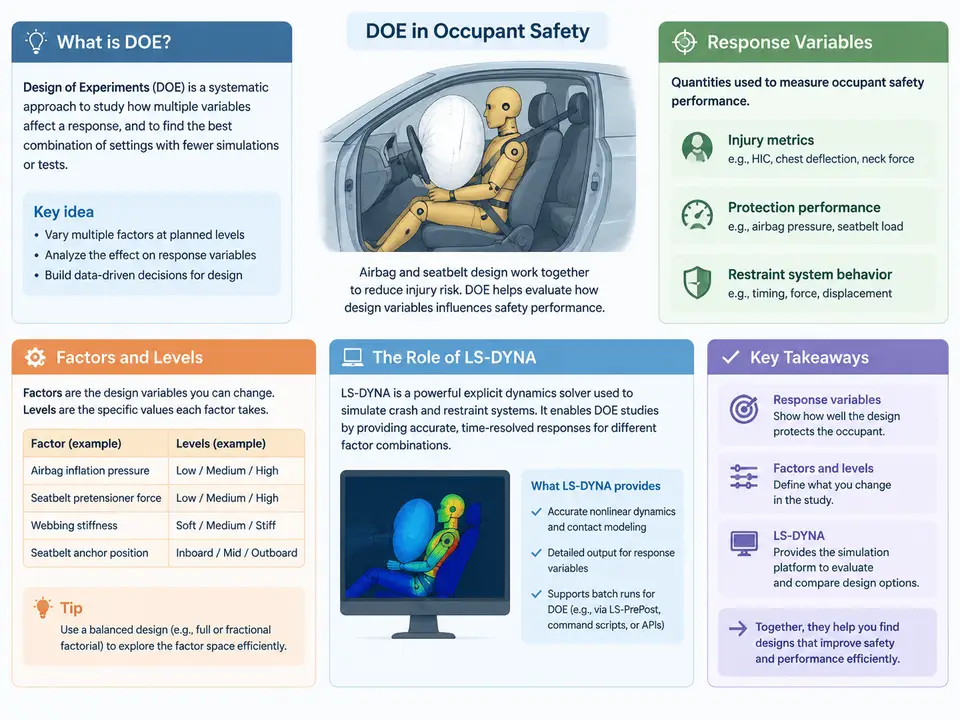
Design of Experiments (DOE) is a structured statistical methodology for planning a set of simulation or physical runs so that the effect of multiple input variables on one or more outputs can be estimated efficiently and with quantifiable confidence. In occupant safety engineering, DOE is not an academic exercise — it is the practical mechanism by which restraint system performance is optimized within a limited budget of CAE runs, prototype builds, and sled tests. This chapter establishes the vocabulary and conceptual framework that every subsequent chapter builds upon: what a response variable is, how factors and levels are defined, and where LS-DYNA fits into the overall study.
Response Variables: Defining What "Good" Means
A response variable (also called output, dependent variable, or objective) is the measurable quantity that characterizes whether a design meets its safety targets. In occupant safety, response variables are almost always derived from injury criteria or occupant kinematics. Typical examples include:
- HIC15 (Head Injury Criterion over a 15 ms window) for the driver or passenger head.
- Head acceleration peak or 3 ms clip value, in g.
- Chest deflection and viscous criterion (VC) for thoracic injury assessment.
- Neck injury criteria such as Nij, and femur axial force for lower extremity loading.
- Seatbelt force and belt payout at specific anchor points.
- Airbag internal pressure and vent flow as intermediate responses that explain occupant outcomes.
Response variables must be defined precisely: which dummy (Hybrid III 50th percentile, THOR, or human body model), which body region, which time window, and which filtering standard (SAE J211 CFC 600 or CFC 1000). A response that is ambiguously defined cannot be compared across runs, and DOE results become meaningless. It is also good practice to distinguish primary responses (the injury criteria that must be minimized or constrained) from secondary responses (intermediate quantities such as bag pressure or belt force that help diagnose why a design behaves as it does).
Factors and Levels: The Controllable Inputs
A factor is an input variable that the engineer can control and that is hypothesized to influence the response. In airbag and seatbelt design, factors fall into several natural families:
| Family | Example factors | Typical units |
|---|---|---|
| Airbag geometry | Bag volume, vent hole diameter, tether length | L, mm, mm |
| Inflator | Mass flow rate, gas temperature, inflator type | kg/s, K, categorical |
| Seatbelt | Retractor force limit, pretensioner stroke, anchor position | kN, mm, mm |
| Occupant/positioning | Dummy position offset, seatback angle | mm, deg |
| Timing | Pretensioner firing delay, bag deployment timing | ms |
Each factor is assigned levels — the discrete values at which it will be tested. A two-level factor takes a low and a high value (coded −1 and +1); a three-level factor adds a center point (0). The choice of levels is a critical engineering decision: they must span the realistic design space without being so wide that the response becomes dominated by non-physical behavior (for example, a vent diameter so large the bag never pressurizes). Levels should be justified by packaging constraints, supplier capability, and prior experience. Categorical factors (inflator type, bag material) are handled differently from continuous factors and require care in interpretation.
Where LS-DYNA Enters the Workflow
LS-DYNA is the explicit finite element solver used to execute each DOE run. The DOE defines what to run; LS-DYNA defines how each run is computed. The connection is made through parameterized input decks: factor values are written into keyword cards (for example, *AIRBAG_SIMPLE_AIRBAG_MODEL for vent area, *MAT_FABRIC for bag material, or a retractor force limit in a seatbelt element definition), and the solver produces time-history output (d3plot, nodout, and ASCII files) from which response variables are extracted.
The practical loop is: (1) define factors and levels; (2) generate a run matrix; (3) for each run, substitute factor values into the LS-DYNA deck, execute the solver, and post-process the responses; (4) fit a response surface or perform ANOVA; (5) use the model to predict an optimum and verify it with a confirmation run. LS-DYNA's role is therefore both computational engine and source of the raw response data — the statistical interpretation happens outside the solver, but the fidelity of the entire study depends on the solver producing stable, converged, physically plausible results for every run in the matrix.
Why DOE Rather Than One-Factor-at-a-Time
The instinctive approach — vary one factor, hold everything else fixed, repeat — is inefficient and, more importantly, blind to interactions. In occupant safety, interactions are the rule rather than the exception: the benefit of a larger vent hole depends on bag volume; the effect of retractor force limit depends on pretensioner timing. A DOE with a proper fractional-factorial or response-surface design estimates main effects and interactions simultaneously with far fewer runs. A five-factor, two-level full factorial requires 32 runs; a resolution-V fractional factorial can screen the same five factors in 16 runs, and a face-centered central composite design for response-surface optimization typically needs around 27–45 runs depending on the number of factors. These numbers matter because each LS-DYNA occupant simulation may take hours to days of wall-clock time.
Practical Considerations Before the First Run
Three engineering checks should precede any DOE execution. First, model stability: run the nominal design and confirm the model is numerically stable (no negative volumes, no excessive hourglass energy, energy balance within a few percent). A DOE built on an unstable model produces noise, not signal. Second, response extraction automation: define a consistent post-processing script that reads the same channels and applies the same filters for every run, so responses are comparable. Third, run matrix traceability: each run must be linked to its exact factor values and its output directory, because a mislabeled run silently corrupts the statistical model.
With these fundamentals in place — clearly defined responses, justified factors and levels, a stable LS-DYNA model, and an automated extraction pipeline — the DOE becomes a reliable instrument for exploring the airbag and seatbelt design space. The chapters that follow apply this framework to screening designs, response-surface methods, and multi-objective optimization of restraint systems.