1. Build a Baseline Frontal Airbag Deployme
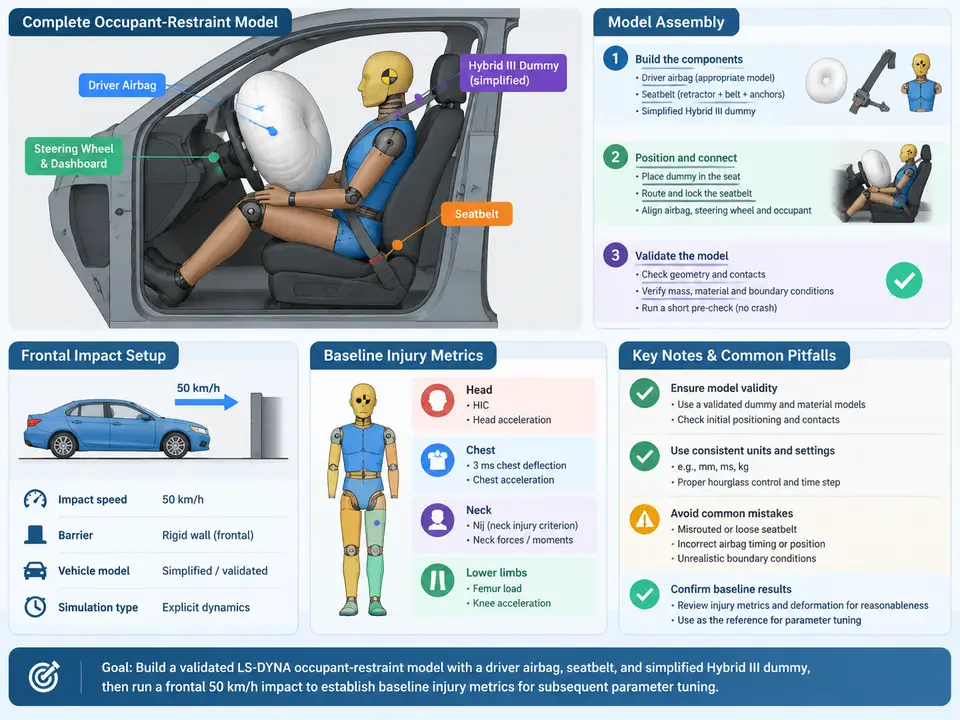
Baseline Model Scope and Assembly Strategy
This first case establishes the reference configuration that every later tuning study will be compared against. The deliverable is a single LS-DYNA keyword deck that runs a 50 km/h frontal barrier pulse with three coupled subsystems: a driver airbag, a three-point seatbelt, and a simplified Hybrid III 50th-percentile dummy. "Validated" here means the model reaches termination without numerical failure, the dummy stays in the seat, the airbag inflates and vents on schedule, and the belt loads the chest and pelvis in a physically plausible sequence. Injury metrics from this run become the baseline for all subsequent parameter sweeps.
Keep the assembly deliberately simple. A baseline model that is over-detailed is hard to debug and slow to sweep. Use a coarse but stable dummy mesh, a single-chamber airbag, and a belt modeled with seatbelt elements rather than a full fabric shell. The goal is a numerically robust reference, not a certification-grade model.
Model Architecture and Unit System
Work in the consistent mm-ton-s system throughout: length in mm, mass in tonnes, time in seconds, force in N, stress in MPa. Mixing units is the most common cause of an airbag that "explodes" or a belt that never engages. The table below summarizes the key components and their modeling approach.
| Subsystem | LS-DYNA approach | Key keywords | Baseline setting |
|---|---|---|---|
| Dummy | Simplified rigid-body Hybrid III with deformable chest | *PART, *MAT_RIGID, *CONSTRAINED_EXTRA_NODES | 50th percentile, seated upright |
| Airbag | Single-chamber fabric, uniform pressure | *MAT_FABRIC, *AIRBAG_SIMPLE_PRESSURE_VOLUME | 60 L, vent area 0.002 m² |
| Inflator | Mass flow rate vs. time curve | *DEFINE_CURVE, *AIRBAG_SIMPLE_PRESSURE_VOLUME | Peak ~0.9 kg/s at 15 ms |
| Seatbelt | Seatbelt elements with slipring | *ELEMENT_SEATBELT, *MAT_SEATBELT | Retractor pretensioner, 4 kN limit |
| Contact | Automatic surface-to-surface | *CONTACT_AUTOMATIC_SURFACE_TO_SURFACE | Dummy-to-airbag, dummy-to-belt |
| Pulse | Prescribed acceleration on sled | *BOUNDARY_PRESCRIBED_MOTION_RIGID | 50 km/h frontal, ~120 ms |
Building the Airbag and Inflator Definition
The airbag is the most sensitive subsystem in a frontal model. Define the fabric with *MAT_FABRIC using a linear elastic approximation for the baseline; the vent hole is represented by the PV (pressure-volume) vent coefficient rather than a physical hole, which keeps the mesh closed and stable. The inflator is driven by a mass flow rate curve that rises quickly and decays, feeding the *AIRBAG_SIMPLE_PRESSURE_VOLUME model.
*AIRBAG_SIMPLE_PRESSURE_VOLUME
$#   sid    sidtyp      rbid      vsca      psca      vini
         1         0         0       1.0       1.0       0.0
$#   sid    sidtyp      rbid      vsca      psca      vini
$   (mass flow curve id, vent area, etc. follow per LS-DYNA manual)
         1         0         0       1.0       1.0       0.0
$#  lcmsf      lcmsf      lcmsf      lcmsf
         1
$#  lcvent     lcvent
         2
$#  c23       lc23
       0.0         0
The mass flow curve (*DEFINE_CURVE id 1) should peak near 0.9 kg/s around 15 ms and fall to zero by roughly 40 ms. The vent curve (id 2) sets the discharge coefficient; for the baseline use a constant value that yields a bag pressure peak near 0.35 MPa. These numbers are starting estimates — the point of this case is to get a stable, plausible baseline, not to match a specific inflator datasheet.
Seatbelt and Dummy Coupling
Model the belt as a chain of seatbelt elements routed from the retractor over the shoulder, across the chest, through the buckle, and to the anchor. Use *MAT_SEATBELT with a load-limiting retractor: the belt force is capped at 4 kN, which prevents the chest from being over-loaded in the baseline and gives a clean signal for later tuning. The pretensioner fires at 10 ms with a short pull-in stroke.
Couple the dummy to the belt and airbag with automatic surface-to-surface contacts. Set the dummy's chest as a deformable part so chest deflection can be measured; rigid-body chests give no deflection signal and defeat the purpose of the baseline. Define a *DATABASE_HISTORY_NODE on the chest front node and a *DATABASE_ASCII request for the airbag pressure and belt force so the baseline metrics are recorded.
Running the Baseline and Reading the Results
Submit the deck with a termination time of 150 ms and a stable time step controlled by *CONTROL_TIMESTEP (mass scaling limited to a 5% added-mass budget). After the run, check the following in order:
- Termination status. The
d3hspfile should report normal termination with no negative-volume or negative-Jacobian errors. If the airbag fabric inverts, reduce the initial time step or add*CONTROL_IMPLICIT_GENERALstabilization. - Energy balance. Hourglass energy should stay below 5% of total energy; if it climbs, the dummy mesh is too coarse or the contact stiffness is too high.
- Airbag pressure history. Expect a rise to roughly 0.3–0.4 MPa within 20–30 ms, then decay as the vent opens. A pressure that never rises means the mass flow curve is not linked to the airbag ID; a pressure that spikes and collapses means the vent coefficient is too large.
- Belt force. The retractor should reach its 4 kN limit within ~15 ms of pretensioner fire. A flat zero trace means the seatbelt elements are not connected to the dummy contact.
- Chest deflection. The baseline should show a peak deflection in the 30–50 mm range for a 50 km/h frontal pulse. Record this value — it is the reference for the vent-area study that follows.
baseline_frontal_50kph.k) and copy it for each tuning case. Never edit the baseline in place; you will need it to compute deltas.Baseline Metrics Record
Fill in the table below from the nodout and rcforc outputs of your run. These values define the reference against which all 29 subsequent cases are measured.
| Metric | Output file | Baseline value (record) | Acceptance check |
|---|---|---|---|
| Peak chest deflection | nodout | ____ mm | 30–50 mm |
| Peak bag pressure | nodout / ASCII | ____ MPa | 0.3–0.4 MPa |
| Peak belt force | rcforc | ____ kN | ≤ 4.2 kN |
| Head acceleration (HIC proxy) | nodout | ____ g | < 80 g |
| Hourglass / total energy | glstat | ____ % | < 5% |
| Added mass | glstat | ____ % | < 5% |
Once every row is filled and within its acceptance band, the baseline is validated and ready to serve as the control configuration for the parameter-tuning cases that follow.