1. Introduction to robust restraint design
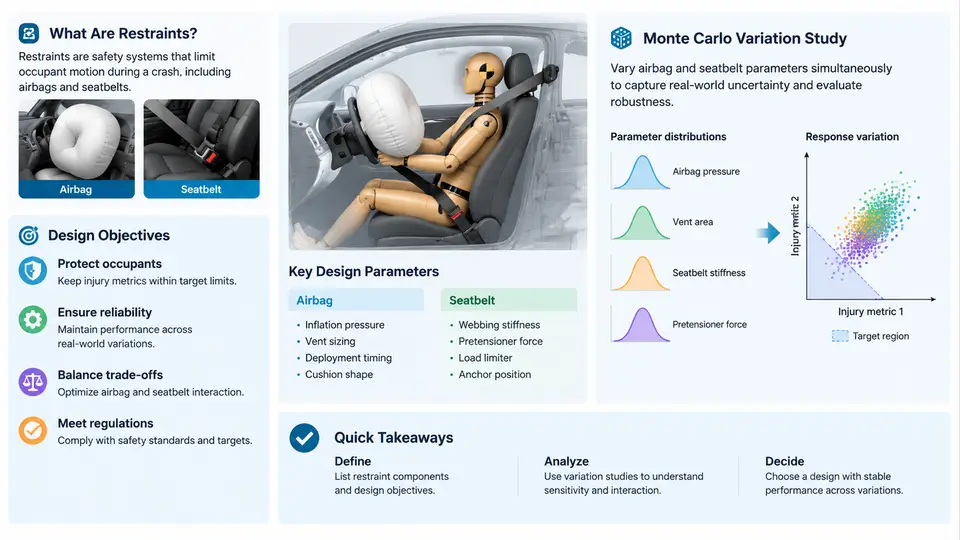
In mechanical and structural engineering, a restraint is any device or interface that limits the degrees of freedom of a component while transmitting the loads that arise from that limitation. A pipe clamp, a bracket, a tie rod, a snubber, a guide shoe, and a bolted support are all restraints in this sense. The restraint does not merely "hold" the part in place; it defines a load path. Every force that the restrained component would otherwise carry as free-body motion is redirected into the restraint and then into the supporting structure. This distinction matters because the restraint's geometry, stiffness, and clearance determine how much load it attracts and how that load is distributed.
Robust restraint design is the practice of specifying restraints so that they continue to meet their functional objectives across the full range of conditions the system will actually experience — not just the nominal design point. A restraint that works perfectly at the drawing-board dimensions but fails when a weld shrinks by 3 mm, when the operating temperature rises by 180 °C, or when the installed bolt preload varies by ±20% is not a robust design. Robustness, in this context, is a measurable property: it is the probability that the restraint system satisfies its performance requirements given the real variability of geometry, material, assembly, and loading.
Design objectives of a restraint
Restraints are usually asked to satisfy several objectives simultaneously, and these objectives frequently conflict. The most common are:
- Position control — keep the restrained component within an allowable displacement envelope under operating and upset loads.
- Load limitation — cap the reaction force or moment transmitted into the support structure so that the support, anchor, or adjacent equipment is not overstressed.
- Thermal accommodation — permit free thermal growth where it must be permitted, while restraining it where it must be restrained. A rigid restraint on a hot line can generate enormous thermal reactions; a sliding restraint must still guide without binding.
- Dynamic performance — provide sufficient stiffness or damping to keep natural frequencies away from excitation frequencies, or to limit seismic and vibration response.
- Installability and maintainability — be assembleable within real tolerances, inspectable, and replaceable.
These objectives are coupled. Increasing stiffness to control position raises the reaction load. Adding clearance to ease installation introduces impact and wear. Tightening a positional tolerance improves alignment but increases scrap and assembly cost. Robust design is therefore not the pursuit of a single "best" value but the selection of a design region in which all objectives remain acceptable despite variation.
Why variation studies belong in the design loop
Traditional deterministic design checks a single set of inputs: nominal dimensions, nominal material properties, and a design load with a safety factor. That approach answers the question "does it pass at the nominal point?" It does not answer "how close to the edge is it, and how often will real units fall over that edge?" Variation studies answer the second question. They treat the inputs as distributions rather than fixed numbers and propagate those distributions through the restraint's performance model.
Monte Carlo simulation is the most general propagation method. Each uncertain input is assigned a probability distribution — for example, a bracket hole position with a ±2 mm tolerance modeled as a normal distribution truncated at the tolerance limits, or a friction coefficient for a sliding shoe modeled as uniform between 0.10 and 0.25. The model is then evaluated many times, each time with a randomly sampled input set, producing a distribution of outputs such as peak reaction force, maximum displacement, or clearance closure. From that output distribution the designer can read a probability of failure or a reliability index directly, and can identify which input variables dominate the scatter through sensitivity analysis.
How the elements fit together
The diagram below shows the relationship between the physical restraint, its performance objectives, the uncertain inputs that act on it, and the variation study that closes the loop. Note that the study does not replace the deterministic design; it sits alongside it and feeds back into the specification of tolerances, stiffness targets, and clearances.
A worked scoping example
Consider a simple but realistic case: a steel pipe at 320 °C is held by a sliding guide shoe that must permit axial thermal growth while limiting lateral displacement to 8 mm under a seismic lateral load of 12 kN. The shoe has a nominal lateral stiffness of 4.5 kN/mm and a nominal clearance of 1.5 mm per side. Deterministic check: 12 kN / 4.5 kN/mm = 2.7 mm, well inside 8 mm, so the design passes with apparent margin.
Now introduce variation. The clearance is a fabrication and assembly variable, realistically between 0.5 and 3.0 mm per side. The friction coefficient between shoe and baseplate ranges from 0.10 to 0.30 depending on surface condition and temperature. The lateral load itself has a lognormal distribution with a 95th percentile of 18 kN. Running 10,000 samples of a model that includes clearance take-up and friction-induced stick-slip produces an output distribution of peak lateral displacement. Suppose the 99th percentile comes out at 9.4 mm — above the 8 mm limit — giving a probability of exceedance of roughly 2%. The deterministic check said "pass"; the variation study says "the tail is outside the envelope."
The sensitivity ranking from the same run might show that clearance contributes 61% of the output variance, friction 24%, and load amplitude 15%. That ranking is the actionable result: tightening the clearance specification from 0.5–3.0 mm to 0.8–2.0 mm reduces the 99th-percentile displacement to about 7.6 mm, restoring margin without changing the shoe's stiffness or the support structure. This is what robust design looks like in practice — not a bigger safety factor applied uniformly, but a targeted change to the variable that actually controls the tail.
What the rest of this course builds on
Three ideas from this introduction recur throughout the course. First, a restraint is a load-path element, so its stiffness and clearance are design variables, not incidental details. Second, robustness is a property of the design across a population of real units, which means it must be evaluated with distributions rather than single values. Third, the value of a variation study lies as much in its sensitivity ranking as in its probability estimate, because the ranking tells the designer where a change will actually buy margin. The chapters that follow develop the modeling of restraint stiffness and clearance, the construction of defensible input distributions, the sampling and convergence practice for Monte Carlo runs, and the interpretation of results into specification decisions.