1. Occupant protection as a multi-objective
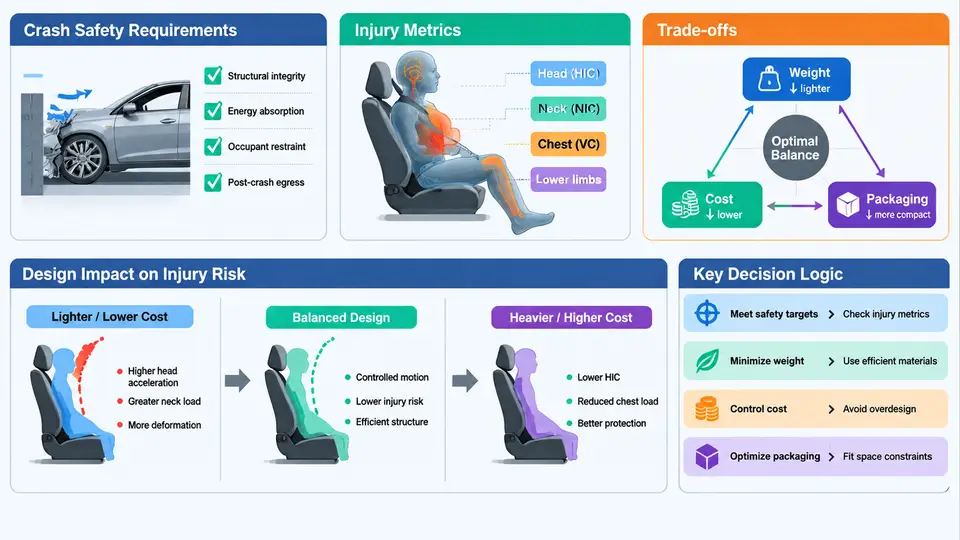
Occupant protection is rarely a single-target design task. A restraint system that minimizes chest deflection in a 56 km/h frontal barrier impact may increase neck loading in a low-speed rear impact, add mass to the steering column, consume package space around the knee bolster, and raise per-vehicle cost. Engineers therefore treat occupant safety as a multi-objective optimization problem: several injury metrics must be driven below regulated and consumer-test thresholds simultaneously, while weight, cost, and packaging budgets act as competing constraints. This chapter establishes the vocabulary and the trade-off structure that the rest of the course formalizes with Pareto methods.
Regulatory and Consumer-Test Requirements
Requirements arrive from two distinct streams. Homologation (e.g., FMVSS 208 in the United States, UN R94/R95 in Europe, GB 11551 in China) defines pass/fail limits that a vehicle must satisfy to be sold. Consumer rating programs (Euro NCAP, C-NCAP, IIHS, US NCAP) impose stricter, often star-graded targets that influence market perception. The two streams differ in pulse severity, dummy type, seating position, and metric definition, so a design tuned only to the regulatory envelope frequently underperforms in consumer tests.
A typical frontal development matrix includes:
- Full-width rigid barrier at 50–56 km/h with a Hybrid III 50th-percentile male;
- Offset deformable barrier (40% overlap, 64 km/h) to exercise structural intrusion and restraint coupling;
- Mobile progressive deformable barrier (MPDB) or oblique tests to capture compatibility and small-overlap loading;
- Side pole and side barrier impacts, where the door trim and side airbag dominate;
- Low-speed rear impact (whiplash) and pedestrian headform tests for the same front-end package.
Injury Metrics as Objective Functions
Each test produces scalar injury criteria that serve as objective functions. The most common are summarized below; values are illustrative development targets, not regulatory text.
| Metric | Body region | Typical development target | Primary design levers |
|---|---|---|---|
| HIC15 | Head | < 500 (consumer), < 700 (regulatory) | Airbag venting, column stroke, belt load limiter |
| BrIC / rotational | Brain | Program-specific | Airbag shape, pillar trim stiffness |
| Nij, Nkm | Neck | < 0.6–0.8 | Airbag pressure, belt geometry, seatback angle |
| Chest deflection, VC | Thorax | < 40 mm, VC < 0.5 m/s | Load limiter level, belt anchor, pretensioner |
| Femur force, knee displacement | Lower extremity | < 6 kN, < 6 mm | Knee bolster, pedal retraction, toe pan |
| a3ms | Whole body | < 60 g | Front-end crush, restraint coupling |
These metrics are not independent. A stiffer belt load limiter reduces chest deflection but raises head excursion and HIC; a higher airbag pressure lowers HIC but increases neck tension. The coupling is what makes the problem genuinely multi-objective rather than a set of separable single-variable problems.
Competing Budgets: Weight, Cost, and Packaging
Every restraint and structure decision consumes resources outside the safety domain. Mass added to the front rail, door beam, or seat structure degrades fuel economy and handling. Cost rises with additional airbags, pretensioners, adaptive load limiters, and the calibration effort they demand. Packaging constrains airbag module volume, knee bolster depth, and the space available for pedal retraction. A design that meets all injury targets but exceeds the mass or cost budget is not a feasible solution; it is an infeasible point that must be traded against.
Visualizing the Trade-off Structure
The figure below maps how a single design variable — belt load limiter force — propagates through the restraint system into multiple injury metrics and then into the weight, cost, and packaging budgets. It is the concrete picture of why a Pareto approach is needed: one input, several outputs, and no single setting that improves all of them.
From Trade-off Awareness to Pareto Formulation
The practical consequence is that a development team cannot report a single "best" restraint calibration. Instead it reports a set of non-dominated designs: configurations for which no other configuration is better in every objective. A design A dominates B if A is at least as good in all objectives and strictly better in at least one. The set of all non-dominated designs forms the Pareto front, and the engineer's job is to characterize that front, then select a point on it using program priorities.
Consider a simplified two-objective example. Suppose a load limiter sweep produces the following development results (illustrative values from a CAE study, not physical test data):
Limiter (kN)   Chest Defl (mm)   HIC15   Mass delta (kg)   Cost delta (USD)
2.5            34                620     +0.0              +0
3.0            37                540     +0.2              +15
3.5            41                480     +0.5              +40
4.0            46                430     +0.9              +80
4.5            52                395     +1.4              +140
If the chest deflection target is 40 mm and HIC target is 500, the 3.0 kN setting satisfies both with margin, while 3.5 kN violates chest but improves HIC. The 3.0 kN point is not dominated by 3.5 kN because it is better in chest deflection and cheaper; 3.5 kN is not dominated either because it is better in HIC. Both lie on the front. The 4.0 and 4.5 kN settings are dominated by 3.5 kN on chest, mass, and cost while offering only marginal HIC gain — they can be discarded. This pruning is the first practical benefit of thinking in Pareto terms, even before any formal algorithm is applied.
What This Course Builds Toward
The remaining chapters develop the machinery to handle this structure rigorously: design-variable parameterization of restraint and structure, surrogate modeling to make large sweeps tractable, multi-objective algorithms that approximate the front efficiently, and decision-making methods that select a final calibration from the front. The foundation laid here — clear objective definitions, explicit constraints, and awareness of coupling — determines whether that machinery produces a defensible design or merely a dense cloud of numbers.