1. Course overview
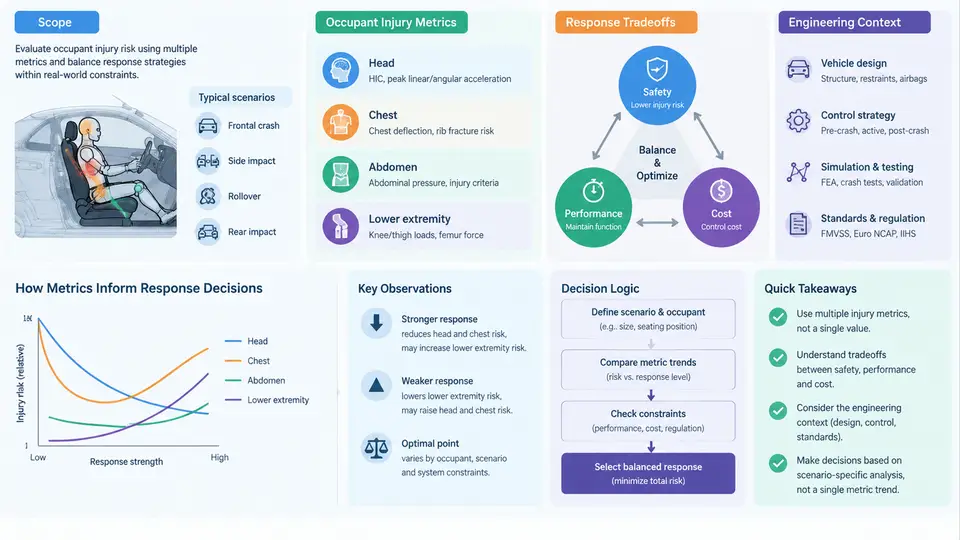
Occupant safety engineering is fundamentally a multi-objective optimization problem. A restraint system that performs brilliantly in a 56 km/h frontal barrier test may be mediocre in a 32 km/h oblique pole impact, and a design tuned to minimize head injury may simultaneously elevate chest deflection beyond acceptable limits. This course examines how engineers quantify occupant injury across multiple metrics, how those metrics respond to design and calibration changes, and how to reason about the tradeoffs that inevitably emerge when a single hardware configuration must protect a diverse population across a wide range of crash modes.
The scope spans frontal, side, and rear impact loading regimes, with emphasis on the physical mechanisms that generate injury and the measurable quantities that serve as surrogates for those mechanisms. We treat the occupant as a system embedded in a chain: vehicle structure decelerates the compartment, the restraint system couples the occupant to that deceleration, and the occupant's own biomechanics determine how the resulting forces and accelerations distribute across the body. Every injury metric in this course is a window into some part of that chain.
The Injury Metrics Landscape
Injury metrics fall into two broad families. Acceleration-based criteria derive from the kinematic response of a body region — the classic Head Injury Criterion (HIC) integrates resultant head acceleration over a 36 ms window, while the 3 ms chest acceleration criterion captures the peak sustained deceleration the thorax experiences. Deformation- and force-based criteria measure how much a structure is physically displaced or loaded: chest deflection (in millimeters) reflects rib cage compression, femur axial force captures load transmitted through the lower extremities, and neck bending moment and axial force characterize cervical loading.
Each metric carries a threshold structure. The Abbreviated Injury Scale (AIS) provides an ordinal severity ranking from 0 (no injury) to 6 (maximum, currently untreatable), and regulatory and consumer programs map metric values to AIS probabilities through risk curves. A chest deflection of 40 mm might correspond to roughly a 25% risk of AIS 3+ chest injury in a mid-sized male, while 50 mm pushes that risk substantially higher. These mappings are statistical, population-derived, and sensitive to occupant size, age, and sex — a fact that becomes central when we discuss small occupants and older occupants later in the course.
It is worth being precise about what these metrics are not. HIC is not a measure of brain injury; it is a correlate derived from cadaver and animal data that predicts skull fracture and severe head injury risk with known uncertainty. Chest deflection is not rib fracture count; it is a proxy. Engineers who forget this distinction tend to over-trust single numbers and under-appreciate the scatter inherent in injury prediction. Throughout the course, we will keep the physical mechanism and the metric's provenance in view.
Where Tradeoffs Come From
The central engineering tension is that restraint systems are shared across crash modes and occupants. Consider a frontal airbag. Increasing bag pressure and vent restriction stiffens the cushion, which helps control head excursion and reduces HIC in a high-severity frontal impact — but the same stiffer cushion increases the force applied to a small occupant positioned close to the module, raising the risk of out-of-position injury. Softening the cushion protects the small occupant but allows greater forward head travel in the large-occupant case.
Seat belt force limiters illustrate the same logic in a different channel. A lower force limit (say 3 kN versus 4.5 kN) reduces chest deflection and rib loading, which is favorable for older occupants with reduced bone strength. But a lower limit allows more forward torso rotation and greater head excursion, which can increase head contact risk with the steering wheel or A-pillar in a severe crash. The load limiter setting is therefore a lever that trades chest injury risk against head injury risk, and the optimal setting depends on the occupant population and the crash severity distribution the vehicle is expected to see.
These are not hypothetical tensions. They are the daily currency of restraint calibration, and they explain why modern vehicles employ adaptive systems — dual-stage inflators, switchable load limiters, pretensioners with force profiling — rather than a single fixed configuration. The figure below maps the principal injury metrics to their physical mechanisms and shows the direction in which common design levers push each metric.
Engineering Context and the Calibration Workflow
In practice, multi-metric analysis sits inside a calibration loop. The inputs are crash pulse characteristics (from sled or full-vehicle testing, or from CAE simulation), occupant anthropometry (the Hybrid III 50th percentile male, the THOR-50M, the Hybrid III 5th percentile female, and increasingly the THOR-5F), and the restraint configuration under evaluation. The outputs are time histories of acceleration, force, and displacement at instrumented locations, from which the metrics are computed.
A representative workflow for a frontal driver-side calibration looks like this. First, define the design variables: airbag vent diameter, inflator output stage timing, seat belt load limiter force level, and pretensioner firing time. Second, run a design of experiments across these variables at two or three crash severities (for example, 40 km/h and 56 km/h full frontal, plus a 32 km/h oblique). Third, extract HIC36, 3 ms chest acceleration, chest deflection, and femur force for each run. Fourth, examine the response surface: which variables move which metrics, and in what direction.
The insight that emerges from such a study is rarely a single optimum. More often it is a Pareto front — a set of configurations where no metric can be improved without worsening another. The engineer's job is then to select a point on that front consistent with the program's injury targets, which are themselves derived from regulatory requirements (FMVSS 208, ECE R94/R95), consumer rating protocols (US NCAP, Euro NCAP), and internal corporate targets that typically sit below the regulatory thresholds to provide margin.
What This Course Will Build
The chapters that follow develop this framework systematically. We begin with the biomechanics of each body region and the derivation of the corresponding metrics, so that the numbers carry physical meaning. We then move to restraint system architecture — belts, pretensioners, load limiters, airbags, and their interaction — and examine how each element shapes the occupant's kinematic and kinetic response. From there we address the tradeoff analysis itself: sensitivity studies, response surface methods, and the construction of Pareto fronts for multi-metric problems.
Later sections treat occupant variability (size, age, posture, and the out-of-position cases that dominate real-world risk), crash mode variability (frontal, oblique, side, rear, and rollover), and the validation chain from component tests through sled tests to full-vehicle and field data. We close with case studies that walk through complete calibration decisions, including the ones that went wrong and why.
The unifying discipline is this: never optimize a single number in isolation. Every metric is a proxy, every lever has a cost, and the engineering judgment lies in making the tradeoff explicit, quantified, and defensible. That is the skill this course is designed to build.