1. Occupant response prediction in crashwor
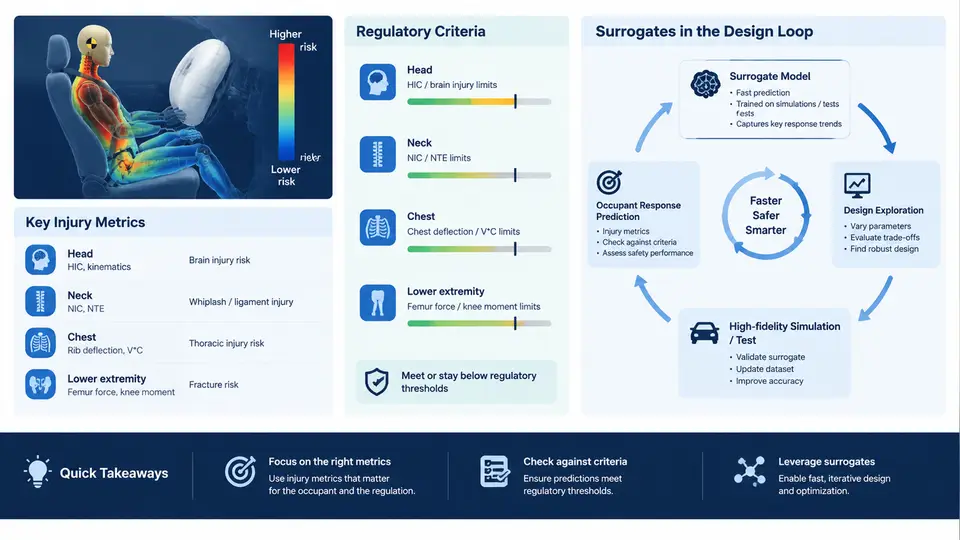
Crashworthiness engineering is fundamentally a decision problem under uncertainty. A vehicle body must absorb a prescribed amount of kinetic energy within a limited crush distance, while the occupant compartment must remain survivable and the restraint system must couple the occupant to the deceleration pulse without introducing its own injury mechanisms. Every one of these decisions is judged against quantified occupant response: head acceleration, chest deflection, neck loads, femur forces, and the timing relationships between them. Machine learning surrogates enter this loop because the physics-based models that produce those responses — typically explicit finite element (FE) occupant and vehicle models — are accurate but expensive, and design exploration demands thousands of evaluations rather than dozens.
This chapter establishes the vocabulary and the workflow context that the rest of the course builds on. It defines the injury metrics that surrogates must predict, the regulatory and consumer-test criteria that convert those metrics into pass/fail decisions, and the position of a surrogate inside a design loop: where it sits, what it replaces, what it must never replace, and how its error propagates into engineering decisions.
Injury metrics: what the surrogate actually outputs
Occupant response is not a single number. A frontal impact simulation of a Hybrid III 50th percentile male in a driver position produces time histories at dozens of channels, and the injury metrics are derived from those histories through standardized signal processing. The most common metrics in frontal loading are:
- Head Injury Criterion (HIC) — computed from the resultant translational acceleration at the head center of gravity over a 36 mm window: HIC = max over t₁, t₂ of [(t₂ − t₁)(1/(t₂ − t₁)) ∫ a dt]^2.5, with the window constrained to 36 ms. HIC is sensitive to the acceleration pulse shape, not just its peak, which is why surrogates must predict the full history or a sufficiently rich set of features rather than a single peak value.
- Brain Injury Criterion (BrIC) — based on peak change in angular velocity about the three head axes, normalized by critical values (ω_x,c = 66.3 rad/s, ω_y,c = 53.1 rad/s, ω_z,c = 41.5 rad/s). BrIC captures rotational loading that HIC misses, and it is increasingly relevant for oblique and far-side impacts.
- Neck Injury Criterion (Nij) — a combined axial force and bending moment measure, Nij = F_z/F_int + M_y/M_int, evaluated against intercept values that differ for tension/extension, tension/flexion, compression/extension, and compression/flexion.
- Chest deflection and Viscous Criterion (VC) — chest compression in millimeters and the rate-dependent VC = max(v(t) × C(t)), where v is the rate of deformation and C is the instantaneous compression fraction.
- Femur force — peak axial compressive load per leg, used to flag lower-extremity injury risk.
Each metric has a different mathematical character. HIC is a windowed integral maximum; BrIC is a normalized vector magnitude; Nij is a linear combination of two channels; VC is a product of a displacement and its derivative. A surrogate trained to predict HIC will not automatically predict BrIC well, because the two depend on different features of the same underlying signal. This is the first practical lesson: define the surrogate's output vector before choosing the model, and treat each metric as a separate regression target with its own error budget.
Regulatory and consumer criteria: turning metrics into decisions
Metrics become engineering requirements only when a criterion assigns a threshold and a test condition. In the United States, FMVSS 208 governs frontal occupant protection and specifies, among other requirements, HIC ≤ 700 for the driver and passenger in the 56 km/h rigid barrier test with belted 50th percentile occupants, chest deflection limits, and Nij limits. European regulations and Euro NCAP apply related but not identical thresholds and, importantly, different barrier configurations and impact angles. Consumer protocols such as Euro NCAP and IIHS add oblique, mobile progressive deformable barrier, and small-overlap cases that stress occupant kinematics in directions the classic frontal test does not.
The practical consequence for surrogate modeling is that a single surrogate is rarely sufficient. The design space is partitioned by load case — barrier type, impact speed, impact angle, occupant size, seating position, belt and airbag configuration — and each partition has its own response surface. A surrogate trained on 56 km/h full-frontal data will extrapolate poorly to a 64 km/h offset deformable barrier case, because the intrusion pattern and the restraint loading sequence differ qualitatively, not just quantitatively.
Where the surrogate sits in the design loop
The design loop for an occupant restraint system typically runs: define the load cases and criteria, build or update the FE model, run the baseline, identify the design variables (belt anchor positions, pretensioner force level, airbag vent size, seat pan angle, energy-absorbing steering column stroke), then iterate. The expensive step is the FE evaluation, which for a full vehicle occupant model can take hours per run. Design of experiments plus surrogate modeling replaces the inner iteration with a cheap approximation, reserving FE runs for validation and for the final candidate set.
The figure below shows the loop with the surrogate inserted at the inner iteration and the FE model retained as the arbiter at the outer boundary. Note the two feedback paths: one from the surrogate's predicted response back to the design variables, and one from the FE validation back to the surrogate's training set when the error exceeds the acceptance threshold.
What the surrogate must and must not do
The surrogate's legitimate role is ranking and screening: given a candidate set of design variable vectors, it orders them by predicted criterion margin and discards the clearly infeasible ones. Its illegitimate role is certification: no surrogate output substitutes for an FE run or a physical sled test in a compliance submission. The engineering discipline is to define an acceptance threshold on surrogate error — commonly 5–10% on the metric of interest, evaluated on a held-out set drawn from the same load case — and to route any candidate that passes the surrogate screen through the FE model before it is accepted.
Error propagation deserves explicit attention. If the surrogate over-predicts HIC by 8% near the 700 threshold, it will reject designs that are actually compliant, which is conservative but costly. If it under-predicts by 8%, it will pass designs that fail, which is unsafe. The asymmetry means the acceptance threshold should be set on the side of the decision boundary that matters: for a pass/fail criterion, evaluate surrogate error in the neighborhood of the threshold, not averaged over the whole design space, because that is where the decision flips.
A minimal worked example
Consider a frontal driver-side restraint study with four design variables: belt anchor x-position (mm), pretensioner force (kN), airbag vent diameter (mm), and steering column stroke (mm). A Latin hypercube sample of 120 FE runs across the 56 km/h full-frontal load case provides the training set. Each run yields time histories from which HIC, BrIC, Nij, chest deflection, and femur force are post-processed. A Gaussian process or gradient-boosted surrogate is fitted per metric, with a 20-run held-out validation set.
Suppose the held-out results show HIC RMSE of 22 (3.4% of the 700 threshold), Nij RMSE of 0.06, and chest deflection RMSE of 1.8 mm. The HIC and Nij surrogates are adequate for screening; the chest deflection surrogate is marginal and should be flagged. The inner loop then evaluates 50,000 candidate vectors in seconds, retains the top 200 by minimum normalized margin across all criteria, and sends those 200 to the FE model. The FE results confirm 187 of the 200 as compliant, and the 13 disagreements cluster near the chest deflection boundary — exactly the metric whose surrogate error was marginal. That clustering is the diagnostic signal: it tells the engineer where to add training points, not to abandon the surrogate.
Terminology and conventions used throughout the course
Two conventions are fixed here and used consistently in later chapters. First, all occupant response metrics are treated as positive-is-worse: larger values indicate higher injury risk, and criteria are upper bounds. Second, the design variable vector x is defined in physical units as listed above, and the surrogate is written ŷ = f̂(x; θ), where θ denotes trained parameters. Normalization of inputs and outputs is an internal modeling choice and is always reported alongside the model, because an unnormalized error figure is not comparable across metrics with different units.
With this foundation — metrics as regression targets, criteria as decision thresholds, and the surrogate as a screening instrument bounded by FE validation — the next step is to examine how training data is generated and how the choice of sampling strategy shapes what the surrogate can and cannot learn.