1. DOE fundamentals for occupant safety
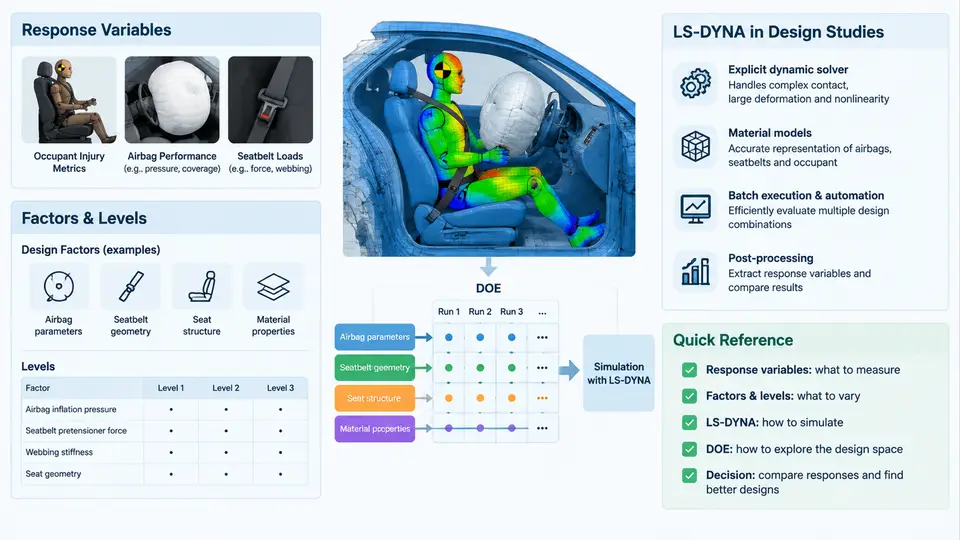
Design of Experiments (DOE) is a structured statistical methodology for planning simulation or physical test campaigns so that the effect of multiple input variables on one or more output responses can be quantified with the fewest runs and the clearest causal interpretation. In occupant safety engineering, DOE is not an academic add-on; it is the practical mechanism that converts a large, coupled restraint-system design space into a defensible set of design decisions. This chapter establishes the vocabulary and the workflow that the remaining chapters build on: what a response variable is, what constitutes a factor and a level, how LS-DYNA fits into the loop, and how to set up a first study that is both statistically valid and physically meaningful.
Response variables: defining what "good" means before running anything
A response variable (also called a response, output, or dependent variable) is a scalar quantity extracted from a simulation or test that represents a performance attribute of interest. In occupant safety, responses fall into three families:
- Injury criteria — HIC15, HIC36, 3 ms chest acceleration (a3ms), chest deflection, chest viscous criterion (VC), neck injury criteria (Nij), femur axial force, and tibia index. These are the primary responses because they map directly to regulatory and consumer-rating limits (FMVSS 208, ECE R94/R95, Euro NCAP, C-NCAP).
- Kinematic and packaging responses — head excursion, head rotation, knee-to-instrument-panel clearance, occupant forward displacement, and belt-to-neck clearance. These often act as constraints rather than objectives.
- System-level responses — peak airbag pressure, bag internal energy, belt force at the retractor, retractor payout, and vent mass flow. These are diagnostic responses that explain why an injury criterion changed.
The critical discipline is to define each response precisely: extraction location, filtering, time window, and sign convention. For example, "chest acceleration" is ambiguous until you specify the accelerometer location (upper sternum, T12), the SAE J211 channel frequency class (CFC 180 for chest), and the integration window for HIC (typically the full event, or a defined 36 ms interval). A DOE built on inconsistently extracted responses produces statistically clean but physically meaningless conclusions. Before any run, write the response definition into a table and freeze it.
Factors and levels: the controllable design space
A factor is an independent design variable that the engineer can set. In airbag and seatbelt studies, factors are typically grouped by subsystem:
| Subsystem | Typical factors | Typical levels |
|---|---|---|
| Driver airbag (DAB) | Vent hole diameter, inflator mass flow rate, bag volume, tether length, fold pattern | 2–4 discrete or continuous |
| Passenger airbag (PAB) | Vent area, inflator output, bag depth, seam position | 2–3 |
| Seatbelt | Retractor load limiter force, pretensioner stroke, anchor position, webbing stiffness, D-ring height | 2–4 |
| Seat / occupant | Seat back angle, cushion stiffness, occupant size (5th/50th/95th percentile), H-point | 2–3 |
A level is a specific value assigned to a factor. Levels may be continuous (vent diameter 30, 40, 50 mm) or categorical (fold pattern A, B, C). The choice of levels determines the resolution of the response surface: two levels only support linear main-effect estimation; three levels allow curvature; four or more support higher-order terms but multiply run count. A practical rule is to set levels at the physical bounds of the feasible design space — the smallest and largest vent the supplier can mold, the lowest and highest load limiter force the retractor can be tuned to — rather than at arbitrary round numbers.
Two further distinctions matter. Controllable factors are set by design; noise factors (occupant position tolerance, inflator lot-to-lot variation, ambient temperature) are not set but still influence responses. Classical DOE treats noise through replication or robust design (Taguchi); in LS-DYNA studies, noise is often handled by adding a small number of perturbed runs or by treating occupant position as a factor with levels representing in-position and out-of-position. Held-constant factors (e.g., gravity, solver version, mesh density) must be documented so the study is reproducible.
The role of LS-DYNA in the DOE loop
LS-DYNA is the simulation engine that evaluates the response for each factor combination. Its role is threefold. First, it provides the physics: explicit time integration of the airbag inflation (via *AIRBAG_ or the particle/ALE methods), belt routing and slip through *ELEMENT_SEATBELT and *MAT_SEATBELT, and occupant kinematics through the dummy model. Second, it produces the raw time-history data from which responses are extracted — accelerations at *DATABASE_HISTORY_NODE, belt forces at *DATABASE_HISTORY_SEATBELT, and airbag pressure at *DATABASE_HISTORY_ALE. Third, it is the unit of computation in the DOE: each run is one LS-DYNA job, and the DOE software (LS-OPT, modeFRONTIER, optiSLang, or a Python driver) writes the input deck, launches the solver, and parses the output.
The practical consequence is that DOE feasibility is bounded by solver cost. A full vehicle frontal impact with a detailed dummy may take 4–12 hours per run on 32–64 cores; a sled or subsystem model may take 10–30 minutes. This cost determines whether a full factorial (2k or 3k runs) is affordable or whether a screening design (Plackett-Burman, fractional factorial) or a space-filling design (Latin hypercube) is required. The choice of design is therefore a joint statistical and computational decision, not a purely statistical one.
A worked first study: driver frontal restraint
Consider a driver frontal 56 km/h full-frontal model with a 50th-percentile Hybrid III dummy. The objective is to minimize HIC15 while keeping chest deflection below 40 mm and belt force below 4.5 kN. Four factors are selected: DAB vent diameter (30, 40, 50 mm), retractor load limiter force (2.5, 3.5, 4.5 kN), pretensioner stroke (60, 80 mm), and seat back angle (20°, 25°). A full factorial requires 3×3×2×2 = 36 runs. At 8 hours per run on 48 cores, that is 288 core-hours — feasible on a small cluster over a weekend, but expensive if the model is heavier.
A screening alternative is a 20-run Latin hypercube with continuous factor ranges, followed by a response-surface refinement around the best region. The LHS design guarantees coverage of the interior of the design space, which matters because the HIC response to vent diameter is often non-monotonic: too small a vent over-pressurizes the bag and increases head acceleration; too large a vent deflates early and allows head contact with the steering wheel. A two-level design would miss this curvature entirely.
After the runs, the analysis proceeds in three steps. First, main-effect plots: plot mean HIC15 against each factor level, holding others at their mid-level. Second, interaction plots: HIC15 versus vent diameter, with separate lines for each load limiter level. A crossing of lines indicates interaction — for example, a large vent may be beneficial only when the load limiter is soft, because the belt and bag share the restraint load. Third, ANOVA or a regression model to rank factor significance and quantify effect sizes. The output is not a single "best" run but a response surface that lets the engineer trade HIC against chest deflection and belt force across the feasible region.
Common pitfalls at the foundation stage
- Confounding design with analysis. Choosing 36 runs does not guarantee 36 useful data points if two factors are varied together across all runs. Randomize run order and verify the design matrix has no aliasing between main effects and two-factor interactions.
- Ignoring solver noise. LS-DYNA results can vary with time-step, contact penalty, and hourglass control. Hold these constant across the campaign and document them; otherwise small factor effects are buried in numerical noise.
- Over-wide factor ranges. A vent range of 10–80 mm may produce runs that are physically invalid (bag rupture, non-deployment). Screen with a small number of runs first, then tighten the range.
- Responses defined after the fact. Extracting HIC with a 36 ms window for some runs and 15 ms for others because "it looked better" destroys the study. Define, freeze, and apply uniformly.
With responses, factors, levels, and the LS-DYNA execution loop clearly defined, the foundation is in place. The next step is to select a design that matches the number of factors, the expected curvature, and the available compute budget — the subject of the following chapter.