1. Program management framework for occupan
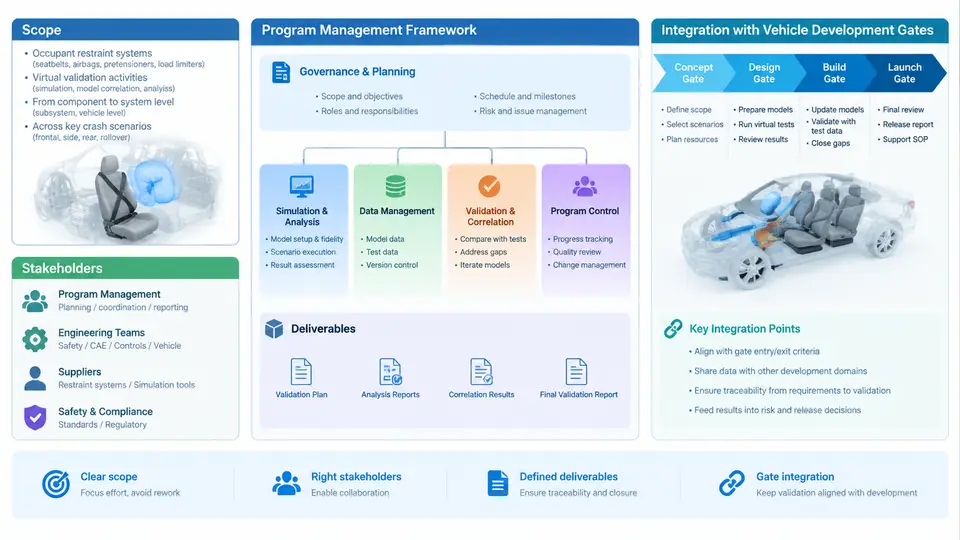
Occupant restraint virtual validation (ORVV) is the discipline of demonstrating, through CAE simulation rather than physical sled or barrier tests alone, that a vehicle's airbags, seat belts, pretensioners, load limiters, seats, and interior structures satisfy occupant protection targets. A single full-vehicle frontal or side model may contain millions of elements, dozens of contacts, and multiple restraint deployment events sequenced within 100 ms. Managing that work as an ad-hoc series of solver runs is the fastest route to late surprises. A program management framework turns ORVV into a predictable, auditable, gate-aligned engineering service.
This chapter defines the framework's four anchors — scope, stakeholders, deliverables, and integration with vehicle development gates — and shows how they interlock. The goal is not bureaucracy; it is to make the right simulation available at the right decision point with evidence that a reviewer can trust.
1.1 Scope: What ORVV Owns and What It Does Not
Scope definition prevents two chronic failures: the restraint CAE team being asked to answer questions it cannot answer (e.g., "will this pass homologation?"), and the team silently expanding into structural crash, NVH, or durability work. A workable scope statement for ORVV covers four dimensions.
- Physical scope: occupant positions (driver, passenger, rear outboard, rear center), restraint devices (frontal airbag, side airbag, curtain airbag, seat belt with pretensioner and load limiter, seat structure), and impact modes (full frontal rigid barrier, offset deformable barrier, side MDB, pole, rear impact, rollover as applicable).
- Analytical scope: which solver and model fidelity are used — e.g., LS-DYNA explicit for structural crash, MADYMO or a coupled LS-DYNA/MADYMO approach for occupant kinematics, and which dummy models (Hybrid III 50th, THOR, WorldSID, Q-series) are approved.
- Evidence scope: what constitutes acceptable evidence — correlation against physical test, sensitivity studies, or engineering judgment — and the required confidence level for each gate.
- Exclusions: explicitly list what is out of scope, such as pedestrian protection, child seat installation, or regulatory certification sign-off, which remain with the responsible function.
A practical scope statement is a table, not a paragraph. For example, a program might declare: "ORVV covers frontal 50 km/h rigid barrier and 64 km/h ODB for driver and front passenger, using Hybrid III 50th percentile, with correlation to physical sled tests required before Gate B." That single sentence tells the team what to model, what to compare against, and when the evidence is due.
1.2 Stakeholders and Their Decision Rights
ORVV sits at the intersection of several functions, each with a different question. The framework must name them and define what they can decide.
| Stakeholder | Primary Question | Decision Right |
|---|---|---|
| Restraint CAE team | Is the model correlated and the result robust? | Model release, correlation sign-off |
| Restraint system engineering | Does the design meet targets? | Design change proposals |
| Vehicle program management | Are we on track for the gate? | Gate readiness, resource escalation |
| Physical test / sled lab | Do we have test data to correlate? | Test matrix, data release |
| Safety attribute / chief engineer | Is the occupant protection target met? | Target acceptance, risk acceptance |
| Homologation / regulatory | Will this satisfy the regulation? | Regulatory interpretation |
The critical governance rule is that the CAE team owns model credibility, not design decisions. When a simulation shows a high injury value, the CAE engineer reports the result and its uncertainty; the restraint engineer decides whether to change the design. Blurring this line leads to simulations being tuned to produce favorable numbers rather than accurate ones.
1.3 Deliverables: The Evidence Chain
ORVV deliverables are not "the CAE report." They form a chain in which each link supports the next. A typical chain for one impact mode includes:
- Model build and check report: mesh quality, mass, energy balance, contact definitions, and initial conditions.
- Correlation report: simulated vs. physical test curves for occupant kinematics and injury criteria, with deviation quantified.
- Design evaluation report: injury criteria (HIC, chest deflection, femur load, neck injury, etc.) against targets, with margin.
- Sensitivity / robustness study: how results change with occupant position, belt routing, deployment timing, and material scatter.
- Gate readiness summary: a one-page status with pass/fail, open risks, and recommended actions.
1.4 Integration with Vehicle Development Gates
Vehicle programs run on gates — typically concept, design freeze, tooling kickoff, prototype build, and production. ORVV must map its work to these gates so that simulation informs decisions before they are locked, not after.
The mapping is bidirectional. Forward, each gate defines what ORVV must deliver. Backward, ORVV's lead time (model build, correlation, iteration) determines when the restraint design must be frozen. If a gate requires a correlated frontal model and correlation takes eight weeks, the design must be stable eight weeks before the gate.
The diagram shows the forward flow from gates to deliverables and the backward feedback loop. The dashed lead-time band is the practical constraint: if correlation is scheduled after design freeze, the program loses the ability to influence the design. The framework's job is to make that constraint visible early.
1.5 A Worked Example: Frontal ODB at Gate B
Consider a mid-size SUV program preparing for Gate B (design freeze). The ORVV scope for this gate is the 64 km/h offset deformable barrier test with a Hybrid III 50th percentile driver. The team has a correlated full-vehicle model from the previous program, but the restraint system is new.
Inputs: baseline model version V3.2, new airbag inflator curve, updated seat belt geometry, and physical sled test data from two runs at 50 km/h. Execution: the team runs the ODB simulation, extracts occupant kinematics, and compares chest deflection and HIC against the sled test. Observable result: the simulated chest deflection is 12% higher than the sled test at peak, and the timing of airbag contact is 4 ms late. Judgment: the model is not yet correlated; the team investigates airbag deployment timing and belt routing before reporting to the gate.
1.6 Framework Summary
The ORVV program management framework is a contract between the restraint CAE team and the vehicle program. Scope defines what is modeled and what evidence is acceptable. Stakeholders define who decides what. Deliverables form a traceable evidence chain. Gate integration ensures simulation informs decisions before they are locked. When these four anchors are in place, ORVV becomes a predictable service rather than a series of emergencies — and the restraint team can spend its time on engineering, not on explaining why the model was not ready.