1. Crash CAE outsourcing landscape
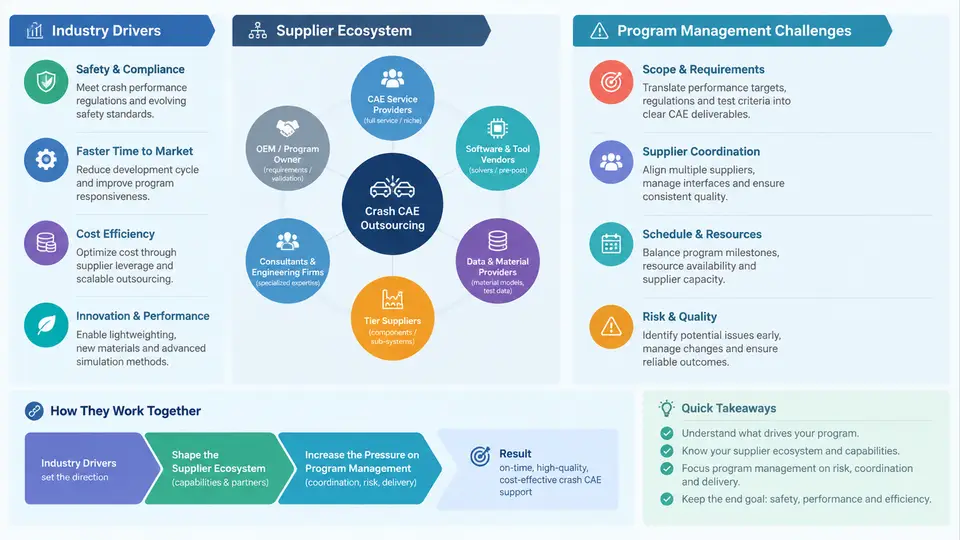
Crash CAE (Computer-Aided Engineering) outsourcing has become a structural feature of modern vehicle development rather than a temporary staffing tactic. As OEMs compress vehicle programs from roughly 48 months to 24–30 months and simultaneously expand the number of crash load cases required for regulatory and consumer-rating compliance, internal CAE capacity rarely scales at the same rate. Outsourcing fills that gap, but it also introduces a distributed delivery model in which model quality, solver settings, correlation status, and reporting conventions must be aligned across organizational boundaries. This chapter establishes the landscape: why outsourcing happens, who the suppliers are, and which program-management problems consistently determine success or failure.
Industry Drivers Behind Crash CAE Outsourcing
Four drivers dominate. First is capacity volatility: crash CAE demand peaks sharply during concept freeze, body-in-white (BIW) design iterations, and final validation, while headcount is expensive to hold at peak level. Second is load-case proliferation: a single program may require frontal ODB, MPDB, side pole, side barrier, rear impact, roof crush, and pedestrian protection analyses, each with multiple variants for powertrain and trim levels. Third is specialization: occupant safety (Hybrid III, THOR, WorldSID), battery pack intrusion for EVs, and pedestrian lower-leg impact each demand distinct modeling expertise. Fourth is cost arbitrage and 24-hour engineering: suppliers in lower-cost regions can execute baseline runs overnight, returning results before the OEM engineering team resumes work.
A typical driver quantification helps set expectations. If an OEM runs 120 full-vehicle crash load cases per program at an average of 18 wall-clock hours per run on 64-core nodes, that is roughly 2,160 node-hours per load case set, or about 259,200 core-hours per program. At an internal fully loaded rate of USD 3.50 per core-hour versus an outsourced rate of USD 1.80, the direct compute-and-labor delta is substantial — but only if rework rates stay low. A 15% rework rate from unclear requirements can erase the entire arbitrage.
The Supplier Ecosystem
The supplier landscape is not homogeneous. It segments into four tiers, each with different commercial models and technical depth.
| Tier | Typical Provider | Core Offering | Engagement Model |
|---|---|---|---|
| Tier 1 — Full-service engineering | Global engineering service firms | Model build, solver execution, correlation, report, design recommendations | Fixed-price work packages or dedicated capacity |
| Tier 2 — Specialized CAE boutiques | Occupant safety or battery specialists | THOR/WorldSID modeling, battery intrusion, restraint optimization | Time-and-materials or expert retainer |
| Tier 3 — Offshore/nearshore capacity | Low-cost-region engineering centers | Baseline runs, mesh generation, DOE sweeps | Rate card per load case or per core-hour |
| Tier 4 — Software and platform vendors | CAE tool and cloud providers | Solver licenses, HPC burst, automation frameworks | Subscription or consumption-based |
In practice, programs blend tiers. A Tier 1 supplier may own the full-vehicle model and reporting, while a Tier 2 boutique handles occupant restraint tuning and a Tier 3 center executes parametric sweeps. This blending is where program management complexity concentrates: interfaces between suppliers must be defined as precisely as interfaces between CAD and CAE.
Program Management Challenges
The recurring failure modes in crash CAE outsourcing are rarely technical solver problems. They are coordination problems that surface as technical symptoms.
- Model and data handover ambiguity. Which party owns the BIW mesh? At what maturity level is the CAD released? If the supplier receives a partially frozen body model, every subsequent result carries a caveat that may not be documented.
- Solver and version drift. A result produced with LS-DYNA R11.1 and a specific material card set is not directly comparable to one produced with R13.0. Version control must be contractual, not informal.
- Correlation baseline disputes. Suppliers need validated physical test data to correlate. If the OEM provides only target curves without test setup details, the supplier cannot judge whether a delta is a modeling error or a test variation.
- Reporting inconsistency. One supplier reports intrusion in millimeters at the door inner panel; another reports it at the occupant H-point. Both are "correct" but not comparable.
- IP and data security. Full-vehicle crash models embed proprietary geometry, material data, and restraint design. Cross-border data transfer and model access must be governed explicitly.
- Change management latency. A design change issued to three suppliers simultaneously can produce three different model states within a week if no single configuration owner exists.
Visualizing the Outsourcing Delivery Chain
The diagram below maps the flow from OEM requirements through supplier execution to program decision, highlighting the control points where program management must intervene. It is not a generic process chart; it reflects the actual handover objects and verification gates in a crash CAE work package.
What Program Management Must Actually Control
Effective crash CAE outsourcing program management reduces to five controllable objects. Each must have a named owner and a defined state at every program gate.
- Model baseline. A single, versioned full-vehicle model with a change log. Suppliers work from released baselines only; no supplier maintains a private variant without written deviation approval.
- Load-case matrix. A table mapping each load case to its regulation or rating source, target value, solver version, and responsible supplier. Ambiguity here produces duplicate or missing runs.
- Correlation status. For each load case, whether the model is correlated to physical test, partially correlated, or predictive only. Results from uncorrelated models must be labeled as such in every report.
- Reporting template. Fixed definitions for intrusion measurement locations, pulse filtering (e.g., SAE J211 CFC 60 for occupant, CFC 180 for structural), and pass/fail thresholds.
- Change control board. A weekly forum where design changes, supplier deviations, and rework requests are dispositioned. Without it, change latency compounds across suppliers.
Practical Example: Scoping a Frontal ODB Work Package
Consider an OEM scoping a frontal offset deformable barrier (ODB) work package per Euro NCAP protocol. The OEM provides: BIW CAD at design freeze level, restraint system definition, material cards, and a correlated baseline model from the previous program. The supplier is asked to deliver intrusion, pulse, and occupant response for three powertrain variants.
A well-scoped work package specifies the following inputs and acceptance criteria:
Load case:      Frontal ODB 64 km/h, 40% overlap
Solver:         LS-DYNA R13.0, double precision, 64 cores
Model baseline: BIW_DS3.2_released, restraint_DS1.0
Outputs:        B-pillar intrusion (mm), firewall intrusion (mm),
                occupant chest deflection (mm), HIC36, femur load (kN)
Filtering:      SAE J211 CFC 180 (structural), CFC 600 (occupant)
Acceptance:     Intrusion within 5% of correlated baseline;
                occupant values within 10% of target
Deliverable:    Result deck, d3plot, report per OEM template
Turnaround:     10 working days per variant
If the supplier returns results showing 12% higher firewall intrusion than baseline, the program manager must determine whether the cause is a model difference, a solver setting difference, or a genuine design change. This requires the supplier to provide the exact model version and solver input deck used. Without that traceability, the discrepancy cannot be resolved and the work package enters rework — the single largest hidden cost in crash CAE outsourcing.
The landscape is therefore not simply a make-or-buy decision. It is a configuration management problem in which technical results are only as trustworthy as the handover discipline behind them. The chapters that follow address each control object in detail: supplier selection and qualification, work package definition, model and data governance, correlation management, and performance monitoring across the program lifecycle.