1. CAE Simulation Verification Program Mana
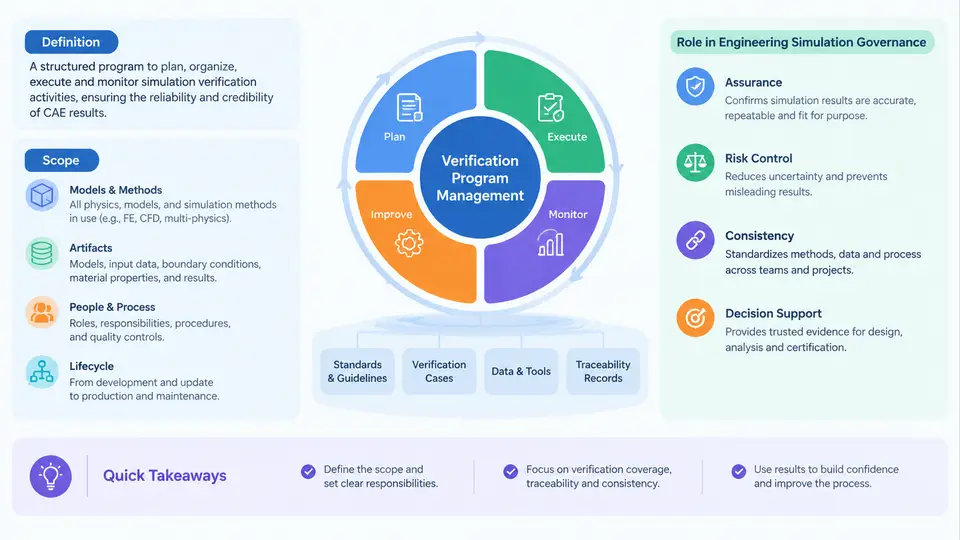
Computer-aided engineering (CAE) has become the primary evidence source for many engineering decisions: structural integrity, thermal margin, crashworthiness, fatigue life, and manufacturability are increasingly accepted on the basis of simulation rather than physical test alone. That shift creates a governance problem. A finite element result is only as trustworthy as the assumptions, mesh, material data, boundary conditions, solver settings, and interpretation behind it. CAE Simulation Verification Program Management is the discipline that makes those elements explicit, controlled, and auditable across an entire program rather than within a single analyst's workflow.
In practical terms, it is the management system that defines what must be verified, how verification evidence is produced and reviewed, who is accountable at each gate, and how deviations are recorded and closed. It sits between two familiar activities: verification and validation (V&V), which is a technical process, and engineering governance, which is an organizational control framework. Program management is the connective layer that turns V&V from a set of good intentions into repeatable, traceable practice.
Definition and Boundaries
A workable definition is: CAE Simulation Verification Program Management is the planned, documented, and auditable control of all simulation verification activities within a program, ensuring that each model used for a decision is verified against defined requirements, reviewed by competent personnel, and traceable to the design decision it supports.
Three terms in that definition carry weight. Planned means verification activities are scheduled and resourced before results are needed, not assembled retrospectively. Documented means evidence exists in a form a third party can inspect. Auditable means the chain from requirement to model to result to decision can be reconstructed.
It is important to separate this from adjacent concepts. Verification asks "did we solve the equations correctly?" — mesh convergence, solver tolerances, unit consistency, element quality. Validation asks "did we solve the right equations?" — comparison against physical test or accepted benchmark. Program management does not perform either; it ensures both happen, in the right order, with the right evidence, and that the results are accepted or rejected through a controlled decision path.
Scope: What the Program Covers
The scope of a CAE simulation verification program is broader than model checking. It typically spans the following areas, each of which must be addressed explicitly in the program plan:
- Requirements traceability. Every simulation must trace upward to a design requirement or decision it informs, and downward to the model, load case, and acceptance criterion used.
- Model verification. Mesh convergence studies, element quality thresholds, solver tolerance settings, and unit-system checks.
- Input data control. Material properties, geometry revisions, and boundary conditions must be version-controlled and linked to a source of record.
- Method qualification. Reusable analysis methods (e.g., a standard bolt preload procedure) must be qualified once and then applied consistently.
- Independent review. Results affecting safety or certification require review by a competent person not responsible for the model.
- Uncertainty and margin. How numerical, material, and load uncertainties are quantified and carried into the margin.
- Evidence retention. Model files, solver decks, logs, and review records retained for the program's audit lifetime.
Scope decisions are program-specific. A concept-study program may require only method qualification and traceability, while a certification program will require full independent review and formal uncertainty treatment. The program plan should state which controls apply at which phase, so that effort is proportionate to consequence.
Role Within Engineering Simulation Governance
Engineering simulation governance is the broader framework of policies, roles, and standards that determine how simulation is used as evidence. CAE simulation verification program management is the operational arm of that framework. Governance sets the policy — for example, "no simulation result may be used for a design release without independent review." Program management implements it: it defines the review trigger, the reviewer competence criteria, the record format, and the escalation path when review is not possible.
The relationship can be understood as a control loop. Governance defines requirements and acceptance criteria. The program plan translates them into verification activities, gates, and evidence. Execution produces models and results. Review compares results against criteria and either accepts, rejects, or conditions the decision. Findings feed back into the program plan and, where systemic, into governance policy itself.
What Program Management Actually Produces
The tangible outputs of a CAE simulation verification program are not simulation results themselves but the controls around them. A mature program typically maintains:
| Artifact | Purpose | Typical Owner |
|---|---|---|
| Verification Program Plan | Defines scope, gates, evidence format, and review rules for the program | Simulation program manager |
| Requirements Traceability Matrix | Links each simulation to the design requirement and acceptance criterion it supports | Lead analyst / systems engineer |
| Method Qualification Records | Documents that a reusable analysis method has been verified and is fit for its stated range | Method owner |
| Verification Evidence Package | Model, inputs, solver settings, convergence data, and results for a specific analysis | Responsible analyst |
| Independent Review Record | Reviewer identity, findings, and disposition (accept / reject / condition) | Independent reviewer |
| Deviation and Finding Log | Tracks non-conformances, their root cause, and closure evidence | Program manager / QA |
These artifacts are not bureaucratic overhead. Each one answers a specific question that will be asked when a result is challenged: What was required? What was modeled? Was the method sound? Who checked it? What was found? How was it closed?
A Concrete Example: Bolt Preload Verification
Consider a program verifying a bolted joint in a pressure vessel. The design requirement is that the joint maintains seal integrity under a specified internal pressure with a safety factor of 1.5 on bolt yield. The program plan might specify the following verification activities:
- Method qualification. A standard bolt preload modeling procedure is qualified against a known analytical solution for a single bolt. The qualification record states the valid range: bolt diameter 8–24 mm, preload 40–70% of proof load, and a mesh refinement criterion of at least three elements across the thread root region.
- Model verification. The analyst performs a mesh convergence study on the joint model. Contact stiffness and friction coefficient are documented as inputs with their source. A unit check confirms that pressure is applied in MPa and geometry in mm, consistent with the material modulus in MPa.
- Execution. The solver runs with a documented convergence tolerance. Residuals and contact status are extracted as evidence. The bolt axial force and joint separation are the primary outputs.
- Review. An independent reviewer checks that the method qualification range covers the actual bolt size and preload, that the mesh meets the refinement criterion, and that the reported safety factor is computed against the correct yield value. The reviewer records acceptance or a finding.
If the bolt diameter in the actual design falls outside the qualified range, the program plan should require either re-qualification or an explicit deviation with justification. This is the point where program management differs from ad hoc analysis: the boundary of validity is defined in advance, and crossing it triggers a controlled response rather than an implicit assumption.
Why This Matters for the Rest of the Course
Every subsequent topic in this course — verification planning, mesh convergence strategy, material data control, independent review, uncertainty quantification, and audit readiness — is an elaboration of the framework introduced here. The definition establishes what is being managed. The scope establishes which controls apply. The governance role establishes why the controls exist and how they connect to design decisions. Without this foundation, verification activities tend to become inconsistent, unrepeatable, and difficult to defend when a design decision is questioned.
The practical takeaway for a program manager or lead analyst is straightforward: before any simulation is run, the program should be able to state which requirement it serves, which method is qualified for it, what evidence will be produced, and who will review it. If those four questions cannot be answered, the verification program is not yet in control of that analysis.