1. CAE review and sign-off in automotive pr
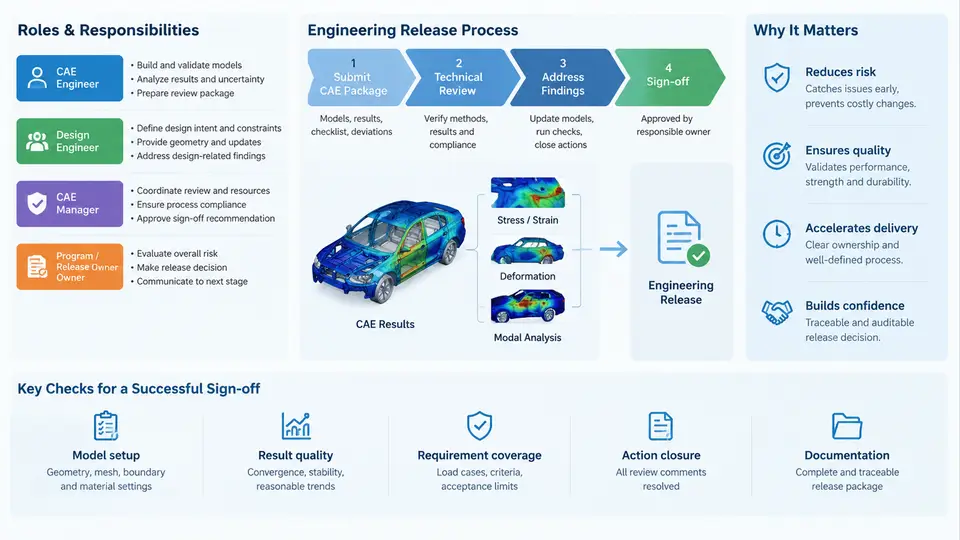
In automotive product development, a CAE result is never "done" when the solver finishes. A simulation becomes engineering evidence only after it has been reviewed, challenged, and formally signed off by accountable engineers. This chapter establishes the vocabulary, organizational roles, and release mechanics that every subsequent review activity depends on. Without a shared understanding of who owns what and how a design actually leaves the CAE domain and enters the release system, review degenerates into informal opinion exchange.
Why CAE Sign-Off Exists
Vehicle programs run on overlapping timelines: body-in-white structure, closures, chassis, powertrain mounts, thermal systems, and crash load paths all mature in parallel. Each discipline produces CAE models that predict stiffness, strength, durability, NVH, crashworthiness, thermal behavior, and manufacturability. A single unverified assumption — an incorrect material card, a misapplied boundary condition, a mesh that is too coarse at a stress riser — can propagate into tooling and physical prototypes, where correction cost is orders of magnitude higher than in the virtual phase.
CAE sign-off is the controlled decision that a specific simulation, on a specific model version, with specific loads and acceptance criteria, is trustworthy enough to support a design release. It is a technical act, not a bureaucratic one. The signature means: the reviewer has examined the model, the setup, the results, and the margins, and accepts professional accountability for the conclusion.
Roles and Responsibilities
Automotive CAE organizations vary, but most mature structures separate four functions. Confusing them is the most common source of review failure.
| Role | Primary Responsibility | Typical Deliverable |
|---|---|---|
| CAE Analyst | Builds the model, runs the load cases, interprets results, documents assumptions and limitations | CAE report with model version, load cases, results, and margin summary |
| CAE Reviewer / Checker | Independently verifies model quality, boundary conditions, material data, and result plausibility | Review record with findings, open issues, and verification status |
| Design Responsible Engineer (DRE) | Owns the part geometry and integrates CAE recommendations into the CAD release | Released CAD dataset and design change documentation |
| Chief Engineer / Technical Authority | Accepts residual risk, resolves cross-functional conflicts, authorizes the release gate | Signed release authorization and risk acceptance record |
The analyst and reviewer must be different people. Self-review is acceptable only for exploratory studies that do not feed a release decision. The DRE is accountable for the physical part, not for the simulation; the CAE reviewer is accountable for the simulation's credibility, not for the design choice. The chief engineer owns the trade-off when CAE margins conflict with cost, mass, or packaging constraints.
The Engineering Release Process
Release is a gated sequence. A typical structure for a structural CAE deliverable looks like this:
- Model freeze and version tagging. The CAD geometry is frozen at a defined revision. The CAE model is tagged to that revision. Any subsequent geometry change invalidates the model and requires re-tagging.
- Analysis execution and self-check. The analyst runs the defined load cases and performs internal checks: mass balance, energy balance, convergence, and comparison against previous iterations or physical test data where available.
- Independent review. The reviewer examines the model setup against a checklist: element quality, connections (welds, adhesives, bolts), material properties, boundary conditions, load application, and result extraction. Findings are logged as open or closed.
- Margin assessment. Results are compared against acceptance criteria. A positive margin means the design meets the target; a negative margin requires either a design change or a documented risk acceptance.
- Sign-off and release. The reviewer signs the CAE report. The DRE incorporates the design into the release dataset. The chief engineer authorizes the gate if all open issues are closed or formally accepted.
What the Review Actually Checks
Review is not a re-run of the analysis. It is a structured interrogation of credibility. For a body structure stiffness study, a reviewer would typically verify:
- Model fidelity: Is the mesh refined at attachment points and stress concentrations? Are spot welds represented with appropriate element types and spacing?
- Boundary conditions: Are the constraints physically representative of the test or vehicle condition? Are they applied at the correct locations and in the correct coordinate system?
- Load application: Are loads applied at the correct points, in the correct direction, and with the correct magnitude? Is the load case definition traceable to a requirement document?
- Material data: Are the material cards from the approved database? Is the grade and thickness correct for the released CAD?
- Result plausibility: Do the deformed shapes, stress patterns, and reaction forces make physical sense? Are there unexpected stress concentrations or zero-stress regions that indicate a modeling error?
- Margin calculation: Is the margin computed against the correct allowable? Is the safety factor applied consistently?
Each finding is classified. A blocking finding prevents sign-off until resolved. A non-blocking finding is recorded for the next iteration. This classification prevents the review from becoming an endless loop of minor comments.
Typical Failure Modes in the Sign-Off Process
Three failure patterns recur across programs. First, version mismatch: the CAE model is built on an older CAD revision, and the sign-off is applied to a design that no longer exists. Second, scope creep: the reviewer expands the review into a redesign exercise, delaying the gate without adding credibility. Third, silent assumption: a boundary condition or material property is assumed without documentation, and the assumption is later found to be wrong after release.
Visualizing the Release Flow
The diagram below shows the relationship between the four roles and the gated release sequence. It is not a generic flowchart; it maps the specific handoffs, decision points, and invalidation triggers that govern a structural CAE deliverable in a vehicle program.
Practical Takeaway
The release process is only as strong as its traceability. Every sign-off must answer four questions: What model version was analyzed? What load cases were applied? What acceptance criteria were used? Who verified the result and who accepted the risk? If any answer is missing, the sign-off is incomplete. In the chapters that follow, each review discipline — structural, crash, NVH, thermal, durability — will be examined through this same framework, with specific checklists, acceptance criteria, and documentation requirements.