1. Campaign planning fundamentals
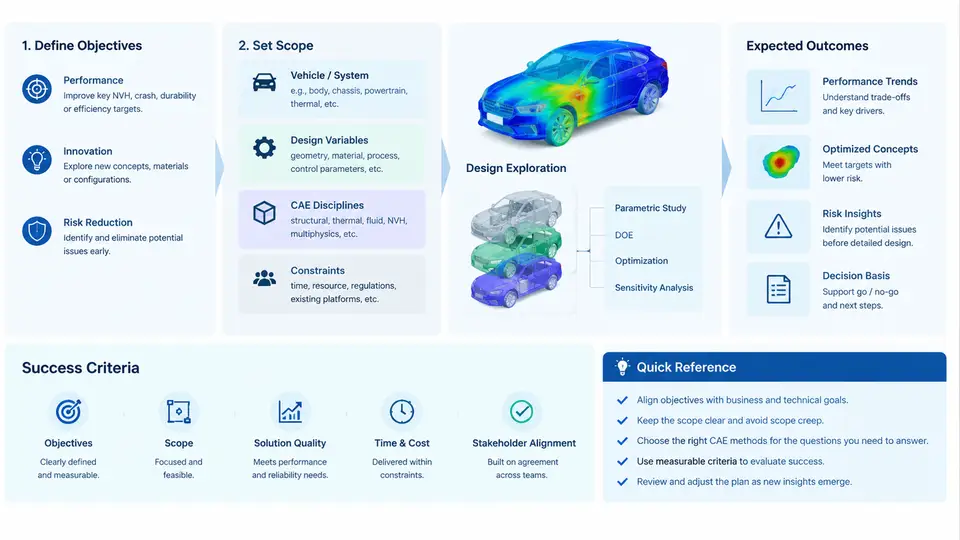
A CAE design exploration campaign is not a single simulation run, nor even a batch of runs. It is a deliberately structured program of virtual experiments whose purpose is to answer a specific engineering question with enough confidence to support a decision. The word campaign is borrowed from experimental testing, and the analogy is useful: a wind-tunnel campaign has a test matrix, a set of response channels, a budget, and a defined exit condition. A CAE campaign needs exactly the same discipline, but the cost structure is inverted — runs are cheap, while model build, correlation, and post-processing attention are expensive.
Most failed exploration programs fail before the first solver job is submitted. They fail because the objective was stated as a deliverable ("run a DOE on the body-in-white") rather than as a decision ("determine whether gauge reduction in the front rail can meet the 40 km/h offset deformable barrier target without exceeding a 12 kg mass increase"). This chapter establishes the three planning artifacts that prevent that failure: a decision-oriented objective, a bounded scope, and measurable success criteria.
From a decision to an objective statement
A well-formed campaign objective answers four questions in one or two sentences: which design variables are free to move, which responses must be characterized, what decision the results will inform, and what accuracy is required for that decision. Consider a battery electric vehicle (BEV) body structure program. A weak objective reads: "Study the effect of material and thickness on crash performance." A usable objective reads: "Quantify the trade-off between front-rail gauge (1.4–2.2 mm), bumper beam material (DP590, DP780, hot-formed 22MnB5), and crash-box trigger geometry on peak longitudinal deceleration and intrusion at the pedal box, to support a 15 kg mass-reduction decision at the next gate review, with response prediction uncertainty below 8% of the baseline value."
The second version immediately constrains the DOE type, the number of runs, the mesh fidelity, and the post-processing effort. It also exposes what is not in scope — rear structure, side impact, and durability are excluded, and that exclusion must be explicit.
Scoping: variables, responses, and the boundary of the model
Scope has three dimensions that must be fixed before any DOE is generated: the design space, the response space, and the modeling fidelity. All three are budget decisions as much as technical ones.
The design space is the set of factors and their ranges. Ranges should be justified by manufacturing feasibility, packaging, or supplier capability — not chosen for mathematical convenience. A gauge range of 1.4–2.2 mm is defensible because the rolling mill supplies those thicknesses; a range of 1.0–3.0 mm would generate designs that can never be built and waste runs at the extremes. Categorical factors such as material grade or joint type must be enumerated explicitly, and any factor interaction that is physically expected (for example, gauge × material grade in a buckling-dominated rail) should be declared so the DOE resolution can capture it.
The response space defines what will be extracted from every run. This is where campaigns most often under-plan. A crash model produces gigabytes of output; the campaign needs a fixed, automated extraction list. Typical responses for a frontal impact campaign include:
- Peak longitudinal deceleration at the tunnel and rocker accelerometers, filtered per SAE J211 CFC 60.
- Maximum intrusion at the pedal box, toe pan, and steering column, measured along the vehicle X axis.
- Section force in the front rail at a defined cut plane, integrated from shell element forces.
- Energy absorbed by the crash box and the rail, separated by component set.
- Mass of the modified subsystem, computed from the updated property assignments.
Each response must have a defined extraction method, a defined coordinate convention, and a defined filtering or averaging rule. If two engineers extract "peak deceleration" differently — one from the raw signal, one from the CFC 60 filtered signal — the campaign results are not comparable, and the surrogate model will be fitted to noise.
Success criteria and the stopping rule
Success criteria are the conditions under which the campaign is declared complete. They are not the same as design targets. A design target says "intrusion must be below 120 mm." A campaign success criterion says "the surrogate model must predict intrusion with a cross-validated R² above 0.90 and a maximum absolute error below 10 mm on a 10-point holdout set, and the Pareto front must contain at least three feasible designs."
Separating these two is essential. A campaign can succeed technically — producing an accurate, well-validated surrogate — while revealing that no feasible design exists in the current space. That is a valuable outcome, because it triggers a scope change (widen the gauge range, add a material, change the rail topology) rather than an endless refinement loop.
Practical success criteria usually combine four elements: a model quality metric (R², RMSE, or classification accuracy on holdout points), a feasibility count (how many designs satisfy all constraints), a robustness check (sensitivity of the optimum to ±1σ variation in gauge and material properties), and a budget condition (runs consumed versus runs allocated). The stopping rule is written as a Boolean: stop when model quality is met AND at least one feasible design exists AND the robustness check passes, or when 80% of the run budget is consumed, whichever comes first.
A worked planning example
Return to the BEV front-rail campaign. The team allocates 120 solver runs. A Latin hypercube with 60 points covers the continuous factors, and the categorical material factor is handled by running 20 points per grade, giving 60 runs for the initial surrogate. The remaining 60 runs are held for adaptive refinement near the predicted Pareto front.
Before generating the DOE, the team writes the extraction script and validates it on the baseline model. The script reads the glstat and nodout outputs, applies the CFC 60 filter, and writes a single CSV row per run with the five responses plus the factor values. Running it on the baseline produces a known reference: peak deceleration 42.3 g, pedal box intrusion −98 mm, rail section force 187 kN. These reference values are recorded in the campaign plan. If a later run returns a peak deceleration of 8 g or 300 g, the extraction script or the model setup is wrong, and the run is flagged rather than fed into the surrogate.
This reference-value check is the cheapest quality gate in the entire campaign. It catches unit errors, missing initial velocity cards, and mislabeled node sets before they contaminate the design space.
Common planning failure modes
| Symptom | Root cause | Corrective action |
|---|---|---|
| Surrogate R² plateaus at 0.6 despite adding runs | A physically important factor was omitted from the design space | Re-examine the physics; add the missing factor and regenerate the DOE rather than refining the existing one |
| Pareto front contains only infeasible designs | Variable ranges do not overlap with the feasible region | Widen ranges or add a new material/joint concept; treat as a scope change, not a solver problem |
| Two engineers report different peak values for the same run | No fixed filtering or coordinate convention | Publish the extraction specification and validate it against the baseline reference values |
| Campaign runs indefinitely with no exit | No stopping rule or budget condition defined | Write the Boolean stopping rule before run one and enforce it at each review |
Deliverable: campaign planning brief
The output of this chapter's process is a one-page planning brief that travels with the campaign from kickoff to closeout. It is deliberately short, because a brief that nobody reads is worse than no brief.
CAMPAIGN PLANNING BRIEF
Program: BEV body structure — front crash mass reduction
Decision owner: Chief Engineer, Body Structures
Decision gate: Gate 3 design review, 2025-11-14

OBJECTIVE
Quantify trade-off between front-rail gauge, bumper beam material,
and crash-box trigger radius on peak deceleration and pedal box
intrusion; support 15 kg mass-reduction decision with response
prediction uncertainty below 8% of baseline.

DESIGN SPACE
  gauge_mm        continuous   1.4 - 2.2
  material        categorical  DP590 | DP780 | 22MnB5
  trigger_r_mm    continuous   15 - 35
  Declared interaction: gauge_mm x material

RESPONSES (fixed extraction, CFC 60 where applicable)
  peak_decel_g          tunnel + rocker accelerometers
  intrusion_pedal_mm    negative X, occupant side
  intrusion_toe_mm      negative X, occupant side
  rail_section_force_kN cut plane at Y = 350 mm
  subsystem_mass_kg     updated property mass

CONVENTIONS
  X forward, Y driver-left, Z up. Intrusion = negative X displacement.
  Baseline reference: 42.3 g | -98 mm | -71 mm | 187 kN | 214.6 kg

SUCCESS CRITERIA (stop when ALL true, or at 80% budget)
  R2 > 0.90 on 10-point holdout
  max abs error < 10 mm on intrusion responses
  >= 3 feasible designs on Pareto front
  optimum robust to +/-1 sigma gauge and material scatter

BUDGET
  120 runs total: 60 initial LHS, 60 adaptive refinement
  Extraction script validated against baseline before run one
The brief is not a contract; it is a shared reference that makes scope changes visible. When the team later decides to add a factor or widen a range, the change is recorded against the brief, and everyone understands that the run budget and the stopping rule may need to move with it. That traceability is what separates a campaign from an open-ended series of simulations.