1. Occupant safety program cost and resourc
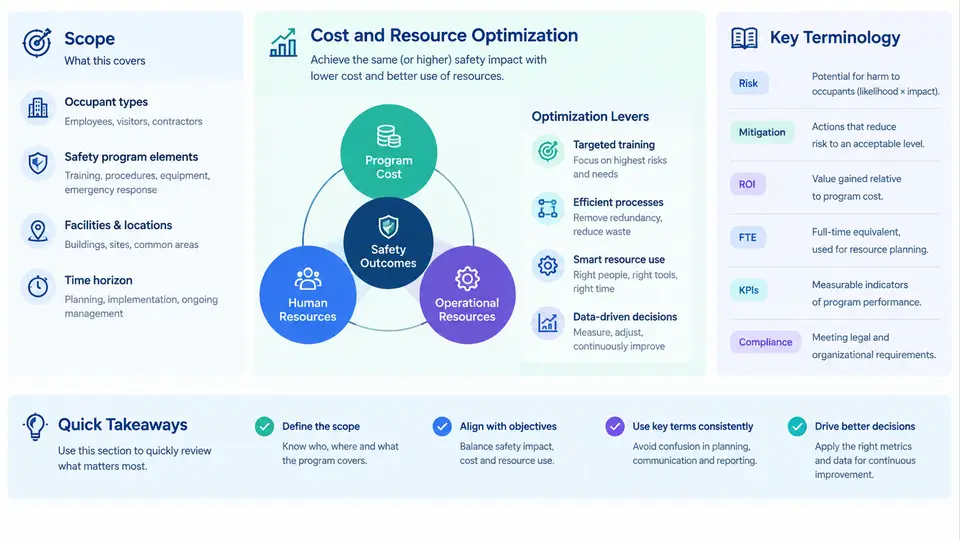
Occupant safety programs consume a substantial share of vehicle development budgets. A single full-vehicle frontal crash test campaign, including sled runs, barrier preparation, instrumentation, and post-test teardown, can easily exceed several million dollars per vehicle program. Multiply that across frontal, side, rear, rollover, and pedestrian protection requirements, and the cost pressure becomes obvious. Cost and resource optimization is not about cutting corners on safety; it is about achieving the required occupant protection performance at the lowest total cost and with the most efficient use of engineering resources.
What This Discipline Covers
The scope of occupant safety program cost and resource optimization spans the entire development lifecycle, from concept phase through series production and beyond. It includes:
- Test asset optimization: Reducing the number of physical crash tests by substituting CAE simulations where correlation confidence is sufficient, while maintaining regulatory and consumer-rating coverage.
- Resource allocation: Assigning sled tests, full-vehicle tests, component tests, and simulation runs to the most cost-effective combination that still validates the design.
- Design cost trade-offs: Evaluating whether adding a side airbag, a knee bolster, or a load-limiting seatbelt retractor delivers sufficient occupant-protection benefit relative to its piece cost, mass penalty, and integration complexity.
- Schedule compression: Sequencing tests and simulations to avoid redundant iterations and to catch failures early when design changes are cheapest.
- Supplier and tooling cost management: Negotiating airbag module, seat structure, and restraint system pricing without compromising performance margins.
The discipline does not replace safety engineering judgment. It provides a structured framework for making resource decisions transparent, defensible, and repeatable.
Objectives
A well-defined optimization program pursues several objectives simultaneously:
- Meet all regulatory and consumer-rating targets with adequate margin. Optimization never trades away compliance.
- Minimize total program cost — including test hardware, CAE licenses, engineering labor, supplier tooling, and piece cost — over the full vehicle program.
- Reduce development time by front-loading simulation and using physical tests for confirmation rather than discovery.
- Improve resource utilization so that expensive assets (sled bucks, crash labs, high-performance computing clusters) are not idle or over-subscribed.
- Maintain traceability so that every optimization decision can be traced back to a requirement, a risk assessment, or a validated correlation.
Key Terminology
Before applying optimization methods, practitioners must share a precise vocabulary. The following terms appear throughout this course.
| Term | Definition |
|---|---|
| Occupant safety program | The coordinated set of design, analysis, and test activities intended to protect vehicle occupants in crash events, covering frontal, side, rear, and rollover impact modes. |
| Injury criteria | Quantitative measures such as HIC (Head Injury Criterion), chest deflection, femur load, and neck injury criterion (Nij) used to assess occupant protection performance. |
| CAE correlation | The degree to which a simulation model reproduces physical test results. High correlation justifies substituting simulation for physical tests. |
| Sled test | A component-level dynamic test using a sled fixture to reproduce occupant kinematics without destroying a full vehicle body. |
| Full-vehicle crash test | A complete vehicle impact test against a barrier or moving deformable barrier, used for final validation. |
| Test matrix | The planned set of tests covering all required load cases, configurations, and occupant sizes. |
| Design of Experiments (DOE) | A statistical method for selecting simulation or test runs that maximize information gain while minimizing the number of runs. |
| Restraint system | The combination of seatbelts, airbags, seat structures, and energy-absorbing components that manage occupant deceleration. |
| Piece cost | The per-vehicle cost of a component or subsystem in series production. |
| Program cost | The total cost incurred from concept through start of production, including engineering, testing, tooling, and validation. |
How the Elements Interact
The relationships among scope, objectives, and terminology are not linear. A change in one area propagates through others. For example, improving CAE correlation confidence (a terminology and capability issue) directly affects test matrix size (scope), which in turn affects program cost (objective). Similarly, a regulatory change that tightens side-impact injury criteria expands the feasible design space boundary, potentially requiring additional restraint system content and increasing piece cost.
The following diagram illustrates the core optimization loop: requirements define constraints, simulation and testing generate performance data, cost models quantify resource consumption, and the optimization engine searches for the best trade-off between safety performance and total cost.
Practical Example: Test Matrix Reduction
Consider a mid-size sedan program required to pass FMVSS 208 (frontal), FMVSS 214 (side), and Euro NCAP frontal offset and side pole tests. A naive test matrix might include 12 full-vehicle tests and 20 sled tests. By applying CAE correlation confidence thresholds, the team determines that frontal occupant kinematics correlate at R² = 0.92 for the driver side, justifying replacement of four full-vehicle frontal tests with validated simulation runs. The revised matrix uses 8 full-vehicle tests and 16 sled tests, saving an estimated $2.4 million in test hardware and lab time while maintaining the same validation coverage.
Common Pitfalls
- Optimizing cost before establishing correlation confidence. Premature test reduction without validated CAE leads to late-stage failures and far higher costs.
- Treating all test assets as interchangeable. Sled tests and full-vehicle tests answer different questions; substituting one for the other without understanding the limitation can leave gaps in validation.
- Ignoring piece cost in early trade studies. A restraint system change that saves one test but adds $15 per vehicle across 300,000 units costs $4.5 million — far more than the test saved.
- Failing to update the cost model as design matures. Early estimates based on concept-level assumptions become misleading if not refreshed at each gate.
With this foundation in scope, objectives, and terminology, subsequent chapters will address specific methods for test matrix optimization, CAE-driven resource allocation, supplier cost negotiation, and program-level trade-off analysis.