1. Program landscape and coordination manda
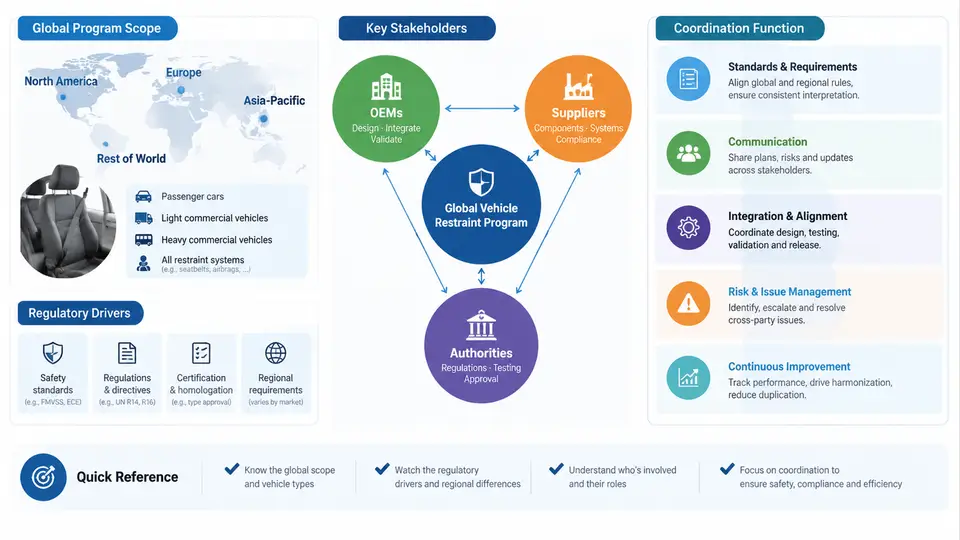
Vehicle restraint programs exist because a vehicle is only as safe as the weakest link between its occupants and the road. A restraint system spans seat belts, buckle assemblies, retractors, pretensioners, load limiters, anchorages, airbags, child restraint anchorage systems (CRS/LATCH), and the structural interfaces that carry crash loads into the body-in-white. No single organization owns that entire chain. An OEM defines the vehicle-level requirement, a Tier-1 supplier designs the seat belt assembly, a Tier-2 supplier provides the webbing or the pyrotechnic initiator, a test house runs the sled and barrier tests, and a regulator decides whether the resulting evidence satisfies a legal standard. Coordination is the discipline that keeps those parties aligned on one set of requirements, one set of interfaces, and one set of evidence.
Scope of a Global Restraint Program
The scope of a restraint program is usually defined along three axes: product coverage, market coverage, and lifecycle coverage. Product coverage includes every seating position and every restraint device installed in the vehicle, from the driver frontal airbag to the third-row inflatable belt. Market coverage includes each jurisdiction where the vehicle is homologated or self-certified. Lifecycle coverage runs from concept target-setting through design validation, production part approval, in-service monitoring, and field action if a defect is found.
A practical way to bound the program is to build a coverage matrix. The rows are restraint commodities; the columns are markets. Each cell records the governing regulation, the required test configuration, and the responsible owner. This matrix becomes the master index for the entire program, because every later activity — a design change, a test request, a compliance statement — can be traced back to a cell in it.
| Restraint commodity | Typical governing requirement | Primary evidence | Typical owner |
|---|---|---|---|
| Frontal occupant restraint | FMVSS 208 / UN R94 / GB 11551 | Full-vehicle barrier test, sled test | OEM safety integration |
| Seat belt assembly | FMVSS 209 / UN R16 | Component strength, retractor, buckle tests | Tier-1 belt supplier |
| Child restraint anchorage | FMVSS 225 / UN R14 (ISOFIX) | Static pull, anchorage strength | Body structure + Tier-1 |
| Side impact restraint | FMVSS 214 / UN R95 / GB 20071 | Moving deformable barrier, pole test | OEM safety integration |
| Airbag inflator | FMVSS 208 / UN R114 | Tank test, inflator output | Tier-2 inflator supplier |
Regulatory Drivers
Regulations are the hard boundary of the program, but they are not the only driver. Three forces typically shape the requirement set:
- Mandatory regulation. FMVSS in the United States, UN Regulations and UN Global Technical Regulations under the 1998 Agreement, and national standards such as GB in China set minimum performance. These are pass/fail gates for market entry.
- Consumer rating programs. Euro NCAP, US NCAP, C-NCAP, and similar programs push performance beyond the legal minimum. A five-star target can raise belt force limits, require rear-seat pretensioners, or demand far-side occupant protection that no regulation yet mandates.
- Corporate and liability requirements. Internal safety targets, insurance data, and field-failure history often add requirements that no regulator wrote. A warranty trend showing buckle release effort drift, for example, can trigger a design requirement long before any standard changes.
The coordination problem is that these drivers do not move together. A market may adopt a UN Regulation while a consumer program in the same region applies a stricter protocol. The program must therefore maintain a requirement hierarchy: regulation first, then consumer rating, then internal target, with explicit traceability so that a design decision can be justified against each layer.
Stakeholder Map
Restraint programs involve a surprisingly wide set of actors. Mapping them by function rather than by org chart clarifies who must agree on what.
- OEM safety integration. Owns the vehicle-level target, the occupant packaging envelope, and the final compliance statement.
- OEM purchasing and quality. Owns supplier nomination, PPAP, and production conformity.
- Tier-1 restraint suppliers. Own subsystem design, component validation, and interface definition with the seat and body.
- Tier-2 suppliers. Own webbing, buckles, retractors, initiators, and sensors; their change control feeds directly into Tier-1 validation.
- Test houses and CAE teams. Own the evidence: sled tests, barrier tests, simulation correlation, and instrumentation.
- Authorities and type-approval bodies. Own the legal interpretation and the approval decision.
- Field quality and legal. Own in-service monitoring and any recall or field-action decision.
The Coordination Function
Coordination is not administration. It is the technical function that maintains a single source of truth across organizational boundaries. In practice it has four recurring outputs:
- A controlled requirement baseline. Every requirement has an identifier, a source, a verification method, and a status. Changes are versioned, not communicated verbally.
- An interface control document (ICD). For restraint systems this covers anchor locations and tolerances, electrical connector pinouts and firing-loop resistance, pyrotechnic deployment timing, and the seat-to-belt routing envelope.
- A validation plan tied to the coverage matrix. Each cell maps to a test or analysis, with a defined pass criterion and a responsible lab or supplier.
- A change-impact process. When a Tier-2 supplier changes a webbing material or an inflator lot, the coordination function determines which tests must be repeated and which markets are affected.
The following diagram shows how these elements connect: regulatory and consumer drivers feed the requirement baseline, which flows through the interface control document into subsystem design, and the resulting evidence returns to the authorities and to field monitoring.
What Coordination Actually Looks Like in Practice
Consider a concrete example. An OEM plans a mid-cycle change to a front seat belt retractor to reduce weight. The Tier-1 supplier proposes a thinner webbing. The coordination function must answer four questions before the change is approved:
- Which requirements are affected? Webbing strength and elongation are governed by FMVSS 209 and UN R16. A thinner webbing may still pass component strength but change occupant kinematics in FMVSS 208 and UN R94.
- Which markets are affected? If the vehicle is sold in markets that self-certify, the OEM carries the burden of proof; in type-approval markets, the approval body must be notified.
- Which tests must be repeated? Component-level retractor and buckle tests, plus at least one full-vehicle frontal test per affected seating row, and a CAE correlation update.
- What is the change-impact record? A documented decision with the rationale, the evidence, and the residual risk, signed by the accountable owner.
If the coordination function is weak, this change is handled by email. The Tier-1 supplier updates its drawing, the OEM updates its bill of materials, and the validation team discovers during the next barrier test that the occupant excursion increased. The cost of that discovery is a delayed launch or a field action. If the coordination function is strong, the change enters a controlled process, the affected coverage-matrix cells are identified, and the required tests are scheduled before the change is released.
Common Failure Modes
- Requirement drift. Verbal agreements replace controlled changes; different parties work to different values.
- Interface ambiguity. Anchor tolerances or connector pinouts are defined in two documents that disagree.
- Evidence gaps. A market is added late, and no test covers its specific configuration.
- Change leakage. A Tier-2 material change is not propagated to the Tier-1 validation plan.
- Ownership gaps. A requirement has no accountable owner, so no one notices when it is not verified.
Each of these failure modes is preventable with the four coordination outputs described earlier: a controlled baseline, an interface control document, a validation plan tied to the coverage matrix, and a change-impact process. The remainder of this course develops each of these in detail, starting with how to build and maintain the requirement baseline across multiple regulatory regimes.