1. Introduction to automotive safety progra
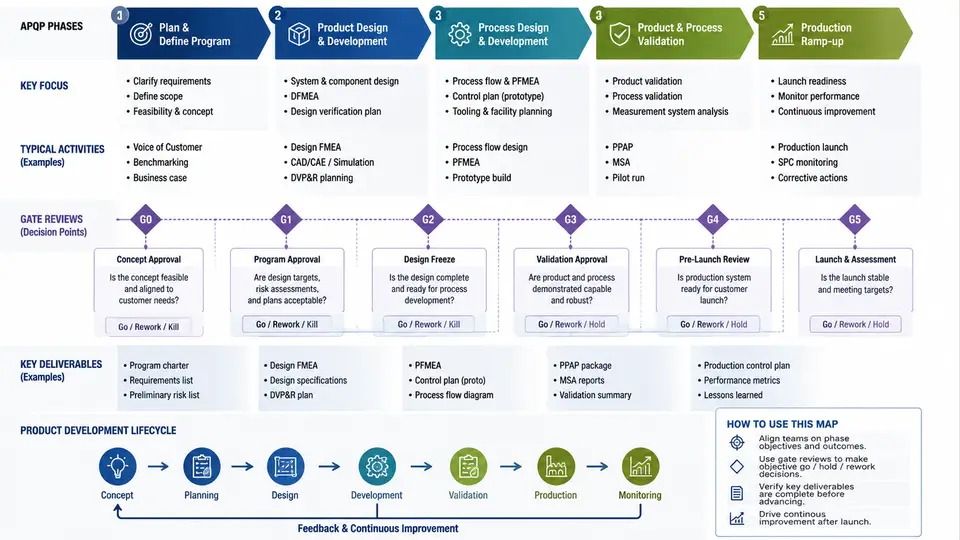
Automotive safety program planning is the discipline of turning a customer requirement, a regulatory obligation, or an internal platform decision into a controlled, evidence-backed development sequence. In practice, this means that every safety-relevant deliverable — from a hazard analysis to a production control plan — is planned, owned, reviewed, and approved before the vehicle program commits to the next phase of spending. The Advanced Product Quality Planning (APQP) framework, standardized in AIAG's APQP manual (and mirrored in supplier requirements such as Ford's APQP, GM's GVDP, and Stellantis's supplier quality manuals), provides the structural backbone for that sequence. Gate reviews are the decision points that convert APQP's five phases into an auditable, go/no-go program rhythm.
Why APQP Exists in a Safety Context
APQP was originally developed by the Big Three to reduce launch risk on new vehicle programs. Its five phases — Plan and Define Program, Product Design and Development, Process Design and Development, Product and Process Validation, and Feedback, Assessment, and Corrective Action — map directly onto the safety lifecycle defined in ISO 26262 (concept, system design, hardware/software development, production, operation). The two frameworks are complementary: APQP governs program management and quality planning, while ISO 26262 governs functional safety work products. A mature safety program plan integrates both, so that a single gate review can simultaneously confirm APQP deliverables (e.g., DFMEA, control plan) and functional safety work products (e.g., Technical Safety Concept, safety validation report).
The practical consequence is that safety planning cannot be bolted on after the design is frozen. If a hazard analysis and risk assessment (HARA) is not completed during Phase 1, the ASIL assignment will be missing when the system architecture is defined in Phase 2, and the safety goals will not be traceable to the validation tests in Phase 4. Gate reviews exist precisely to catch this kind of sequencing failure before it becomes a recall or a field safety campaign.
The Five APQP Phases and Their Safety Deliverables
Each APQP phase has a defined purpose, a set of inputs, and a set of outputs that must be reviewed at the gate. The table below summarizes the safety-relevant deliverables that a program planner should expect at each phase.
| APQP Phase | Primary Purpose | Safety-Relevant Deliverables (examples) |
|---|---|---|
| Phase 1 — Plan and Define | Establish scope, customer requirements, and program timing | Preliminary HARA, safety goals, ASIL assignment, safety plan, DIA (Development Interface Agreement) draft |
| Phase 2 — Product Design & Development | Design the product to meet requirements | DFMEA, Technical Safety Concept, safety requirements allocation, design verification plan |
| Phase 3 — Process Design & Development | Design the manufacturing process | PFMEA, control plan, special characteristics, safety-critical process parameters |
| Phase 4 — Product & Process Validation | Validate product and process against requirements | Design validation (DV) and production validation (PV) results, safety validation report, confirmation of ASIL integrity |
| Phase 5 — Feedback & Corrective Action | Assess performance and drive improvement | Field safety monitoring, lessons learned, safety case updates, corrective action closure |
Note that the phases are not strictly sequential in time. Phase 3 process design often begins while Phase 2 design is still being refined, and Phase 5 feedback feeds back into the next program's Phase 1. The gate review is what enforces the discipline: no phase exit without the required evidence.
Gate Reviews: The Decision Architecture
A gate review is a formal, scheduled event where the program team presents evidence that the exit criteria for the current phase have been met, and the gate authority (typically a program manager, chief engineer, or safety manager) makes a decision: pass, conditional pass (with open actions and a deadline), or fail (rework required before re-review). In safety programs, the gate authority must include someone with functional safety competence, because a gate that passes without a valid safety argument is a latent defect.
Effective gate reviews share four characteristics:
- Defined exit criteria — each gate has a checklist of required work products, not a vague "design is ready" statement.
- Traceability — every safety goal traces to a safety requirement, which traces to a design element, which traces to a verification test.
- Evidence, not opinion — the review examines actual analysis results, test reports, and review records, not slideware summaries.
- Action closure — open actions have owners, due dates, and a re-review mechanism.
Integrating the Product Development Lifecycle
The product development lifecycle in automotive extends from concept through series production and into the field. APQP covers the development portion; ISO 26262 extends into production, operation, service, and decommissioning. A safety program plan must therefore define the safety lifecycle as a superset of the APQP timeline, with explicit handoffs between the two.
A typical program timeline for a new ECU with an ASIL D safety goal might look like this (illustrative example, not a measured result):
Month 0–3   : Phase 1 — HARA, safety goals, ASIL assignment, safety plan
Month 3–9   : Phase 2 — Technical Safety Concept, DFMEA, design verification
Month 9–15  : Phase 3 — PFMEA, control plan, process capability studies
Month 15–21 : Phase 4 — DV/PV testing, safety validation, production trial run
Month 21–24 : Phase 5 — Launch, field monitoring, safety case finalization
Month 24+   : Operations — field data collection, periodic safety review
The gate reviews are placed at the boundaries: Gate 1 at month 3, Gate 2 at month 9, Gate 3 at month 15, Gate 4 at month 21, and Gate 5 at month 24. Each gate has a defined set of safety work products that must be complete. For example, Gate 2 cannot pass unless the Technical Safety Concept is approved and the DFMEA has no open high-severity (S≥9) failure modes without a defined mitigation.
Common Failure Modes in Safety Program Planning
Three failure patterns recur across automotive safety programs:
- Late HARA — the hazard analysis is performed after the architecture is frozen, forcing retrofits or, worse, an ASIL downgrade that cannot be justified. Symptom: safety goals appear in the safety plan but have no traceable link to system requirements.
- Gate as formality — gates are scheduled but exit criteria are not enforced; open actions accumulate and are carried forward. Symptom: the same action item appears in three consecutive gate minutes.
- Disconnected safety case — the safety case is written at the end as a documentation exercise rather than assembled incrementally from gate evidence. Symptom: the safety case references documents that do not exist or are marked "draft."
Visualizing the APQP–Gate–Safety Lifecycle Relationship
The diagram below shows how the five APQP phases, the gate reviews, and the ISO 26262 safety lifecycle interlock. The key insight is that gates are not just phase boundaries — they are the synchronization points where safety evidence is verified before the program commits to the next phase.
What a Safety Program Planner Actually Produces
The primary deliverable of this planning activity is the Safety Program Plan (sometimes called the Safety Plan under ISO 26262-2, Clause 6). It is not a Gantt chart. It is a controlled document that defines:
- The safety lifecycle scope and the applicable standards (ISO 26262, AIAG APQP, customer-specific requirements).
- The safety organization: who is the safety manager, who is the DIA partner, who approves safety work products.
- The gate schedule with exit criteria per gate, mapped to APQP phases.
- The work product list: HARA, safety goals, TSC, DFMEA, PFMEA, control plan, safety validation report, safety case.
- The traceability strategy: how safety goals link to requirements, design, and tests.
- The change management process: how safety-relevant changes are assessed and re-approved.
A well-formed plan is specific enough that a new engineer joining the program can identify, for any given week, which safety work product is due, who owns it, and which gate it feeds. That specificity is what separates a safety program plan from a project schedule.
Key Takeaways
- APQP provides the phase structure; gate reviews provide the decision discipline; ISO 26262 provides the safety work products. A safety program plan integrates all three.
- Gates are evidence-based decision points, not status meetings. Each gate must have defined exit criteria and a competent safety authority.
- Traceability from safety goal to verification evidence is the core technical thread that gates verify.
- Late HARA, formalistic gates, and disconnected safety cases are the three most common planning failures — each is preventable with disciplined gate enforcement.