1. Launch readiness management for automoti
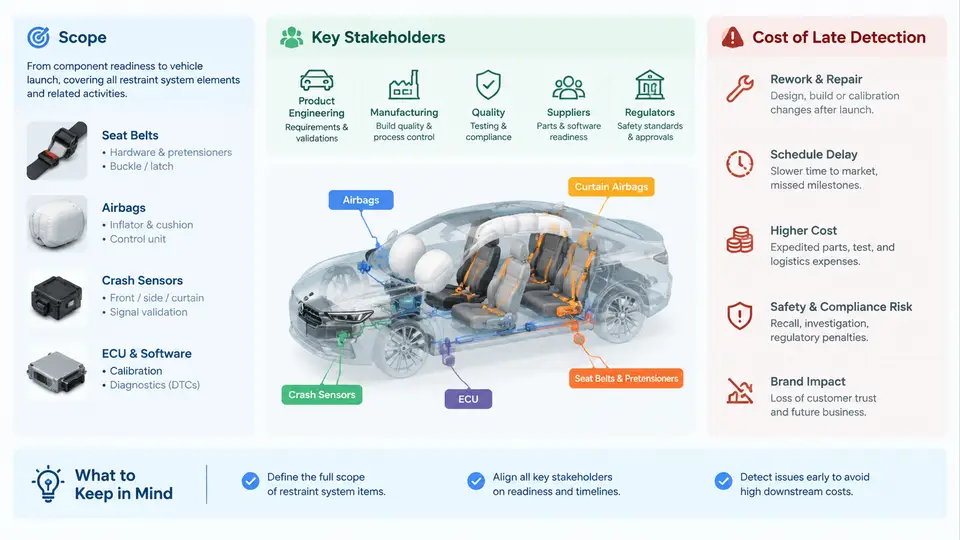
An automotive restraint system is not a single component but a safety-critical subsystem that spans sensing, decision logic, energy release, and occupant interface. It includes airbag modules (driver, passenger, side, curtain, knee, and far-side), seat belt assemblies with pretensioners and load limiters, the Occupant Classification System (OCS), crash sensors and satellite accelerometers, the Airbag Control Unit (ACU), wiring harnesses and squib circuits, and increasingly the integration with ADAS and vehicle electrical/electronic (E/E) architecture. Launch readiness management is the discipline of proving, before Job 1 and throughout ramp-up, that this entire chain will deploy correctly, consistently, and within regulatory and customer requirements across every build configuration.
The scope of launch readiness is deliberately broader than "passing the crash test." It covers design verification (DV) and production validation (PV) status, restraint control module software calibration maturity, plant process capability, supplier PPAP status, diagnostic coverage, and field-failure containment readiness. A restraint system that performs perfectly in a DV sled test but has an unvalidated OCS calibration for a new seat trim, or a squib connector that is not fully seated on the assembly line, is not launch-ready. The management task is to make these disparate readiness states visible, comparable, and actionable on a single timeline.
Why Late Detection Is Expensive
The cost of discovering a restraint defect scales non-linearly with the phase in which it is found. A calibration error caught during CAE or bench simulation may cost a few engineering hours. The same error found after Job 1 can trigger a stop-ship, a field service campaign, or a safety recall. The table below illustrates a representative cost escalation for a hypothetical restraint-system defect (illustrative figures, not measured data):
| Detection Phase | Typical Action | Relative Cost Impact | Schedule Impact |
|---|---|---|---|
| Design / CAE | Model update, re-run simulation | 1× | Days |
| DV / PV testing | Re-test, calibration change | 10× | Weeks |
| Pilot / pre-Job 1 | Line rework, containment | 50× | Weeks–months |
| Post-Job 1 / field | Recall, campaign, legal exposure | 100–1000× | Months–years |
Beyond direct cost, late detection erodes regulatory compliance margins. Restraint systems are governed by FMVSS 208 (occupant crash protection), FMVSS 209/210 (seat belt assemblies and anchorage), FMVSS 214 (side impact), and equivalent UN ECE regulations. A defect found after certification can invalidate the compliance demonstration and force re-certification, which is both expensive and reputationally damaging.
Stakeholders and Their Readiness Concerns
Launch readiness is a cross-functional state, and each stakeholder owns a different slice of evidence. The OEM restraint system engineer owns DV/PV test completion and calibration sign-off. The ACU software team owns diagnostic and deployment algorithm maturity. Manufacturing owns process capability, poka-yoke verification, and end-of-line (EOL) test pass rates. Supplier quality owns PPAP and sub-tier readiness. Regulatory affairs owns certification documentation. Field quality and legal own containment and recall readiness. A launch readiness manager must reconcile these views without owning any single one of them.
The practical mechanism is a readiness dashboard with defined exit criteria per gate. For example, a restraint system gate might require: all DV tests passed with no open deviations; PV completed on production tooling; OCS calibration validated across all seat trim variants; EOL squib circuit test coverage at 100%; and zero open safety-critical supplier issues. Each criterion has an owner, a status, and an evidence link. The dashboard is reviewed at weekly launch readiness meetings, and any red item triggers a recovery plan with a named owner and date.
From Readiness Criteria to Engineering Evidence
Consider a concrete example: validating the OCS calibration for a new passenger seat with a heated, ventilated leather trim. The input is the seat build configuration and the OCS sensor mat part number. The engineering step is to run the FMVSS 208 occupant classification test matrix (5th percentile female, 50th percentile male, 95th percentile male, child seat, and out-of-position occupants) on the production-intent seat. The observable output is the classification accuracy and the airbag suppression/enable decision for each occupant scenario. The pass criterion is zero misclassifications across the required matrix. A typical failure symptom is intermittent "airbag off" for a 50th percentile male due to sensor mat pressure distribution changes from the new trim. Troubleshooting would involve re-seating the mat, checking the trim compression, and re-running the calibration. This is the level of detail that launch readiness management must track, not just "OCS validation in progress."
Practical Readiness Tracking in the Ramp-Up Phase
During ramp-up, readiness management shifts from gate reviews to daily containment and trend monitoring. A useful practice is to track EOL restraint test results as a control chart. For example, if the squib circuit resistance test shows a mean of 2.0 Ω with an upper specification limit of 2.5 Ω, a rising trend toward 2.3 Ω may indicate a connector seating issue before any unit actually fails. The launch readiness manager reviews this trend daily with manufacturing and supplier quality, and triggers corrective action when the trend crosses a defined threshold (e.g., mean + 2σ). This is how late detection is prevented: by treating leading indicators, not just pass/fail results, as readiness signals.
Another practical tool is the open-issues list with severity classification. Each issue is tagged as safety-critical, regulatory, or cosmetic. Safety-critical issues block the gate unconditionally. Regulatory issues require a compliance assessment before gate passage. Cosmetic issues may be deferred with documented rationale. This classification prevents the common failure mode where a long list of minor issues obscures one critical restraint defect.
Key Takeaways
- Restraint system launch readiness covers the full chain from sensors to airbag deployment, not just crash test pass/fail.
- Late detection cost escalates by roughly an order of magnitude per phase, reaching recall-level exposure after Job 1.
- Stakeholders each own a different evidence slice; the readiness manager reconciles them through a gate dashboard with defined exit criteria.
- Effective tracking uses leading indicators such as EOL test trends and severity-classified open issues, not just milestone completion.
- Every readiness criterion must have an owner, a status, and an evidence link to be actionable.