1. Restraint program lifecycle and risk lan
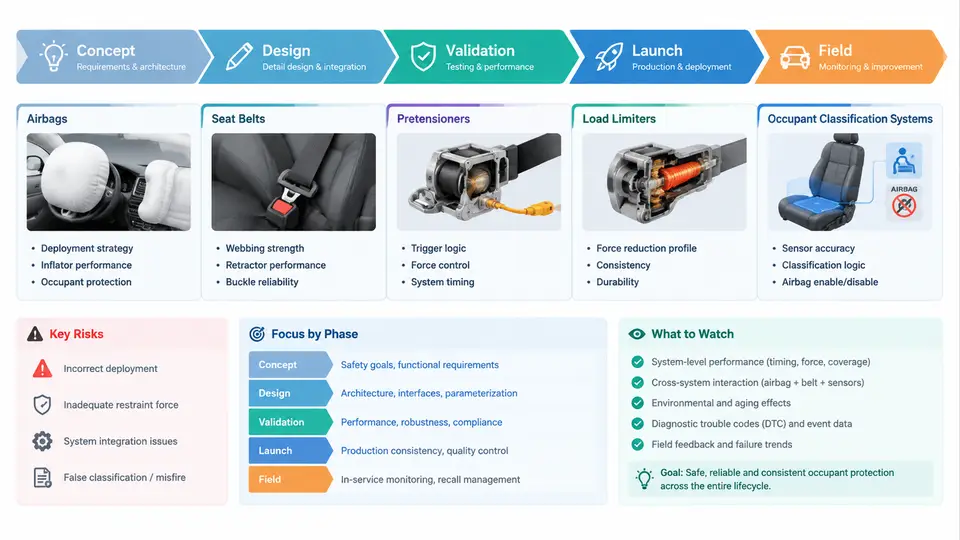
An automotive restraint program is not a single component development effort. It is a coordinated system-of-systems program that spans airbags, seat belts, pretensioners, load limiters, and occupant classification systems (OCS), each with its own maturity curve, supplier base, and regulatory exposure. The program moves through five broadly recognized phases — concept, design, validation, launch, and field — and the risk profile changes materially at each transition. Understanding where risk concentrates, and why, is the foundation for any recovery strategy later in this course.
The Five Phases and What Each One Actually Produces
Concept phase. The restraint system is defined at the vehicle architecture level. Key outputs include the occupant packaging envelope, the restraint system topology (frontal dual-stage airbags, side thorax/pelvis airbags, curtain airbags, driver knee airbag), belt anchorage locations, and the initial OCS sensing strategy (weight-based, capacitive, or camera-assisted). The dominant risk here is late requirement discovery: a regulatory target (FMVSS 208, FMVSS 226, ECE R94/R95, or China GB 11551) or an internal occupant protection target that is not fully decomposed before architecture freeze. Once the body-in-white hard points are set, changing airbag volume or belt geometry becomes expensive.
Design phase. Detailed component and subsystem design occurs: airbag module CAD, inflator selection (pyrotechnic vs. hybrid), folded cushion geometry, retractor and pretensioner packaging, load limiter torsion bar calibration, and OCS algorithm development. This is where interface risk dominates — the airbag module must fit the steering wheel or instrument panel, the pretensioner must package within the B-pillar or buckle stalk, and the OCS must communicate reliably over the vehicle network. A common failure mode is a design that meets component-level requirements but violates system-level timing or energy absorption targets.
Validation phase. Physical and virtual testing confirm performance. This includes sled tests, barrier tests, static deployment, out-of-position (OOP) tests, and OCS classification accuracy across occupant sizes. The risk here is test-article representativeness: a validation build that does not match production intent (different inflator lot, hand-built cushion, prototype OCS sensor) can produce passing results that do not transfer to launch. Validation also exposes calibration sensitivity — a load limiter that performs well at nominal temperature may exceed chest deflection limits at cold temperature.
Launch phase. Production tooling, process capability, and end-of-line (EOL) verification are established. Risk shifts to manufacturing variation: inflator output spread, cushion fold consistency, pretensioner crimp quality, and OCS sensor calibration drift. A restraint system that passed validation can still fail launch if process capability (Cpk) is marginal on a safety-critical characteristic.
Field phase. The system is in customer hands. Risk becomes field performance and regulatory surveillance: warranty claims, field reports, NHTSA or equivalent queries, recall investigations, and OCS false-classification complaints. Field data often reveals usage patterns not covered in validation — child seats in the front passenger seat, aftermarket seat covers affecting OCS, or belt routing over bulky clothing.
Risk Landscape by Component
Each restraint component carries a distinct risk signature. Airbags concentrate risk in inflator performance, cushion deployment timing, and OOP injury potential. Seat belts carry risk in webbing strength, retractor locking, and anchorage durability. Pretensioners introduce pyrotechnic risk and buckle-stalk packaging constraints. Load limiters trade chest deflection against forward excursion, and their calibration is highly sensitive to occupant mass and belt geometry. OCS carries the highest software and sensing risk because it must classify occupants correctly across a wide range of conditions while meeting strict false-negative and false-positive limits.
Visualizing the Lifecycle and Risk Concentration
The SVG below maps the five phases against the five restraint subsystems, showing where risk concentrates and how it migrates. It is not a process flow; it is a risk-density map intended to help program teams see where recovery effort is most likely to be needed.
Why the Risk Map Matters for Recovery Management
The map above is deliberately not a timeline. It shows that risk is not uniformly distributed and does not simply decrease as the program matures. Airbag risk peaks in design and validation, then drops at launch and field. OCS risk, by contrast, remains high through validation, launch, and field because classification accuracy depends on real-world occupant variability that is difficult to fully replicate in a test lab. Pretensioner risk peaks in design (packaging and crimp) but can resurface at launch if process capability is not controlled.
For a program manager, the practical implication is that recovery planning must be phase-aware and component-aware. A recovery action that works for an airbag timing issue — re-running sled tests with a revised inflator — is not appropriate for an OCS false-classification issue, which may require field data analysis, algorithm retraining, and regulatory consultation. Similarly, a launch-phase pretensioner crimp issue is a process-capability problem, not a design problem, and the recovery path is statistical process control and supplier containment, not CAD revision.
Regulatory and Customer-Facing Risk Overlay
Restraint risk is never purely technical. Each phase carries a regulatory and customer-facing dimension. In concept and design, the risk is failing to meet a regulatory target that is discovered late. In validation, the risk is a test failure that triggers a design change with schedule impact. In launch, the risk is a production nonconformance that could lead to a stop-ship or recall. In field, the risk is a safety defect investigation, which can escalate to a recall with significant financial and reputational consequences.
Occupant classification systems deserve special attention because they sit at the intersection of sensing, software, and regulatory compliance. An OCS that suppresses the passenger airbag when it should not, or fails to suppress when required, can create both an injury risk and a regulatory violation. This is why OCS validation typically includes a large matrix of occupant sizes, seating positions, and environmental conditions, and why field monitoring for OCS-related complaints is a permanent activity rather than a launch milestone.
Summary
The restraint program lifecycle moves through concept, design, validation, launch, and field, and each phase concentrates risk differently across airbags, seat belts, pretensioners, load limiters, and OCS. Effective recovery management begins with recognizing where risk currently sits, what evidence is available, and which discipline owns the response. The risk map is a starting point for that diagnosis, not a substitute for it.