1. Restraint system program landscape
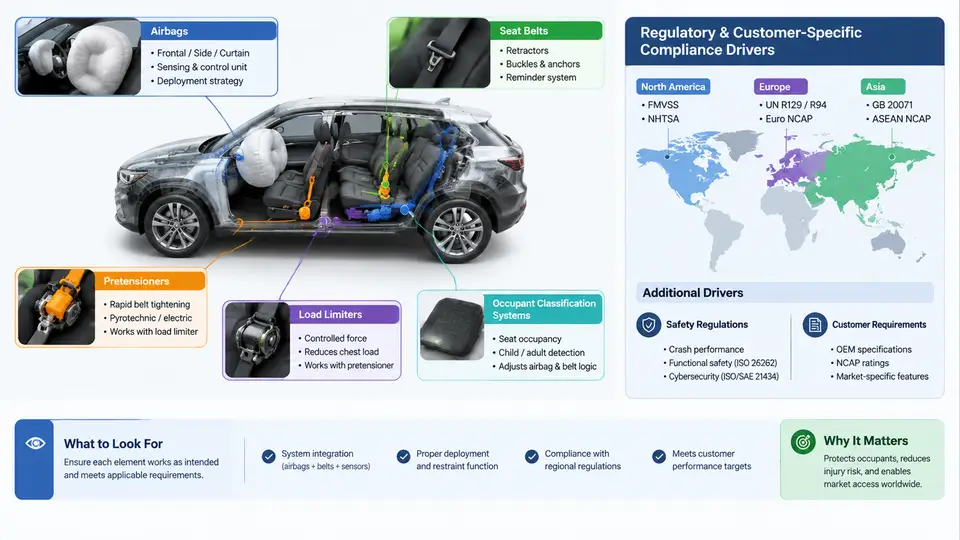
An automotive restraint system is not a single product but a coordinated safety subsystem whose performance is judged as a whole. The program landscape spans five functional families: airbags, seat belts, pretensioners, load limiters, and occupant classification systems (OCS). Each family has its own design logic, its own failure modes, and its own regulatory and customer-specific acceptance criteria. A restraint program manager must understand how these families interact, because compliance is evaluated against the deployed system, not against individual components in isolation.
Functional Families and Their Roles
Airbags provide supplemental protection by deploying a gas-inflated cushion within tens of milliseconds of a detected crash. Front airbags (driver and passenger), side airbags (thorax, pelvis, curtain), and knee airbags each target specific injury mechanisms. Deployment is governed by an electronic control unit (ECU) that applies crash severity thresholds and suppression logic. The critical compliance parameters are deployment time, inflation pressure, venting behavior, and the suppression/disable conditions defined by regulation and by the OEM's own specification.
Seat belts remain the primary restraint. A three-point belt converts occupant kinetic energy into belt elongation and controlled deceleration. Belt geometry — anchor positions, D-ring height, buckle stalk angle — determines how load is distributed across the pelvis and thorax. Regulatory compliance for belts is defined by static strength tests (e.g., 22 kN tensile on the webbing and hardware) and by dynamic sled tests that measure chest deflection and head excursion.
Pretensioners remove belt slack at the onset of a crash, typically within 10–20 ms, using a pyrotechnic or motor-driven retractor. By pulling the occupant into the seat early, the pretensioner improves coupling between the occupant and the restraint system. The design trade-off is between pretensioning force and occupant comfort during normal driving; a pretensioner that fires too aggressively can cause belt-induced injury.
Load limiters work in opposition to pretensioners. Once belt force exceeds a calibrated threshold — commonly 2.5–4.5 kN at the retractor or buckle — a torsion bar or tearing stitch allows controlled webbing payout. This caps the force transmitted to the chest, reducing rib fracture and internal organ injury. The interaction between pretensioning and load limiting is one of the most sensitive calibration tasks in restraint engineering.
Occupant classification systems determine whether the passenger seat is occupied, and if so, by what — an adult, a child in a child restraint, or an object. OCS uses pressure sensors, capacitive mats, or weight-based strain gauges, and outputs a classification that enables or suppresses passenger airbag deployment. Misclassification is a direct safety and compliance risk: an adult incorrectly classified as a child may have the airbag suppressed, while a rear-facing child seat incorrectly classified as an adult may receive a deployment that causes injury.
Regulatory Compliance Drivers by Market
Global restraint compliance is fragmented across several regulatory regimes, and a single vehicle platform must often satisfy multiple sets simultaneously. The table below summarizes the primary frameworks and their key restraint-related requirements.
| Market / Regime | Key Standard | Primary Restraint Requirements | Notable Differences |
|---|---|---|---|
| United States | FMVSS 208, 209, 214, 226 | Frontal 56 km/h rigid barrier; offset deformable barrier; side pole; ejection mitigation | Unbelted occupant testing; advanced airbag suppression logic required |
| European Union | ECE R94, R95, R16, R14 | Frontal 56 km/h ODB; side 50 km/h MDB; belt anchor strength | Belted occupant focus; ECE R16 belt installation requirements |
| China | GB 11551, GB 20071, GB 14166 | Frontal 50 km/h; side 50 km/h; belt and pretensioner performance | Harmonized with ECE but with local test lab and certification process |
| Global NCAP | Euro NCAP, C-NCAP, Latin NCAP | Frontal offset, side impact, whiplash, child occupant protection | Star rating drives OEM design targets beyond minimum regulation |
| OEM-Specific | Internal restraint specifications | Deployment timing, OCS robustness, durability, EMC, environmental | Often stricter than regulation; defines program validation matrix |
The practical consequence is that a restraint program cannot be designed to a single market. A vehicle sold in the US, EU, and China must satisfy FMVSS 208's unbelted requirements, ECE R94's belted offset test, and GB 11551's frontal impact — all with the same hardware. This drives the need for adaptive restraint systems: dual-stage airbags, variable-output pretensioners, and OCS that can be calibrated per market without hardware changes.
Customer-Specific Compliance Drivers
Beyond regulation, OEM customers impose their own requirements. These typically include:
- Deployment timing windows — e.g., driver airbag must reach full inflation between 25 and 35 ms after ECU trigger at 50 km/h frontal impact.
- OCS robustness — classification must remain stable across temperature extremes (−40 °C to +85 °C), humidity, and seat wear cycles.
- Durability — pretensioner and load limiter must survive 10-year/150,000-mile life without degradation of function.
- EMC and environmental — restraint ECU must meet CISPR 25 and ISO 11452 without false deployment or suppression.
- Diagnostic coverage — OCS and airbag circuits must achieve defined fault detection thresholds and set DTCs per ISO 14229 (UDS).
Program Integration and Validation Flow
Restraint program execution follows a staged validation logic. The table below outlines a representative validation matrix for a global platform, showing how each restraint family is tested against regulatory and customer-specific criteria.
| Validation Stage | Airbag | Seat Belt | Pretensioner | Load Limiter | OCS |
|---|---|---|---|---|---|
| Component-level | Pressure vessel, inflator burn | 22 kN tensile, webbing elongation | Fire time, force curve | Threshold force, payout | Sensor accuracy, drift |
| Subsystem sled | Deployment kinematics | Belt geometry, anchor loads | Slack removal timing | Force limiting profile | Classification under vibration |
| Full vehicle crash | FMVSS 208 / ECE R94 | FMVSS 209 / ECE R16 | Integrated with belt | Integrated with belt | Suppression logic verification |
| Environmental | Thermal cycling, humidity | Corrosion, UV | Thermal aging | Fatigue cycling | Temperature/humidity matrix |
| Production | End-of-line leak test | Buckle force audit | Fire circuit continuity | Dimensional check | Calibration verification |
Key Program Risks and Mitigation
Three risks dominate restraint program execution. First, OCS misclassification — mitigated by redundant sensing (pressure plus capacitive), robust algorithm validation across the occupant population, and field monitoring. Second, pretensioner/load limiter interaction — mitigated by sled testing across the full force-time envelope and by ensuring the load limiter threshold is calibrated after pretensioning completes. Third, regulatory divergence — mitigated by early market mapping and by designing adaptive hardware that can be tuned per market through software calibration rather than hardware variants.
Understanding this landscape is the foundation for every subsequent chapter. The restraint system is a system of systems, and compliance is achieved only when each family performs its function within the integrated whole.