1. Restraint system program crisis landscap
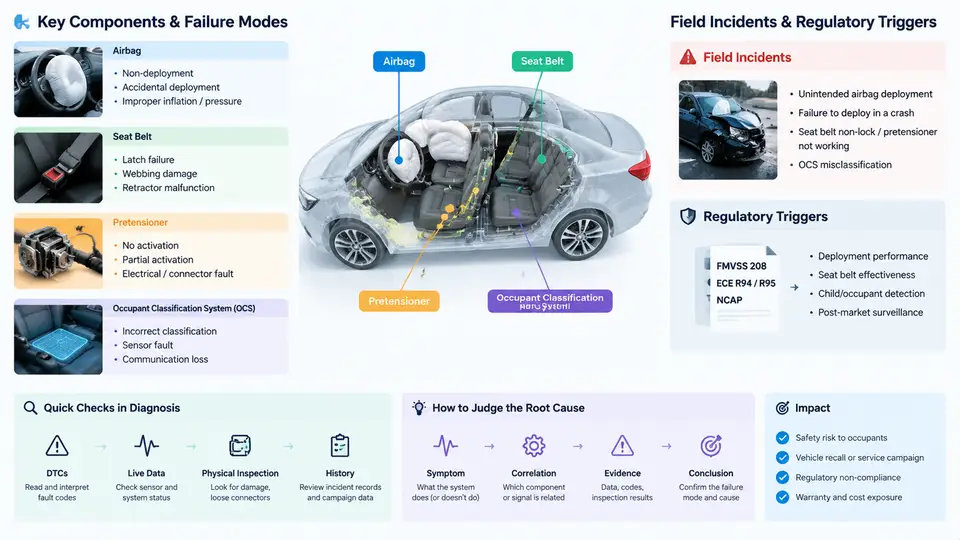
Automotive restraint programs rarely fail because a single component breaks. They fail when a failure mode, a field incident pattern, and a regulatory trigger converge faster than the organization can respond. This chapter establishes the crisis landscape for four core subsystems — airbags, seat belts, pretensioners, and occupant classification systems (OCS) — and shows how each generates a distinct class of program emergency.
The practical value of this framing is diagnostic speed. When a field signal arrives, the first question is not "what is broken?" but "which subsystem class does this belong to, and which regulatory clock has started?" Those two answers determine the response team, the containment strategy, and the reporting obligation.
Failure Mode Taxonomy by Subsystem
Each restraint subsystem has a characteristic failure signature. Recognizing the signature early prevents misrouting the issue to the wrong engineering team.
| Subsystem | Dominant Failure Modes | Typical Field Symptom | Regulatory Exposure |
|---|---|---|---|
| Frontal airbag (driver/passenger) | Inflator over-pressure, propellant degradation, connector corrosion, clock spring open circuit | Airbag warning lamp, no-deploy in crash, inadvertent deploy, metal fragment ejection | FMVSS 208, defect investigation, recall |
| Seat belt assembly | Retractor lock failure, webbing abrasion, buckle latch release under load, anchor bolt torque loss | Belt fails to restrain in crash, buckle opens, excessive spool-out | FMVSS 209, FMVSS 210 |
| Pretensioner | Pyrotechnic initiator no-fire, gas generator seal breach, cable/piston jam, premature activation | No belt tensioning in crash, unexpected bang and belt lock at startup | FMVSS 208 (occupant protection), FMVSS 209 |
| Occupant Classification System | Pressure/bladder sensor drift, capacitive mat delamination, ECU calibration mismatch, seat foam replacement without recalibration | Passenger airbag suppressed with adult occupant, or enabled with child seat present | FMVSS 208 suppression logic, TREAD Act reporting |
Note that OCS failures are uniquely dangerous because they are silent. A suppressed airbag produces no warning to the occupant in many architectures, and the failure only manifests in a crash. This makes OCS the highest-priority subsystem for field-data surveillance.
From Failure Mode to Field Incident
A failure mode becomes a field incident when three conditions align: the failure occurs in the installed population, it produces an observable or reportable event, and the event rate exceeds the noise floor of normal warranty data. The transition is not instantaneous, and the delay between first occurrence and organizational awareness is where most programs lose control.
Consider a representative scenario. A pretensioner initiator supplier changes a pyrotechnic charge lot. Units built between two date codes exhibit a no-fire rate of approximately 1 in 4,000 in bench testing, versus a baseline of 1 in 500,000. In the field, this manifests as crash reports where the belt pretensioner did not fire. Because pretensioner function is not directly observable by the driver, the first signal is typically a NHTSA Early Warning Report (EWR) field report or a plaintiff attorney's crash reconstruction — not a warranty claim.
The engineering response requires reconstructing the build population. Using the vehicle identification number (VIN) range associated with the suspect lot, the team queries production records to determine the installed base. If the suspect lot spans 60,000 vehicles and the observed no-fire rate is 1 in 4,000, the expected field failures are approximately 15 units. That number, combined with the safety-critical nature of the function, is sufficient to trigger a Part 573 defect report.
Regulatory Triggers and Reporting Clocks
Regulatory triggers are not uniform. Each has a distinct clock, a distinct reporting channel, and a distinct consequence for late or incomplete response.
- Part 573 Defect Report: Must be filed within 5 working days of determining that a safety-related defect exists. The clock starts at the determination, not at the first field report.
- Part 579 Early Warning Reporting: Quarterly submission of field reports, warranty claims, and property damage claims. Late or missing submissions carry civil penalties.
- FMVSS noncompliance: If a test failure indicates noncompliance with FMVSS 208, 209, or 210, the manufacturer must notify NHTSA within 5 working days and initiate a recall.
- TREAD Act obligations: Expanded reporting for tire and restraint systems, including foreign campaign reporting.
The critical operational point is that the 5-working-day clock is triggered by an internal determination, not by an external inquiry. Organizations that wait for NHTSA to open an investigation before filing have already lost the compliance window.
Incident Signal Flow and Decision Points
The following diagram maps how a raw field signal propagates through the organization and where the regulatory clock starts. It is not a generic process flow — it shows the specific decision nodes where a restraint program either contains the issue or escalates into a full crisis.
The diagram shows two feedback loops that matter operationally. The first is the field data feedback loop from recall back to triage — returned parts and claim rates refine the population estimate and can expand the recall scope. The second is the dashed loop from field data back to triage, which represents continuous surveillance. Programs that treat the Part 573 filing as the end of the process rather than the beginning of a data-collection phase consistently underestimate final recall scope.
Practical Triage: A Worked Example
Suppose an OCS supplier reports that a capacitive seat mat production lot exhibits a drift of 15% in capacitance reading after 500 thermal cycles. The specification allows ±5%. The suspect lot was installed in 12,000 vehicles across two model lines.
The triage team must answer three questions before the 5-day clock is evaluated:
- Does the drift cause a suppression logic error? If the drifted reading falls below the child-presence threshold, the passenger airbag will be suppressed for an adult occupant. This is a safety defect.
- Is the drift detectable by the occupant? In most architectures, no. The OCS warning lamp only illuminates on circuit fault, not on calibration drift. This raises severity.
- What is the field exposure? 12,000 vehicles, with an estimated 60% adult passenger occupancy rate, yields approximately 7,200 vehicles where the failure mode is safety-relevant.
Given a confirmed suppression error in bench testing and a safety-relevant population of 7,200, the determination is a safety defect. The Part 573 report is filed, and the recall remedy is a seat mat replacement with recalibration. The engineering team simultaneously initiates a design change to the mat specification and a supplier audit of the thermal cycle test protocol.
Why This Landscape Matters
The four subsystems share a common crisis dynamic: a latent failure mode, a silent or delayed field manifestation, and a regulatory clock that starts before the organization feels urgency. Airbag inflator failures, seat belt retractor lock failures, pretensioner no-fires, and OCS calibration drift all follow this pattern. The difference between a contained issue and a program crisis is almost always the speed of triage and the willingness to make a safety defect determination on engineering evidence rather than field fatalities.
The next chapter examines how these failure modes are detected in the field — the data sources, the signal thresholds, and the statistical methods used to distinguish a real defect trend from normal warranty noise.