1. Introduction to reduced order modeling i
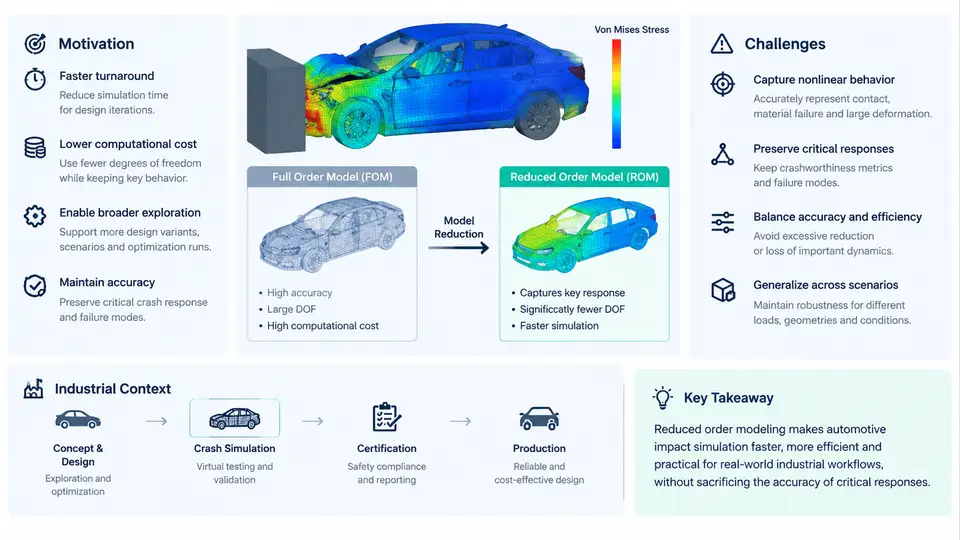
Full-vehicle crash simulation is one of the most computationally expensive activities in automotive engineering. A single frontal offset deformable barrier (ODB) run on a detailed finite element (FE) model with 8–15 million elements, explicit time integration, and a 150 ms physical event typically consumes 12–30 hours on 200–500 CPU cores. When a program must evaluate hundreds of design variants — thickness sweeps, material grades, joint layouts, battery-pack enclosures — the cost of running every configuration in full fidelity becomes prohibitive. Reduced order modeling (ROM) addresses this bottleneck by constructing a compact mathematical surrogate that reproduces the dominant input–output behavior of the high-fidelity model at a fraction of the cost.
This chapter establishes why ROM matters in the crash domain, what makes crash problems unusually difficult for reduction techniques, and how ROM fits into the industrial CAE workflow alongside physical testing and full-FE simulation.
Why Crash Simulation Needs Surrogates
Crashworthiness development is fundamentally a many-query problem. A typical body-in-white (BIW) optimization loop may involve:
- Design variables: 20–80 thickness and material parameters across front rail, shotgun, bumper beam, B-pillar, rocker, and floor members.
- Responses of interest: intrusion at pedal box and toe pan, steering column rearward displacement, chest deceleration (g), HIC, femur loads, and battery enclosure deformation.
- Constraint set: regulatory and consumer-test criteria (FMVSS 208, Euro NCAP, C-NCAP) plus internal targets.
A single design-of-experiments (DOE) campaign with 200 samples at 20 hours per run equals roughly 4,000 core-hours per sample set — before any optimization iterations. Surrogate models trained on a well-chosen DOE can evaluate a new design point in milliseconds to seconds, enabling gradient-free optimizers, Monte Carlo robustness studies, and real-time design-space exploration.
What Makes Crash Problems Hard to Reduce
Linear modal reduction, which works well for NVH and durability, breaks down in crash because the physics is fundamentally different:
| Characteristic | NVH / Durability | Crash / Impact |
|---|---|---|
| Response regime | Small strain, linear elastic | Large strain, plastic, strain-rate dependent |
| Dominant physics | Modal superposition | Contact, folding, rupture, buckling |
| Time integration | Implicit, steady-state | Explicit, transient, 1–2 µs steps |
| Solution manifold | Low-dimensional, smooth | High-dimensional, discontinuous (contact on/off) |
| Parametric dependence | Often weakly nonlinear | Strongly nonlinear, topology-changing |
Three specific challenges dominate:
- Contact nonlinearity. As members fold, contact interfaces appear and disappear, producing non-smooth force–displacement curves. A reduced basis built from a few snapshots may miss a folding mode that only activates at a particular thickness combination.
- Material nonlinearity and failure. Mild steel, AHSS, aluminum extrusions, and CFRP each exhibit different hardening, strain-rate sensitivity, and failure strain. Surrogates must interpolate across material grades without violating physical bounds.
- High-dimensional parametric space. With 40+ design variables, the number of training samples needed for a global surrogate grows rapidly. Naive space-filling DOE becomes impractical, motivating adaptive sampling and multi-fidelity strategies.
Where ROM Sits in the Industrial Workflow
In practice, ROM is not a single technique but a family of methods deployed at different stages. The diagram below shows the typical data and decision flow from CAD through full-FE simulation to surrogate-based optimization and final verification.
Industrial Context and Adoption Drivers
Three industry trends are accelerating ROM adoption in crash engineering:
- Electrification. Battery electric vehicle (BEV) platforms introduce large, stiff battery enclosures that fundamentally alter crash load paths. The design space is new, and OEMs cannot rely on legacy intuition — surrogates help explore it quickly.
- Shortened development cycles. Vehicle programs that once allowed 48 months now target 24–30 months. Simulation throughput must increase without proportional hardware investment.
- Regulatory and rating complexity. Euro NCAP now includes far-side occupant protection, post-crash battery integrity, and vulnerable road user (VRU) scenarios. Each adds simulation load cases that multiply the DOE size.
Typical industrial ROM applications include:
| Application | Typical Inputs | Typical Outputs | Speedup vs. Full FE |
|---|---|---|---|
| Front rail thickness optimization | 6–12 gauge variables | Intrusion, force–displacement | 10³–10⁵× |
| Battery pack enclosure design | Material, rib layout, thickness | Deformation, intrusion, stress | 10²–10⁴× |
| Occupant restraint tuning | Airbag pressure, belt limit, pretensioner | HIC, chest g, femur load | 10²–10³× |
| Pedestrian head impact | Hood thickness, inner panel geometry | HIC, deflection | 10³–10⁴× |
Key Terminology and Scope of This Course
Before proceeding, align on the vocabulary used throughout:
- High-fidelity model (HFM): The full FE model solved by an explicit crash code. Treated as ground truth for ROM training and validation.
- Snapshot: A single HFM solution (e.g., nodal displacements, section forces) at one design point and time step.
- Reduced basis: A low-dimensional subspace (e.g., from proper orthogonal decomposition, POD) that captures dominant spatial patterns.
- Surrogate / metamodel: A regression or interpolation model (kriging, radial basis function, polynomial chaos, neural network) mapping design variables to responses.
- Projection-based ROM: A method that projects the governing equations onto a reduced basis (e.g., POD-Galerkin), as opposed to purely data-driven surrogates.
- Non-intrusive ROM: A method that treats the solver as a black box and builds the surrogate from input–output data only.
This course covers both projection-based and non-intrusive approaches, with emphasis on crash-specific challenges: contact, material failure, and high-dimensional parametric spaces. Later chapters address snapshot generation, basis construction, surrogate training, error estimation, and industrial deployment.
The next chapter examines the mathematical foundations of model reduction, starting with proper orthogonal decomposition and its application to transient crash response data.