1. Crash pulse fundamentals for vehicle saf
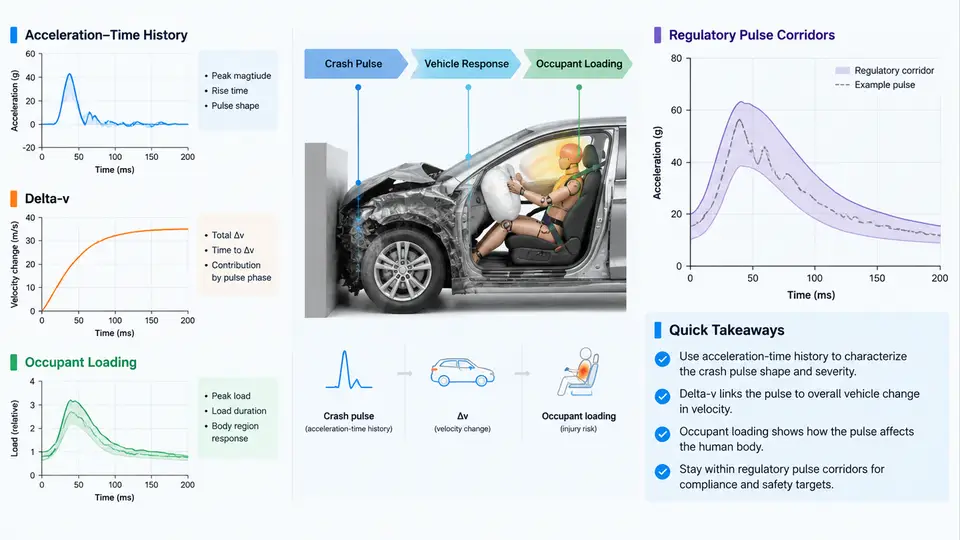
Every occupant-protection decision in a vehicle program ultimately traces back to one physical quantity: the acceleration–time history experienced by the body structure during a collision. This history, called the crash pulse, is the bridge between the barrier test event and everything the restraint system must accomplish. Engineers who understand the pulse can predict occupant loading, size airbags, tune load limiters, and judge whether a design will satisfy regulatory corridors — often before a single physical sled test is run.
Acceleration–Time History and the Sign Convention
A crash pulse is a time-domain record of vehicle acceleration measured at a rigid point on the body, typically the B-pillar base or the rocker, during a barrier impact. The standard convention used throughout this course is: positive acceleration points opposite to the direction of travel, meaning a vehicle moving forward and decelerating in a frontal impact produces a positive pulse. This is the SAE J211 / ISO 6487 convention, and it must be stated explicitly whenever data is exchanged, because a reversed sign silently inverts every downstream calculation.
A typical frontal pulse has three recognizable phases. The initial rise lasts 5–15 ms as the bumper, crush cans, and front rails begin to deform. The primary plateau follows, where the main longitudinal members collapse in a controlled manner and acceleration holds relatively steady. Finally, the rebound and settling phase occurs as stored elastic energy pushes the vehicle backward, producing a negative acceleration tail. The shape of the plateau — its level, duration, and smoothness — determines how much force reaches the occupant through the restraint system.
Pulses are captured with accelerometers and processed per SAE J211 Channel Filter Class (CFC). CFC 60 is standard for vehicle structure; CFC 180 is used for occupant responses. Filter class matters: an unfiltered or wrongly filtered pulse can show spikes that do not represent real structural behavior and will mislead any corridor comparison.
Delta-v: The Integrated Quantity That Governs Severity
Delta-v is the change in velocity of the vehicle over the crash event, obtained by integrating the acceleration–time history:
delta_v = ∫ a(t) dt   (over the crash duration)

Example (frontal rigid barrier, 56 km/h = 15.56 m/s):
  If the pulse integrates to 15.56 m/s over ~100 ms,
  the vehicle has come to rest relative to the barrier.
  A 40 km/h (11.11 m/s) offset test integrates to 11.11 m/s.
Delta-v is the single most useful scalar for comparing crash severity. Two pulses with identical delta-v but different durations produce very different occupant outcomes: a short, high-magnitude pulse delivers the same velocity change in less time, demanding higher restraint forces and generating higher occupant accelerations. This is why a 56 km/h rigid barrier test and a 64 km/h offset deformable barrier test are not interchangeable even though their nominal speeds are close — the offset test concentrates deformation on one side and changes both the pulse shape and the effective delta-v experienced by the occupant compartment.
Occupant Loading: How the Pulse Reaches the Body
The occupant does not experience the vehicle pulse directly. The pulse is transmitted through the seat, belt, airbag, and knee bolster — a chain of compliance and force limiting. The occupant's own acceleration history is therefore a filtered, delayed version of the vehicle pulse. Three mechanisms dominate:
- Belt loading: The lap and shoulder belts apply force to the pelvis and chest. A load limiter allows the belt to pay out at a controlled force (commonly 3–5 kN), trading ride-down distance for reduced chest deflection.
- Airbag interaction: The airbag must deploy before the occupant moves forward significantly. Timing is set relative to the pulse's initial rise; a late deployment means the occupant contacts a partially inflated bag or the steering wheel.
- Ride-down: The longer the occupant decelerates, the lower the peak force. The pulse plateau duration sets the available ride-down time; a short pulse leaves little room for restraint tuning.
In practice, engineers evaluate occupant loading with a sled test that reproduces the vehicle pulse on a test buck. The sled acceleration is programmed to match the target pulse, and the dummy's head, chest, and pelvis responses are measured. If chest deflection exceeds the injury assessment reference value (IARV), the fix is usually a combination of load limiter force reduction, airbag vent tuning, or seat geometry change — not a change to the vehicle pulse, which is fixed by the structure.
Regulatory Pulse Corridors
Regulations do not specify a single pulse; they define a corridor — an envelope of acceptable acceleration–time histories. FMVSS 208 (US) and ECE R94/R95 (Europe) establish corridors for frontal and side impacts respectively. A corridor is bounded by upper and lower acceleration limits at each time point, and a candidate pulse must stay inside both bounds throughout the event.
| Parameter | Typical Frontal Corridor Value | Design Implication |
|---|---|---|
| Peak acceleration | ~40–60 g (vehicle structure) | Limits rail crush force; higher peaks raise occupant loads |
| Pulse duration | ~80–120 ms to rest | Sets available ride-down time |
| Delta-v | Matches test speed (e.g., 15.56 m/s at 56 km/h) | Fixed by regulation; cannot be reduced |
| Corridor width | Narrow at early rise, wider at plateau | Early timing is critical for airbag deployment |
The corridor concept is powerful because it allows different structural designs to satisfy the same regulation. A vehicle with a stiff front end and short crush zone may produce a high, short pulse; a vehicle with a long, soft crush zone produces a lower, longer pulse. Both can pass if they stay within the envelope and keep occupant responses below IARVs. The corridor is therefore a design space, not a target curve.
Reading a Pulse: A Worked Example
Suppose a frontal sled pulse is measured with CFC 60 and shows a peak of 48 g at 35 ms, a plateau of roughly 30 g from 40–80 ms, and a negative rebound of −8 g from 85–110 ms. Integrating the positive portion yields approximately 15.5 m/s, consistent with a 56 km/h test. The plateau duration of 40 ms gives the restraint system a ride-down window; if the dummy chest deflection is high, the engineer can reduce the load limiter from 4.5 kN to 3.5 kN and re-run the sled, expecting lower chest deflection but slightly greater occupant excursion. This iterative loop — pulse, occupant response, restraint adjustment — is the daily work of crash safety design.
Practical Takeaways for Design Work
Three habits separate effective crash pulse work from guesswork. First, always state and verify the sign convention and filter class before using any pulse data. Second, treat delta-v as the invariant: if your integrated delta-v does not match the test speed, stop and find the error before proceeding. Third, remember that the corridor is a design space — your job is not to match a single curve but to place your structure and restraints inside the envelope while keeping occupant responses below IARVs. The pulse is the language your structure speaks to the occupant; learning to read it fluently is the foundation of everything that follows in this course.