1. Side impact restraint calibration scope
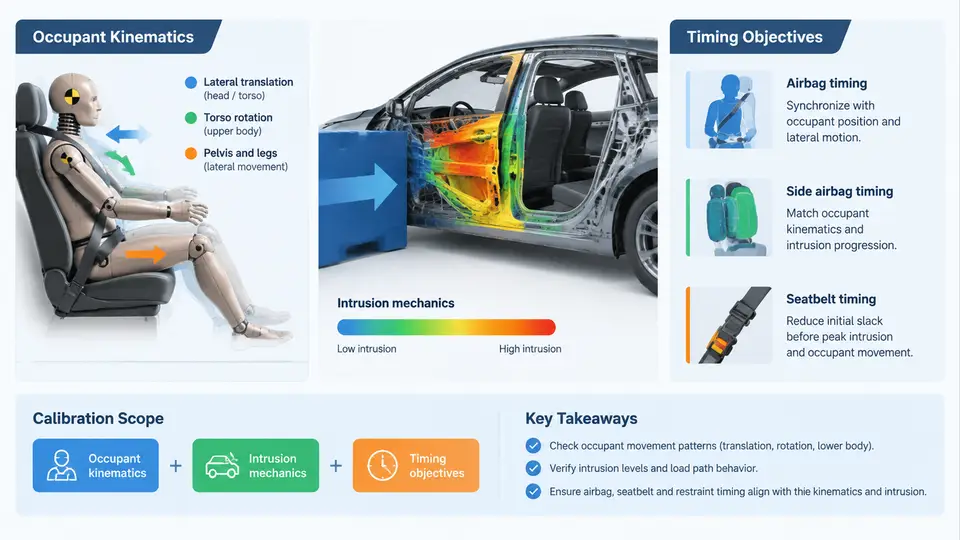
Side impact restraint calibration sits at the intersection of three physical domains that evolve simultaneously within a few tens of milliseconds: the occupant's free-flight kinematics, the deforming door and B-pillar structure that intrudes into the occupant's survival space, and the restraint deployment timing that must place energy-absorbing hardware between the occupant and that intruding structure. Unlike frontal calibration, where a long crush zone and generous ride-down distance give the restraint engineer hundreds of milliseconds of latitude, a side impact offers roughly 20–50 ms from impact to peak occupant loading. Every calibration decision — sensor threshold, deployment time, bag pressure, thorax coverage — is compressed into that window. This chapter defines the calibration scope: what the engineer is actually solving for, which physical quantities matter, and how the three domains constrain one another.
The Three Coupled Domains
Occupant kinematics describes how the occupant's body moves relative to the vehicle interior once the struck-side structure begins to accelerate. In a moving deformable barrier (MDB) test at 50 km/h with a 27° crab angle, the struck vehicle is pushed laterally; the occupant, restrained only by friction and the seat, initially stays nearly stationary in inertial space while the door panel closes on them. The critical kinematic quantities are lateral excursion of the pelvis, thorax, and head relative to the door trim, and the velocity at which the thorax approaches the intruding surface. A typical mid-size sedan in a FMVSS 214-style MDB test shows 150–250 mm of thorax-to-door gap closure within the first 40 ms.
Intrusion mechanics governs how much of that gap is consumed by structure rather than occupant motion. The door outer panel, intrusion beam, and B-pillar form a load path that either resists the barrier or folds inward. Intrusion velocity at the door trim — not just peak displacement — drives injury risk, because a door moving at 8–12 m/s into a stationary thorax produces far higher chest deflection than the same door reaching 200 mm of static intrusion slowly. Calibration engineers therefore track intrusion velocity profiles, not only the final deformed shape.
Timing objectives translate the first two domains into a deployment schedule. The airbag or side curtain must be fully inflated and pressurized before the thorax arrives at the trim surface, but not so early that it has already vented or been pushed aside by the intruding door. The usable window is often only 5–15 ms wide.
What the Calibration Engineer Actually Solves
The calibration problem can be stated as a constrained optimization: minimize occupant injury metrics (chest deflection, V*C, rib deflection, head HIC) subject to the physical constraints imposed by the intrusion profile and the actuator response time. The decision variables are the sensor algorithm threshold and arming time, the inflator output (pressure vs. time), vent size, bag geometry and coverage, and — in some architectures — the seat-mounted thorax bag vs. curtain airbag split.
A practical calibration workflow begins with a baseline finite element (FE) model validated against a physical MDB test. The engineer extracts the intrusion velocity profile at the door trim at thorax height, then runs a simplified lumped-parameter occupant model to estimate the time available before contact. For a typical B-pillar intrusion velocity of 10 m/s and an initial gap of 180 mm, the time to contact is roughly 18 ms. Subtracting the sensor decision time (6–10 ms) and the inflator fill time (5–8 ms) leaves a margin that is often negative — which is why side airbags frequently use pressure-based or acceleration-based sensors with very fast trigger algorithms, and why some systems pre-arm based on seat occupancy and belt status.
Example calibration target set (illustrative, not measured):
- Sensor trigger time: ≤ 8 ms after barrier contact
- Bag full inflation: ≤ 15 ms after trigger
- Thorax contact with inflated bag: 18–22 ms after barrier contact
- Peak chest deflection: < 42 mm (Euro NCAP threshold)
- V*C: < 1.0 m/s
- Intrusion velocity at trim: < 12 m/s at thorax height
Intrusion Mechanics in Detail
Intrusion is not a single number. The engineer must characterize it as a function of height and time. At the sill level, the door beam and rocker panel absorb energy and limit intrusion. At thorax height (roughly 500–700 mm above the ground), the door outer panel and intrusion beam bend inward, and the trim surface moves toward the occupant. At head height, the B-pillar and roof rail govern. A calibration that works at thorax height may fail at pelvis height if the door trim geometry differs.
The key measurable is intrusion velocity, obtained from a string potentiometer or high-speed camera tracking on the door trim. A typical profile rises from zero to 8–12 m/s within 15–25 ms, then plateaus or decays as the barrier decelerates. The occupant's thorax, initially stationary, accelerates laterally once the bag or trim contacts it. The relative velocity between thorax and trim at the moment of contact determines the severity of the loading pulse.
Timing Objectives and Trade-offs
Timing is the most sensitive calibration variable because it is bounded on both sides. Deploy too late and the occupant strikes the trim or a partially inflated bag; deploy too early and the bag has already vented or been displaced by the intruding door. The usable window is typically 5–15 ms wide, and it shifts with barrier speed, occupant size (5th percentile female vs. 95th percentile male), and seat position.
Calibration engineers use a timing margin metric: the difference between bag full-inflation time and occupant contact time. A positive margin of 3–5 ms is generally targeted. To achieve this, the sensor algorithm must distinguish a side impact from a rough road event or a door slam within 6–10 ms — a challenging signal processing problem that drives the use of dual-axis accelerometers and pressure sensors in the door cavity.
Practical note: When calibrating, always verify the timing margin at the worst-case occupant position (closest to the door, typically a 5th percentile female in the forward-most seat track position). The nominal 50th percentile male may show a comfortable margin while the small occupant has none.
Scope Boundaries: What Is In and Out
This course focuses on the calibration of side impact restraint systems — airbags, curtains, and seat belts — as they interact with intrusion and timing. It does not cover structural design of the door beam or B-pillar (that is body-in-white engineering), nor does it cover the sensor hardware design itself. The calibration engineer takes the structure and sensor as given inputs and optimizes the restraint deployment to minimize injury within the available time and space.
The scope includes: occupant kinematics modeling and validation, intrusion profile characterization, sensor trigger algorithm tuning, inflator and vent calibration, bag geometry and coverage optimization, and the verification matrix across barrier speeds, occupant sizes, and seat positions. Each of these will be treated in subsequent chapters with specific methods, example parameters, and result interpretation.
Key Takeaways
- Side impact calibration is a three-domain problem: occupant kinematics, intrusion mechanics, and timing objectives are coupled and cannot be optimized independently.
- The usable deployment window is narrow (5–15 ms), bounded by late deployment (occupant strikes trim) and early deployment (bag vents before contact).
- Intrusion velocity at the trim, not just peak displacement, is the critical structural input to the calibration.
- Timing margin — bag full inflation minus occupant contact — should be positive by 3–5 ms at the worst-case occupant position.
- Calibration targets are injury metrics (chest deflection, V*C, HIC) constrained by physical actuator response and structural intrusion.