1. Course overview
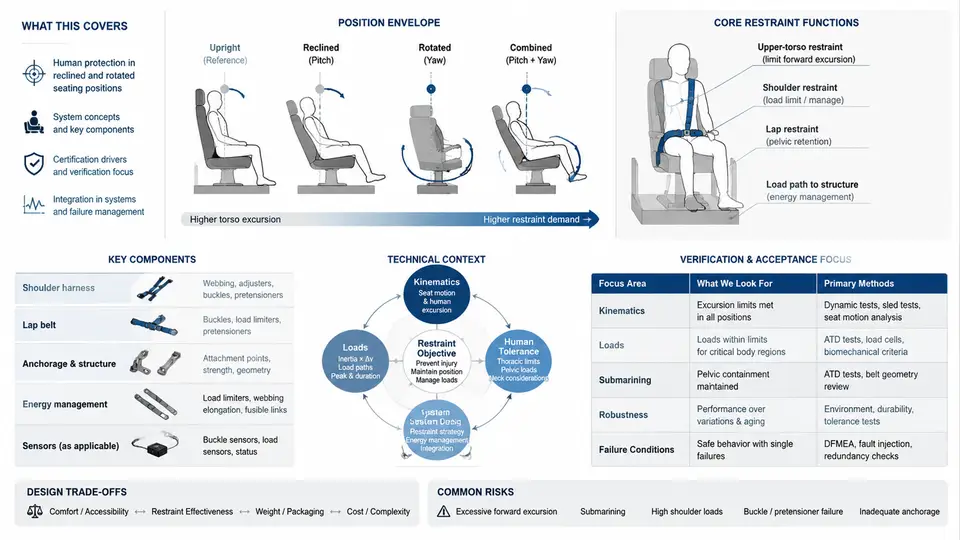
Modern vehicle interiors are moving away from the fixed, forward-facing bench. Long-wheelbase executive sedans, autonomous shuttles, camper vans, and premium MPVs now offer seats that recline far beyond the traditional comfort range and, in some concepts, rotate to face other occupants. Each of these postures changes how an occupant interacts with the restraint system, and those changes ripple through every downstream engineering decision: belt geometry, airbag deployment, seat structure, anchor strength, and the occupant-classification logic that decides when to fire a pyrotechnic device.
This course treats reclined and rotated seating positions as a single engineering problem space. A reclined position is one where the seat-back angle is significantly increased relative to the upright design position — typically beyond roughly 30–40° from vertical, and in extreme "lie-flat" concepts approaching 60–80°. A rotated position is one where the seat pan yaw is changed relative to the vehicle's longitudinal axis, commonly by 15–30° for comfort-oriented "conversation" modes and up to 180° for fully rear-facing or face-to-face layouts. The two can combine: a seat rotated 20° and reclined 45° is a distinct restraint case from either change alone.
Why the conventional restraint architecture stops working
A standard three-point belt is designed around an upright occupant whose torso is roughly perpendicular to the seat cushion. The lap portion loads the pelvis through the anterior superior iliac spines; the shoulder portion crosses the chest and routes the upper-body load into the retractor and anchor. That geometry depends on the occupant's torso being close to the belt path and on the belt being able to "ride down" the occupant against a controlled force.
When the seat-back reclines, the shoulder belt tends to lift off the chest and migrate toward the neck or the abdomen. The lap belt can slide upward over the pelvis, a phenomenon known as submarining, because the pelvis rotates under the belt rather than loading it. When the seat rotates, the belt anchor points no longer align with the occupant's loading directions, and the retractor may lock in an orientation for which it was not validated. In a rotated, reclined seat, the occupant's head and torso may also be outside the deployment corridor of a frontal airbag, so the airbag can strike the occupant before it has fully inflated — the classic "out-of-position" (OOP) problem.
The scope of this course
The course covers the full engineering chain, from regulatory and consumer-test context through concept selection, detailed design, simulation, and validation. The chapters are organized so that a reader can move from understanding the problem to producing a defensible design. The main technical threads are:
- Occupant kinematics and injury criteria. How the body moves in a reclined or rotated posture during a crash, and which injury metrics (HIC, chest deflection, Nij, femur load) remain meaningful.
- Belt geometry and anchor placement. How to route a three- or four-point belt so that it stays on the pelvis and chest across the full range of recline and rotation.
- Airbag and adaptive restraint strategies. Dual-stage inflators, venting, tethering, and seat-integrated airbags that can accommodate a moving occupant.
- Seat structure and anchorage. Load paths through the recliner, the seat pan, and the floor anchors, including the strength requirements for rotated seats.
- Sensing and decision logic. Occupant classification, seat-position sensing, and the arbitration that decides deployment level.
- Simulation and physical validation. Sled testing, component tests, and the role of CAE in narrowing the design space.
The course does not attempt to reproduce the full text of FMVSS 208, ECE R94/R16, or Euro NCAP protocols. Instead, it uses those documents as the boundary conditions that define what a design must ultimately satisfy, and focuses on the engineering reasoning that connects a seating concept to a compliant restraint system.
Technical context: standards, ratings, and the moving target
Regulation has historically assumed a forward-facing, upright occupant. FMVSS 208 defines test procedures with the seat in its design position; ECE R16 addresses belt anchorage strength for seats in their normal configuration. Neither framework was written for a seat that rotates 180° or reclines to 60°. This creates a gap: a manufacturer may build a rotated seat that is comfortable and structurally sound, yet have no directly applicable regulatory test to demonstrate restraint performance.
In practice, engineers close this gap in three ways. First, they apply the intent of existing requirements — for example, maintaining belt-to-pelvis contact under a 50th-percentile male load case — to the new posture. Second, they use consumer-rating programs and internal targets to define additional test matrices. Third, they rely on CAE and sled testing to explore postures that no published protocol covers. The result is a design process that is more exploratory than the traditional "test to the standard" approach.
| Posture change | Primary restraint concern | Typical engineering response |
|---|---|---|
| Recline 30–45° | Shoulder belt lift-off, submarining | Belt routing guides, anti-submarining ramp, pretensioner tuning |
| Recline > 45° | Occupant out of airbag corridor, high chest deflection | Seat-integrated airbag, adaptive venting, four-point belt |
| Rotate 15–30° | Anchor misalignment, retractor orientation | Re-oriented anchors, seat-integrated retractor, load-limiting belt |
| Rotate 90–180° | No frontal airbag coverage, rear-impact exposure | All-direction airbag, structural seat back, revised anchor strength |
The table above is a simplified map, not a design rule. Real programs combine these responses, and the correct choice depends on the vehicle architecture, the seat's structural interface, and the occupant population the vehicle must protect.
How the system behaves: a signal-and-load view
It helps to think of the restraint system as two coupled chains. The sensing chain observes the occupant and the seat: seat-track position, seat-back angle, seat yaw, occupant weight and presence, and crash severity from the ECU's accelerometers. The actuation chain converts those observations into belt pretension, belt load limiting, and airbag deployment level. In a reclined or rotated seat, both chains gain new states, and the arbitration logic must decide not only whether to deploy but how much and in what sequence.
The diagram shows why a reclined or rotated seat cannot be treated as a simple extension of the upright case. The sensing chain must resolve additional states (yaw, recline, and their combination), the arbitration logic must select among more deployment modes, and the actuation chain must be capable of delivering different outputs for the same crash severity depending on posture. The dashed feedback path represents the adaptive loop used in some advanced systems, where the seat state and occupant response inform subsequent restraint stages.
What a reader should be able to do after this course
By the end of the course, a reader should be able to take a seating concept — say, a second-row seat that reclines to 50° and rotates 25° — and produce a defensible restraint architecture. That means being able to:
- Identify the dominant occupant-kinematics risks for that posture and map them to injury criteria.
- Select a belt configuration and anchor layout that maintains pelvis and chest contact across the posture range.
- Specify airbag type, volume, and deployment strategy consistent with the occupant's expected position.
- Define the sensing and arbitration requirements, including failure modes and degradation behavior.
- Plan a validation matrix that combines CAE, sled, and component tests, and interpret the results against regulatory and internal targets.
The remainder of the course builds on this foundation. The next chapters examine occupant kinematics in detail, then move through belt geometry, airbag strategy, seat structure, sensing, and validation. Each chapter uses concrete examples and, where useful, worked calculations or test matrices that can be adapted to a real program. The goal is not to prescribe a single solution, but to give the reader the tools to reason about a posture that the existing rulebook does not fully describe.