1. Restraint system optimization landscape
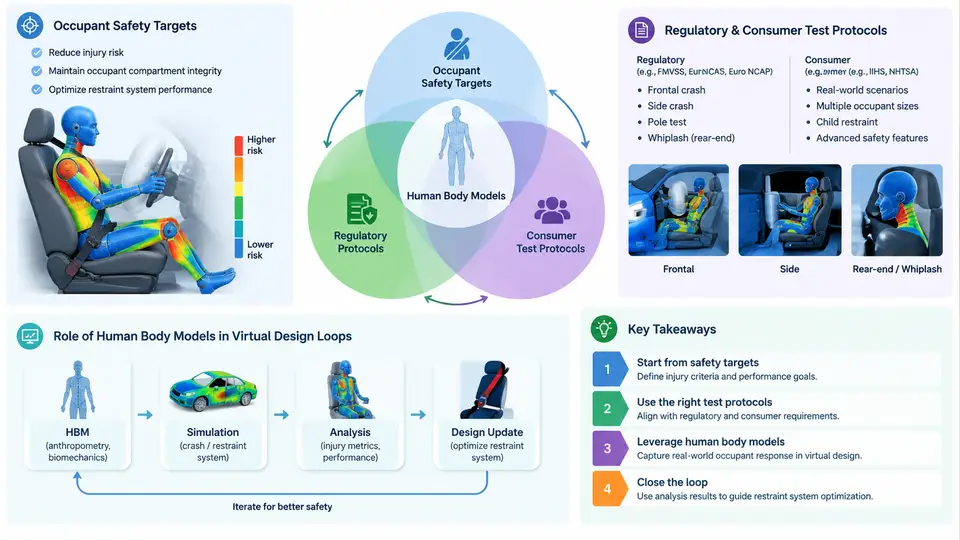
Restraint system optimization sits at the intersection of three forces: the injuries we are trying to prevent, the test protocols that define acceptable performance, and the engineering tools we use to predict that performance before a physical prototype exists. A restraint system — seat belts with load limiters and pretensioners, airbags, seat structures, and increasingly seat-integrated and adaptive devices — must satisfy all three simultaneously. Human body models (HBMs) have become the connective tissue that lets engineers explore this space virtually rather than through trial-and-error sled testing.
Occupant Safety Targets
Safety targets are expressed as measurable injury criteria, not vague goals. The most common are:
- HIC15 — Head Injury Criterion over a 15 ms window, derived from resultant head acceleration. A common design target is HIC15 < 700 for a 50th-percentile male in a frontal crash.
- Nij — Neck Injury Criterion combining axial force and bending moment; typically Nij < 1.0.
- Chest deflection and VC — Chest compression (e.g., < 50 mm) and Viscous Criterion (VC < 1.0 m/s).
- Femur force — Axial femur load, often < 10 kN.
- Pelvis and abdomen — Pressure or deflection limits depending on the loading mode.
These criteria are not independent. A stiffer belt reduces chest deflection but raises neck load; a softer load limiter lowers chest force but increases forward excursion and head contact risk. Optimization is therefore a multi-objective trade study, and the HBM is the instrument that reveals those trade-offs.
Regulatory and Consumer Test Protocols
Two families of protocols dominate. Regulatory tests (FMVSS 208 in the US, ECE R94/R95 in Europe, GB 11551 in China) define pass/fail thresholds using Anthropomorphic Test Devices (ATDs) — primarily the Hybrid III 50th-percentile male and, increasingly, the THOR dummy. Consumer tests (Euro NCAP, C-NCAP, IIHS, NHTSA NCAP) go further: they use multiple occupant sizes, offset and oblique impacts, and star ratings that directly influence market perception.
The practical consequence is that a restraint system must be tuned across a matrix of load cases, not a single crash pulse. A typical frontal matrix might include:
| Load Case | Occupant | Key Metric |
|---|---|---|
| Full frontal 56 km/h | HIII 50M | HIC15, chest defl. |
| Offset deformable 64 km/h | HIII 50M | Chest VC, femur |
| Oblique 32 km/h | THOR 50M | Nij, chest |
| Far-side lateral | HIII 5F | Head excursion |
Each cell demands a different restraint response. The ATD, however, is a rigid, biofidelic approximation — it cannot predict soft-tissue injury or capture occupant variability. This is precisely where HBMs enter.
The Role of Human Body Models in Virtual Design Loops
An HBM is a finite-element representation of human anatomy — skeleton, organs, ligaments, and soft tissue — with material properties derived from cadaver and volunteer testing. The THUMS and GHBMC families are the most widely used. Unlike an ATD, an HBM can be morphed to represent different statures, ages, and body compositions, and it outputs tissue-level metrics such as strain, stress, and organ deformation.
In a virtual design loop, the HBM replaces or supplements the ATD in the CAE model. The workflow is iterative:
- Define the design space — belt anchor positions, load limiter force, pretensioner timing, airbag vent size and pressure.
- Build the CAE model — sled or full-vehicle FE model with the HBM positioned per the protocol.
- Run the simulation — solve for occupant kinematics and injury metrics.
- Evaluate against targets — compare HIC15, Nij, chest deflection, etc. to thresholds.
- Adjust and repeat — use DOE or optimization algorithms to converge on a robust design.
The key advantage is that the HBM captures occupant variability that the ATD cannot. A restraint system optimized only for the 50th-percentile male may perform poorly for a 5th-percentile female or a 95th-percentile male. By running the HBM across a morphometric range, engineers can identify designs that are robust across the population — a requirement increasingly embedded in consumer protocols.
Why the Landscape Matters
Understanding this landscape prevents a common failure mode: optimizing against a single metric or a single occupant. A restraint system that achieves HIC15 = 600 for the 50M may produce Nij > 1.2 for a smaller occupant if the load limiter is too stiff. The HBM reveals this because it models the neck as a deformable structure, not a rigid link. Similarly, a design that passes FMVSS 208 may still score poorly in Euro NCAP's oblique test, where the belt interacts with the shoulder differently.
The optimization loop therefore must be framed as a multi-objective, multi-occupant, multi-load-case problem. The HBM is not a replacement for the ATD — it is a complementary tool that extends the design space into regions the ATD cannot reach. The rest of this course builds the practical skills to run that loop: model setup, positioning, material calibration, DOE, and robustness assessment.
The diagram above summarizes the loop: safety targets and test protocols define the problem; the HBM evaluates candidate designs; design parameters are adjusted; and the cycle repeats until the restraint system meets all criteria across the occupant matrix. In the chapters that follow, each element of this loop is developed in detail — from model setup and positioning to optimization algorithms and robustness assessment.