1. Frontal restraint calibration across mul
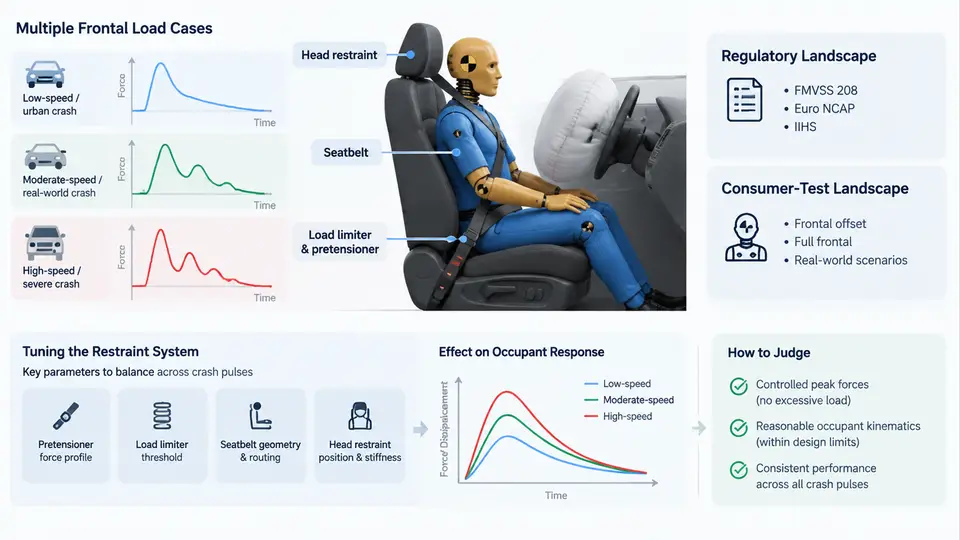
Frontal restraint calibration is the discipline of shaping how airbags, seat belts, pretensioners, load limiters, and seat structures deploy and absorb energy during a frontal impact. The defining difficulty of this course is stated in its title: a single production restraint system must perform well across multiple crash pulses — not one idealized barrier test. A vehicle that scores perfectly in a 56 km/h full-frontal rigid-barrier test may still produce excessive chest deflection in a 64 km/h offset deformable-barrier test, or fail to fire the second-stage inflator early enough in a 25 km/h rigid-pole impact. This chapter establishes the scope of the course, maps the regulatory and consumer-test landscape that defines the target pulses, and frames the core engineering problem: how to tune one set of restraint parameters so that occupant injury metrics stay inside their corridors across a diverse family of frontal load cases.
Why "Multiple Pulses" Is the Central Problem
A crash pulse is the vehicle's deceleration-versus-time history measured at a structural location (typically the B-pillar base or tunnel) during an impact. Its shape — peak deceleration, duration, rise time, and total velocity change (delta-v) — determines how much kinetic energy the restraint system must manage and how quickly the occupant begins to move relative to the vehicle interior. Different frontal test configurations produce fundamentally different pulses:
- Full-frontal rigid barrier (FRB): the entire vehicle front engages a fixed wall. The pulse is short and severe, with high peak deceleration and a large delta-v. Both sides of the restraint system see nearly symmetric loading.
- Offset deformable barrier (ODB): only part of the front structure crushes against a deformable honeycomb element. The pulse is longer and lower in peak, but the vehicle may yaw, and the occupant loads the belt and airbag asymmetrically.
- Angled / oblique impacts: the barrier or moving deformable barrier strikes at an angle, introducing lateral occupant motion and belt-slippage effects that a purely longitudinal pulse does not excite.
- Rigid pole: a narrow, stiff object concentrates loading, producing a sharp local pulse and often a late or weak airbag trigger if the sensor path is not tuned for it.
- Low-speed / no-fire cases: below the deployment threshold, the belt alone must manage the occupant, and the calibration must avoid unnecessary airbag deployment.
The restraint engineer therefore cannot optimize for a single pulse. Every change to inflator output, vent size, tether length, load-limiter force, or pretensioner timing that improves one case can degrade another. This trade-off space is the subject of the entire course.
Regulatory and Consumer-Test Landscape
Calibration targets come from two overlapping sources: government regulations that set minimum legal performance, and consumer-test programs that award star ratings and drive market perception. The table below summarizes the principal frontal programs a global restraint engineer must typically satisfy. Values are representative of current practice and should be verified against the latest published protocol for any specific program year.
| Program | Typical frontal configuration | Primary occupant metrics | Calibration implication |
|---|---|---|---|
| FMVSS 208 (US) | Full-frontal rigid barrier, 56 km/h; plus offset and unbelted variants | HIC, chest deflection, femur load, neck | Must protect unbelted occupants; drives aggressive airbag output |
| ECE R94 / R137 (EU) | Offset deformable barrier, 64 km/h | HIC, chest deflection, chest acceleration | Belt-dominated loading; load limiter and pretensioner critical |
| Euro NCAP frontal | Mobile progressive deformable barrier (MPDB), 50 km/h, 50% overlap | HIC, chest, compatibility (MDB deformation) | Adds compatibility scoring; penalizes overly stiff front structures |
| C-NCAP frontal | Full-frontal rigid barrier 50 km/h + MPDB 50 km/h | HIC, chest, pelvis, compatibility | Dual-pulse requirement in one vehicle |
| IIHS moderate overlap | 40% overlap deformable barrier, 64 km/h | HIC, chest, femur, lower leg | Asymmetric loading; seat and belt geometry matter |
| IIHS small overlap | 25% overlap rigid barrier, 64 km/h | HIC, chest, lower extremity, structural intrusion | Extreme asymmetry; airbag coverage and side-curtain interaction |
The Engineering Problem: Tuning One System for Diverse Load Cases
Consider a concrete, illustrative example. A mid-size SUV is being calibrated for two frontal pulses: an FRB at 56 km/h and an ODB at 64 km/h. The restraint system has a driver airbag with a dual-stage inflator, a retractor pretensioner, a buckle pretensioner, and a seat-belt load limiter with a switchable force level. The calibration variables include:
- Stage-1 and stage-2 inflator timing and mass flow
- Airbag vent diameter and tether length (which set internal pressure and bag stiffness)
- Load-limiter force level and switch threshold
- Pretensioner fire time relative to the crash pulse
- Seat position and belt geometry (often fixed late in the program)
In the FRB case, the pulse is short and severe. The occupant loads the belt and airbag quickly, and the airbag must be stiff enough to prevent bottoming-out against the steering wheel. A high load-limiter force and early stage-2 deployment help. In the ODB case, the pulse is longer and the occupant moves forward more gradually. A high load-limiter force now produces excessive chest deflection because the belt is the primary load path and the airbag is less engaged. The engineer needs a lower load-limiter force and a softer bag — the opposite of the FRB optimum.
This is the essence of multi-pulse calibration: the variables that improve one pulse degrade another, and the engineer must find a parameter set that satisfies all cases simultaneously. The figure below illustrates the trade-off structure.
What This Course Covers
Over the following chapters, we will build the capability to navigate this trade-off space systematically. The course is organized around four threads:
- Pulse characterization and test landscape — how to read a crash pulse, extract its governing parameters, and map regulatory and consumer protocols to the pulses they generate.
- Restraint system architecture and parameter sensitivity — how airbag, belt, pretensioner, and load-limiter parameters influence occupant kinematics and injury metrics in each pulse type.
- Calibration methodology — DOE, surrogate modeling, optimization under constraints, and robustness to manufacturing and occupant variation.
- Verification and validation — sled and full-vehicle test correlation, metric interpretation, and the judgment required to declare a calibration release-ready.
The remainder of this course assumes familiarity with basic occupant kinematics and restraint component function. Where a concept is specific to multi-pulse calibration — such as pulse-shape sensitivity, adaptive restraint logic, or the interaction between load-limiter switching and airbag venting — it will be developed from first principles. By the end, you should be able to take a set of target pulses, a restraint system architecture, and a set of injury-metric corridors, and construct a calibration strategy that satisfies all of them with documented margin.