1. Introduction to anti-submarining
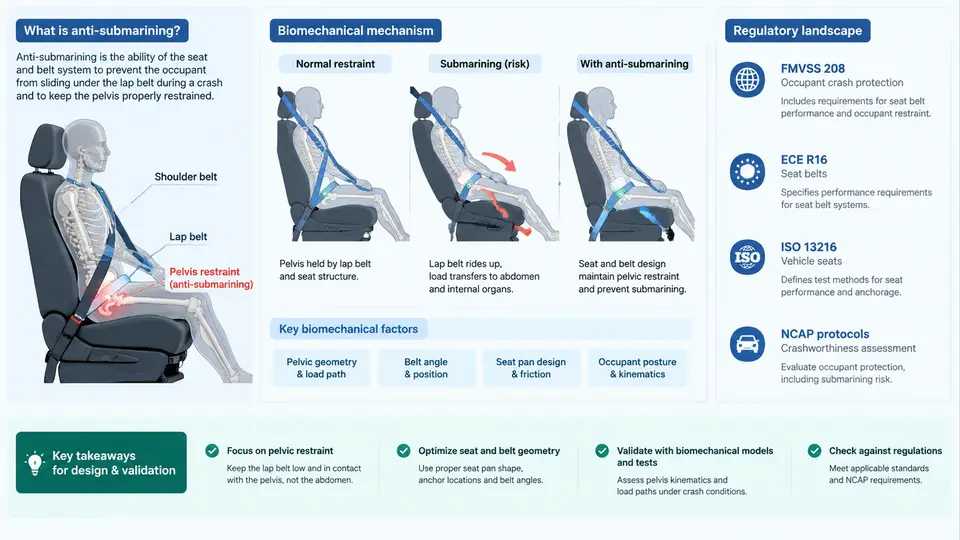
Submarining is the occupant kinematics phenomenon in which the pelvis slides forward and downward beneath the lap portion of a seat belt during a frontal impact. Once the pelvis has escaped the belt, the belt loads the soft abdominal tissues instead of the pelvic bone, and the torso rotates into a reclined posture that defeats the restraint's ability to control the upper body. The result is a characteristic injury pattern: intra-abdominal organ rupture, lumbar spine compression or flexion-distraction injury, and, in severe cases, occupant ejection from the belt path. Anti-submarining design is therefore not a comfort feature — it is a primary restraint performance requirement that determines whether the belt can do its job at all.
1.1 Defining the phenomenon precisely
It is useful to separate three related but distinct events that are often conflated in casual discussion:
- Pelvis excursion — the forward translation of the pelvis relative to the seat cushion and the lap belt anchor geometry. Some excursion is normal and expected; the belt stretches and the occupant compresses the cushion.
- Belt–pelvis disengagement — the lap belt loses contact with the anterior superior iliac spine (ASIS) and rides up onto the abdomen. This is the defining moment of submarining.
- Submarining kinematics — the subsequent combined forward translation and rearward torso rotation, which produces the abdominal belt loading and lumbar loading that cause injury.
The distinction matters because countermeasures act at different points. A seat pan angle change may reduce excursion without preventing disengagement; a lap belt pretensioner or a belt-positioning geometry change may prevent disengagement even when excursion is unchanged.
1.2 Biomechanical mechanisms
Three load paths govern whether the pelvis stays captured. First, the lap belt must engage the ASIS and the anterior pelvis. The iliac crest and ASIS form a bony shelf; if the belt sits above this shelf, it slides up. If it sits below it, it slides down and forward. The belt's vertical position relative to the ASIS is therefore the single most sensitive geometric variable in the system.
Second, the seat cushion and pan must resist forward pelvis motion. Cushion compression, pan angle, and the friction coefficient between the occupant's clothing and the seat surface all contribute. A pan angle that slopes downward toward the front (a "negative" or anti-submarining ramp) creates a mechanical wedge that raises the front of the cushion and blocks forward pelvis travel.
Third, the belt geometry and pretensioning determine how quickly and how firmly the belt engages the pelvis. A lap belt anchored too far forward or too high allows the pelvis to rotate under it. A pretensioner that removes slack in the first 20–30 ms of the event pulls the belt into the pelvis before the occupant has developed significant forward velocity relative to the seat.
The interaction of these paths is captured in the diagram below, which shows the load paths and the decision point at which the belt either stays on the ASIS or rides onto the abdomen.
1.3 Regulatory landscape
Anti-submarining requirements appear in several regulatory and consumer-test frameworks, and they differ in both the test setup and the pass/fail criterion. The table below summarizes the principal ones a development engineer will encounter.
| Framework | Test / requirement | Key criterion |
|---|---|---|
| FMVSS 208 | Frontal rigid barrier, 56 km/h; optional belted and unbelted configurations | Injury Assessment Reference Values (IARVs) for the abdomen and lumbar spine; belt must remain on the pelvis |
| ECE R16 / R94 | Frontal offset deformable barrier, 56 km/h; belt anchorage strength | Belt anchorage displacement limits; occupant kinematics must not allow the lap belt to leave the pelvis |
| Euro NCAP | Frontal offset (50 km/h, 50% overlap) and mobile progressive deformable barrier | Submarining is assessed via dummy pelvis displacement and belt position; abdominal pressure sensors used in some protocols |
| C-NCAP | Frontal 100% and 40% overlap tests | Similar IARV-based assessment with additional attention to belt–pelvis interaction |
| IIHS | Moderate overlap frontal and small overlap frontal | Lower extremity and pelvis injury measures; belt geometry evaluated in rating |
Two practical points deserve emphasis. First, the regulatory tests are not a complete description of real-world submarining risk. They use a specific dummy (Hybrid III 50th percentile male in most cases), a specific seat, and a specific belt geometry. A design that passes FMVSS 208 can still submarine with a smaller occupant, a reclined seat back, or a different cushion foam. Second, the trend in consumer testing is toward more direct measurement of belt–pelvis interaction — pressure sensors, pelvis displacement measurement, and video analysis — rather than relying solely on dummy injury values. This means the development engineer must be able to demonstrate not just that the dummy's abdomen did not exceed a threshold, but that the belt stayed on the pelvis throughout the event.
1.4 What this means for development
Anti-submarining development is a geometry-and-timing problem, not a single-component problem. The variables that matter most in practice are:
- Lap belt angle relative to the horizontal — typically targeted between 45° and 65° in side view, with the belt passing over the ASIS.
- Seat pan angle — a front-up ramp of 5° to 15° is common; the exact value depends on cushion stiffness and occupant size.
- Belt anchor position — the outboard anchor should be positioned so the belt wraps the pelvis rather than the abdomen; the inboard anchor (buckle) should not pull the belt upward.
- Pretensioner timing and force — early slack removal (within the first 20–30 ms) is more effective than high force later.
- Cushion foam density and thickness — softer foam allows more pelvis excursion; a firmer front section can act as a mechanical stop.
1.5 A minimal verification example
To make the concept concrete, consider a simplified sled test setup used for early concept screening. The input is a seat with an adjustable pan angle, a three-point belt with a 4 kN pretensioner, and a Hybrid III 50th percentile male dummy. The test matrix varies pan angle (0°, 8°, 15°) and pretensioner trigger time (10 ms, 25 ms, 40 ms). The observable output is the lap belt position relative to the ASIS, measured from high-speed video at 1000 fps, and the pelvis forward displacement relative to the seat reference point.
A typical result pattern is that at 0° pan angle and 40 ms trigger, the belt rides above the ASIS by 30–40 mm within 60 ms, indicating submarining. At 8° pan angle and 25 ms trigger, the belt remains within 10 mm of the ASIS and the pelvis displacement is reduced by roughly 40%. At 15° pan angle, the ramp itself begins to cause occupant discomfort and may interfere with normal seating posture, so the practical optimum is usually in the 8°–12° range. These values are illustrative and must be confirmed by actual sled testing for the specific seat and belt system.
The remainder of this course builds on these fundamentals: seat structure and pan design, belt geometry and anchor placement, pretensioner and load limiter integration, cushion foam specification, CAE modeling approaches, sled and vehicle test methods, and the data analysis needed to demonstrate that the belt stays on the pelvis across the full range of real-world conditions.