1. Occupant variability in crash safety
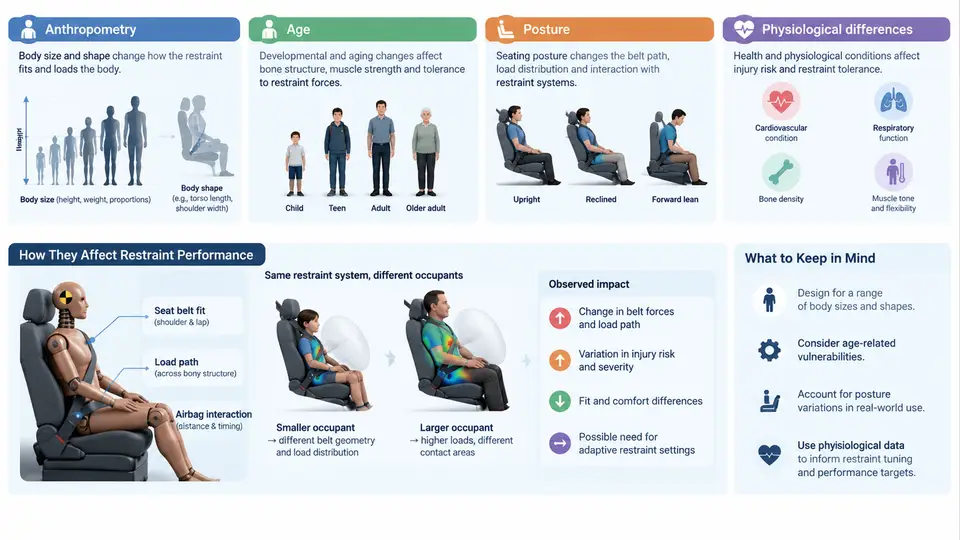
Every restraint system is designed around a set of assumptions about who is sitting in the seat. The airbag inflator is sized for a specific occupant mass and position; the seat belt geometry assumes a particular shoulder height and hip location; the load limiter is tuned for a tolerable chest deflection on a mid-sized adult male. When the actual occupant deviates from those assumptions — and most do — the protection margin shrinks. Understanding the dimensions of that deviation is the first step toward designing adaptive restraint systems that compensate.
Anthropometry: The Geometry of the Occupant
Anthropometry provides the physical measurements that define how an occupant interacts with the restraint system. The critical dimensions for restraint performance are:
- Sitting height and torso length — determines shoulder belt routing and the distance between the shoulder anchor and the sternum. A shorter torso means the belt may cross the neck rather than the clavicle.
- Hip breadth and seated hip location — affects lap belt fit and the likelihood of submarining under the belt during frontal impact.
- Knee-to-hip length (thigh length) — influences the occupant's seated position relative to the knee bolster and the lower extremity loading path.
- Chest depth — determines the standoff distance between the chest and the airbag module, which directly affects airbag deployment timing and chest compression.
The standard reference occupant in most regulatory tests is the Hybrid III 50th percentile male, representing approximately 78 kg and 175 cm. But real-world occupant distribution spans from the 5th percentile female (approximately 50 kg, 150 cm) to the 95th percentile male (approximately 100 kg, 190 cm). A restraint system optimized for the 50th percentile may produce excessive chest deflection on a small female and insufficient restraint on a large male.
Age-Related Effects on Restraint Tolerance
Age changes both the material properties of biological tissues and the behavioral patterns that determine occupant position.
Pediatric occupants (0–12 years): The pediatric skeleton is not a scaled-down adult skeleton. The head is proportionally larger and heavier relative to the body, the neck is weaker, and the rib cage is more compliant. For children under approximately 12 years or 150 cm, the seat belt geometry designed for adults places the shoulder belt across the neck and the lap belt over the abdomen rather than the pelvis. This is why booster seats are required — they reposition the child so that the adult belt geometry works correctly. The key parameter is the belt fit: shoulder belt on the clavicle, lap belt on the anterior superior iliac spine.
Elderly occupants (65+ years): Age-related changes include reduced bone mineral density (increased fracture risk at lower loads), decreased chest wall compliance (higher chest deflection for the same belt force), and reduced muscle strength (affecting the ability to brace before impact). The elderly occupant is more susceptible to rib fractures from belt loading and to sternal fractures from airbag contact. A load limiter calibrated for a 40-year-old may produce injurious belt forces on a 75-year-old with osteoporotic ribs.
Posture: The Occupant's Position at Impact
Posture determines the initial conditions of the occupant-restraint interaction. Even a perfectly designed restraint system performs poorly if the occupant is out of position (OOP).
| Posture Deviation | Effect on Restraint Performance | Typical Scenario |
|---|---|---|
| Seat back reclined >30° | Occupant submarines under lap belt; shoulder belt moves off clavicle | Relaxed driving, passenger sleeping |
| Torso leaned forward | Reduced airbag standoff; airbag may deploy into occupant before full inflation | Reaching for controls, looking down |
| Feet on dashboard | Extreme knee-to-hip compression; airbag deploys into lower legs | Passenger in reclined seat |
| Seat belt under arm or behind back | Complete loss of upper torso restraint; occupant loads airbag directly | Discomfort, habit |
| Child in rear-facing seat in front of active airbag | Airbag impact on child seat shell; fatal head/neck loading | Misinstallation |
The OOP problem is particularly challenging because the restraint system must decide whether to deploy at full force, reduced force, or not at all — and that decision must be made within 10–20 ms of impact detection. This is where occupant sensing and adaptive deployment logic become critical.
Physiological Differences Beyond Size
Beyond anthropometry and age, several physiological factors affect restraint performance:
- Bone strength: Osteoporosis, osteogenesis imperfecta, and other conditions reduce the load at which ribs fracture. A belt force of 4 kN may be safe for a healthy adult but injurious for an osteoporotic elderly occupant.
- Body mass index (BMI): High BMI affects belt fit (the lap belt may ride up over the abdomen) and changes the effective stiffness of the occupant-restraint interface. Obese occupants also have different mass distribution, affecting the center of gravity and kinematics.
- Pregnancy: The uterus and fetus are vulnerable to belt loading. The lap belt must be positioned low on the pelvis, and the shoulder belt should be between the breasts. Airbag deployment can cause placental abruption.
- Neurological and cognitive conditions: Occupants with reduced muscle tone or delayed reaction time may not brace effectively, increasing excursion and contact with interior surfaces.
Implications for Adaptive Restraint Design
The variability described above creates a fundamental design tension: a restraint system that is aggressive enough to protect a large male in a high-speed crash may be injurious to a small female in a low-speed crash. Adaptive restraint systems resolve this tension by sensing occupant characteristics and adjusting restraint parameters in real time.
The key adjustable parameters are:
- Airbag inflator output: Dual-stage or variable-output inflators can reduce deployment force for smaller occupants.
- Seat belt load limiter threshold: Switchable or adaptive load limiters can lower the belt force for frail occupants.
- Belt pretensioner force: Reduced pretensioning for out-of-position occupants to avoid pulling them into the deploying airbag.
- Deployment timing: Delayed or suppressed deployment for occupants who are too close to the airbag module.
The sensing inputs that drive these adjustments include occupant weight (seat weight sensors), seat position (track position sensors), belt buckle status, and increasingly, camera-based or radar-based occupant monitoring that can classify occupant size, posture, and position.
Practical Example: Belt Fit Assessment for a Small Female Occupant
Consider a 5th percentile female occupant (approximately 150 cm, 50 kg) seated in a vehicle designed around the 50th percentile male. The shoulder belt anchor is positioned for a 175 cm occupant. The belt crosses the occupant's neck rather than the clavicle, and the lap belt sits above the anterior superior iliac spine.
To assess this, an engineer would measure the following in a static seat mockup:
- Shoulder belt clearance to neck: Measure the gap between the belt and the side of the neck. A negative clearance (belt touching or crossing the neck) indicates a fit problem.
- Lap belt angle: Measure the angle of the lap belt relative to the horizontal. An angle greater than approximately 30° above horizontal increases submarining risk.
- Belt-to-body gap: Measure the gap between the belt and the chest at the sternum. Excessive gap (>50 mm) delays belt engagement.
If the shoulder belt crosses the neck, the adaptive system can respond by adjusting the shoulder anchor height (if adjustable) or by reducing pretensioner force to avoid neck loading. If the lap belt is too high, a belt positioning device or a different anchor geometry is required. The key is that the system must know the occupant is small before it can adapt.
Summary
Occupant variability is not a single problem but a set of overlapping challenges: geometric (anthropometry), material (age-related tissue changes), positional (posture), and physiological (bone strength, BMI, pregnancy). Each domain affects restraint performance through a different mechanism — belt fit, load tolerance, standoff distance, or injury threshold. Adaptive restraint systems address this variability by sensing occupant characteristics and adjusting deployment parameters in real time. The effectiveness of any adaptive system depends on the accuracy of its occupant sensing and the range of adjustment available in its actuators. The following chapters will examine each sensing modality and actuation strategy in detail.