1. ATD and HBM correlation in injury assess
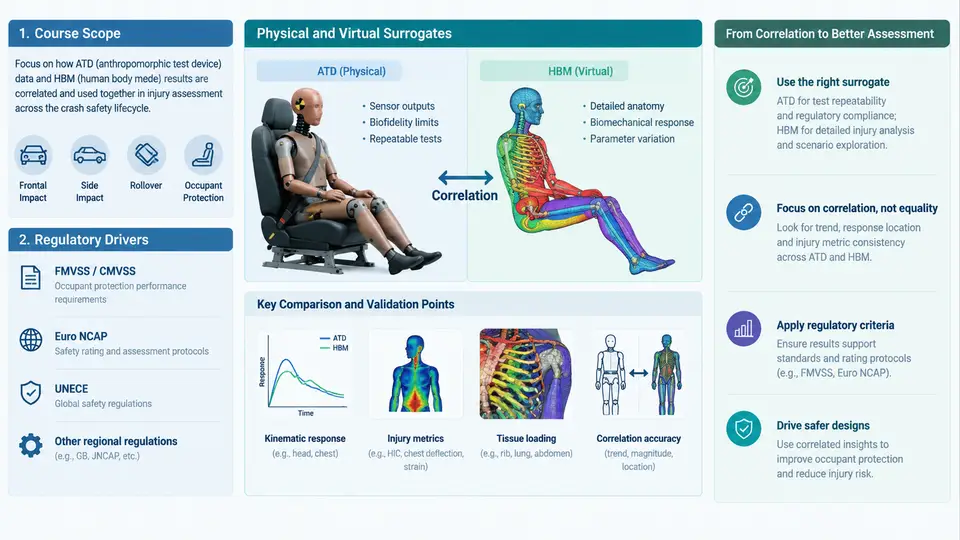
Crash safety engineering rests on a deceptively simple question: when a human body is exposed to a given impact, what happens to it? Answering that question requires a surrogate — a stand-in that can be tested, instrumented, and repeated. Two families of surrogates dominate modern injury assessment. The Anthropomorphic Test Device (ATD), commonly called a crash test dummy, is a physical mechanical surrogate. The Human Body Model (HBM) is a computational surrogate, typically a finite element (FE) representation of human anatomy. Neither is the human body. Both are approximations, and the credibility of any injury assessment depends on understanding how well each surrogate corresponds to real human response — and to each other.
This chapter establishes the conceptual and regulatory foundation for the entire course. It defines what ATD–HBM correlation means, identifies the regulatory and consumer-rating drivers that make correlation a practical necessity rather than an academic exercise, and explains how physical and virtual surrogates divide the work of crash safety assessment.
What Correlation Actually Means
In this course, correlation refers to the quantitative and qualitative agreement between the responses of two surrogates — or between a surrogate and human reference data — under matched loading conditions. It is not a single number. A meaningful correlation statement specifies the loading condition, the response channel, the time window, and the acceptance criterion.
Consider a frontal sled test at a delta-V of 56 km/h with a 40% offset deformable barrier. An ATD in the driver seat records chest deflection, head resultant acceleration, and femur loads. A validated HBM subjected to the same boundary conditions produces the same channels. Correlation is then assessed channel by channel: peak value, time of peak, pulse shape, and phase. A typical engineering criterion might require peak chest deflection within ±10% and peak timing within ±5 ms, with a CORA (CORrelation and Analysis) rating above 0.8 for the overall curve. These thresholds are illustrative; the governing protocol defines the actual values.
Three distinct correlation relationships matter, and conflating them is a common source of confusion:
- ATD-to-human correlation — how well the dummy reproduces cadaveric, PMHS (post-mortem human subject), or volunteer response.
- HBM-to-human correlation — how well the model reproduces the same reference data, usually after mesh convergence and material calibration.
- ATD-to-HBM correlation — how well the two surrogates agree with each other under identical loading.
The third relationship is the operational one. If an ATD and an HBM disagree, at least one of them misrepresents the human. Correlation work exists to detect, quantify, and reduce that disagreement.
Why Correlation Is a Regulatory and Engineering Necessity
Regulation and consumer rating programs were built around physical testing. FMVSS 208 specifies ATD-based occupant protection requirements. Euro NCAP, C-NCAP, and IIHS publish protocols that prescribe dummy type, seating position, impact configuration, and injury criteria thresholds. These programs define the legal and market-facing pass/fail landscape.
Virtual testing enters through a different door. UN Regulation No. 137 and the broader UN WP.29 framework permit simulation in defined cases. Euro NCAP's virtual testing protocol allows FE simulation for selected assessment areas, provided the model is validated against physical tests. This creates a direct dependency: a virtual result is only admissible if the underlying HBM has demonstrated correlation with the physical surrogate or with human reference data under the relevant condition.
The practical consequence is that correlation is not a research nicety. It is the evidence that licenses a simulation to stand in for a test. When an OEM substitutes an HBM run for a sled test, the correlation dossier is what makes that substitution defensible to a regulator or a rating body.
Physical and Virtual Surrogates: Division of Labor
ATDs and HBMs are not competitors. They occupy different roles in the same assessment workflow, and each has strengths the other lacks.
The ATD is a calibrated mechanical system. Its mass distribution, joint stiffness, and instrumentation are standardized, so results are repeatable across laboratories and traceable to a certification procedure. It measures what its sensors can measure: accelerations, forces, moments, and displacements at discrete locations. It cannot report stress or strain inside tissue, and its biofidelity is limited by its construction — a steel and polymer assembly approximating a human.
The HBM is a discretized anatomical model. It can output stress, strain, strain rate, and internal organ deformation at any element, which makes it suitable for injury mechanisms that no physical sensor can reach — diffuse axonal injury, aortic rupture, liver laceration. Its weakness is credibility: mesh density, material properties, and boundary conditions all influence the result, and a model can produce plausible-looking output that is physically wrong.
Correlation binds them. The ATD provides the validated physical anchor; the HBM extends the assessment into regions and mechanisms the ATD cannot instrument. When the two agree under matched conditions, confidence in both increases. When they diverge, the divergence localizes the problem — a sensor location, a material model, a boundary condition — and directs the next investigation.
How the Two Surrogates Are Matched in Practice
Correlation studies follow a consistent logic even when the details vary. The essential requirement is that both surrogates experience the same loading. In a frontal impact study, that means the same sled pulse, the same restraint configuration, the same seat geometry, and the same initial posture. Any mismatch in boundary conditions invalidates the comparison before it begins.
A representative workflow proceeds as follows. First, define the loading condition and the response channels of interest — for example, a 56 km/h frontal sled pulse with chest deflection and head acceleration as primary channels. Second, run the physical test with the ATD and record the channels at the specified sample rate. Third, build the HBM simulation with boundary conditions matched to the physical setup, including belt routing, seat cushion stiffness, and contact definitions. Fourth, extract the same channels from the simulation. Fifth, compute correlation metrics — peak magnitude ratio, peak timing difference, and a curve-shape metric such as CORA or ISO/TS 18571. Sixth, interpret the result against the acceptance criterion.
Interpretation is where engineering judgment matters most. A peak magnitude match with a large timing offset suggests a stiffness or mass distribution problem. A good early-phase match with divergence late in the pulse suggests a failure or bottoming-out mechanism that one surrogate captures and the other does not. A systematic offset across all channels often points to a boundary condition error rather than a surrogate deficiency.
Scope of This Course
The chapters that follow build from this foundation. They cover the anatomy and instrumentation of the principal ATD families, the construction and material modeling of HBMs, the reference data used for biofidelity assessment, the metrics and protocols used to quantify correlation, and the application of correlated surrogates to injury risk assessment. The through-line is consistent: a surrogate is only as credible as the evidence that it corresponds to the human body under the conditions being assessed, and correlation is how that evidence is produced and defended.
By the end of the course, you should be able to read a correlation study critically, design a matched ATD–HBM comparison for a given loading condition, select appropriate metrics, and judge whether a virtual result is credible enough to support an injury assessment decision.