1. CAE credibility landscape
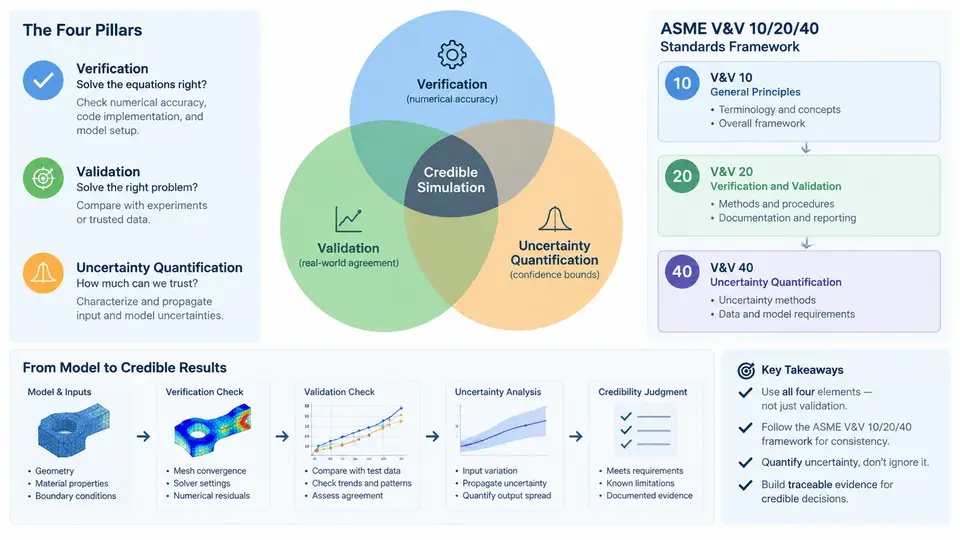
Computer-aided engineering (CAE) results are routinely used to justify design margins, certify structural integrity, and support regulatory submissions. Yet a finite element stress contour or a CFD pressure field is not evidence by itself. It becomes evidence only when the analyst can demonstrate that the model solves the intended equations correctly, that those equations represent the physical reality of interest, and that the remaining uncertainty is quantified and acceptable for the decision at hand. This is the domain of simulation credibility, and it is organized around three technical pillars — verification, validation, and uncertainty quantification (UQ) — governed by a standards framework led by ASME V&V 10, V&V 20, and V&V 40.
The Three Pillars and What Each One Answers
The most common source of confusion in V&V practice is conflating verification with validation. They answer fundamentally different questions and use different evidence.
- Verification asks: Are we solving the equations right? It is a mathematics-and-software activity. It has two sub-types. Code verification establishes that the software correctly implements the numerical algorithms — typically through order-of-accuracy tests against manufactured or analytical solutions. Calculation verification (also called solution verification) estimates the numerical error in a specific simulation, dominated by discretization error from mesh and time-step size.
- Validation asks: Are we solving the right equations? It is a physics-and-experiment activity. Model predictions are compared against experimental measurements of the real system, and the comparison is judged within the combined uncertainty of both the simulation and the experiment.
- Uncertainty quantification asks: How much confidence can we place in the prediction? UQ identifies, characterizes, and propagates all significant uncertainty sources — input variability, model form error, numerical error, and experimental uncertainty — through to the quantity of interest (QoI).
A useful mental model: verification builds the instrument, validation checks the instrument against reality, and UQ states how precisely the instrument reads. Skipping any one of them leaves a gap that a reviewer, regulator, or certification authority will eventually find.
The ASME V&V Standards Framework
ASME has published a family of standards that give the credibility process a defensible, auditable structure. The three most relevant to general CAE practice are:
| Standard | Scope | Core Contribution |
|---|---|---|
| ASME V&V 10 | Verification and validation in computational solid mechanics | Defines the V&V process, terminology, and the concept of the validation metric; establishes code verification and calculation verification requirements |
| ASME V&V 20 | Verification and validation in computational fluid dynamics and heat transfer | Adapts the V&V 10 framework to CFD/CHT, with emphasis on discretization error estimation (Richardson extrapolation, grid convergence index) and turbulence model validation |
| ASME V&V 40 | Assessing the credibility of computational modeling and simulation | Provides a risk-informed credibility assessment framework: the required credibility activities scale with the model's influence on the decision and the consequence of being wrong |
V&V 10 and V&V 20 are discipline-specific: they tell you how to perform verification and validation for solids and fluids respectively. V&V 40 is discipline-agnostic and tells you how much V&V and UQ effort is warranted, based on risk. Together they form a layered system: V&V 40 sets the credibility target, and V&V 10 or 20 provides the technical methods to reach it.
The Risk-Informed Credibility Logic of V&V 40
The central insight of V&V 40 is that not every simulation deserves the same level of rigor. A preliminary trade study and a nuclear containment certification analysis should not consume the same verification budget. V&V 40 formalizes this through a graded approach driven by two axes: the influence of the simulation on the decision, and the consequence of an incorrect decision. High influence plus high consequence demands a comprehensive credibility assessment; low influence and low consequence permit a lighter one.
The standard defines a set of credibility factors — verification, validation, uncertainty characterization, sensitivity analysis, data quality, and code/software quality assurance — and asks the analyst to justify the level of each. The output is not a pass/fail verdict but a structured credibility argument that a reviewer can audit.
How the Pieces Interlock
The diagram below shows the credibility landscape as a connected system rather than a linear checklist. Verification and validation feed evidence into the credibility assessment; UQ quantifies the gaps that verification and validation cannot close; and the risk context from V&V 40 determines how much of each is required.
What This Means in Practice
For an analyst, the framework translates into concrete obligations. Before running a simulation that will support a decision, you should be able to answer:
- What is the QoI and what decision does it inform? This determines the risk context and therefore the required credibility level.
- Has the code been verified? At minimum, confirm that the solver has documented order-of-accuracy results for the element or scheme type you are using.
- Has the calculation been verified? Perform a mesh convergence study and report the discretization error estimate. For CFD, the grid convergence index (GCI) from Richardson extrapolation is the standard approach; for solids, a comparable mesh-refinement study applies.
- Is there a validation case that covers your regime? The validation domain must bracket the intended use — same physics, comparable Reynolds or Mach number, similar material behavior. Extrapolating a validation beyond its domain is a credibility gap.
- What are the dominant uncertainty sources? Rank them by sensitivity. If a 5% variation in a material property changes the QoI by 20%, that property needs better characterization before the simulation can be trusted.
Common Failure Modes in Credibility Practice
Three patterns recur in reviews and audits. First, verification skipped under schedule pressure: the mesh is "fine enough" by visual inspection, no convergence study is performed, and the discretization error is unknown. Second, validation by anecdote: a single comparison against a published test is presented as validation without checking whether the test conditions fall within the intended use domain. Third, UQ as an afterthought: uncertainty is mentioned qualitatively but never propagated to the QoI, so the decision-maker cannot judge whether the margin is adequate.
The ASME framework exists precisely to make these gaps visible and to force a structured, risk-proportionate response. The remaining chapters of this course will develop each pillar in depth — code and calculation verification methods, validation experiment design and metric selection, UQ techniques from Monte Carlo to polynomial chaos, and the construction of a defensible credibility argument under V&V 40.