1. Industrial data quality landscape
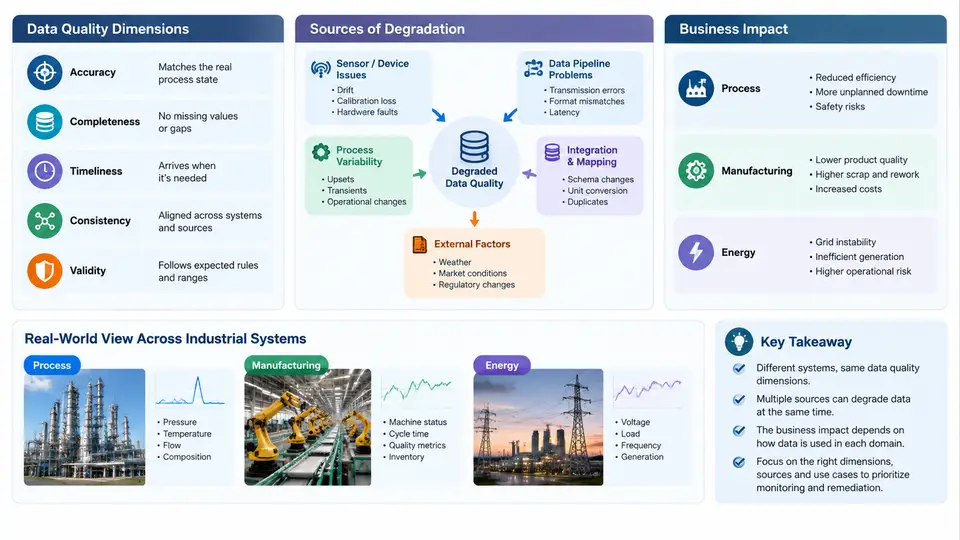
Industrial data quality is not a single metric but a multi-dimensional property of the measurements, events, and contextual records that flow from physical assets into historians, MES platforms, SCADA systems, and enterprise analytics. In process, manufacturing, and energy environments, data quality determines whether operators trust a trend, whether engineers can reconstruct a fault, and whether business systems can calculate production yield, energy intensity, or emissions with defensible accuracy. This chapter establishes the vocabulary and mental model used throughout the course: which quality dimensions matter, where degradation originates, and how poor quality translates into operational and financial consequences.
Quality Dimensions That Matter in Industrial Systems
Industrial practitioners typically evaluate data quality across several orthogonal dimensions. Each dimension can fail independently, and a dataset may be excellent in one and unusable in another.
- Accuracy — the closeness of a recorded value to the true physical quantity. A temperature transmitter reading 152.3 °C when the reference is 150.0 °C has a 2.3 °C error, whether from drift, miscalibration, or installation effects.
- Completeness — the proportion of expected samples or records actually present. A flow meter configured for 1 Hz that delivers 3,400 samples in an hour has 94.4% completeness.
- Timeliness — the delay between physical event and data availability. A vibration alarm that reaches the control room 90 seconds after the event may be useless for protection, even if perfectly accurate.
- Consistency — agreement across redundant or related sources. Two redundant pressure transmitters reading 4.2 bar and 6.8 bar indicate a consistency failure that must be resolved before either value is trusted.
- Validity — conformance to defined ranges, data types, and engineering units. A pH value of 47 is syntactically valid but physically impossible.
- Uniqueness — absence of duplicate records, common when multiple collectors or gateways ingest the same tag.
- Provenance and traceability — the ability to identify source device, calibration state, and transformation history for any value.
These dimensions are not equally weighted in every context. A custody-transfer flow measurement in a gas pipeline prioritizes accuracy and traceability; a real-time compressor protection loop prioritizes timeliness and validity; a monthly energy report prioritizes completeness and consistency. The first practical step in any monitoring program is to map each data stream to the dimensions that actually govern its use.
Where Degradation Originates
Data quality degradation in industrial environments rarely has a single cause. It accumulates across the signal chain, from the physical sensor to the enterprise data warehouse. Understanding the origin points is essential because remediation strategies differ fundamentally depending on where the problem enters.
Sensor and instrument layer. Thermocouples drift with aging; RTDs suffer lead resistance errors; Coriolis meters accumulate zero drift; pH electrodes foul and require cleaning. Calibration intervals that are too long, or calibration performed without proper traceability, introduce systematic bias that propagates into every downstream calculation.
Signal conditioning and wiring. Ground loops inject noise into 4–20 mA loops. Shielded cable damaged during maintenance creates intermittent spikes. Incorrect scaling in the transmitter or PLC analog input card produces a constant offset that may go unnoticed for months.
Control system and gateway layer. PLC scan times that are too slow for fast transients cause aliasing. OPC servers configured with deadbands that are too wide suppress small but meaningful changes. Gateway buffering during network outages can produce out-of-order timestamps or duplicate records when connectivity is restored.
Historian and data platform layer. Compression algorithms in historians such as OSIsoft PI or AVEVA Historian discard data points according to deviation and time thresholds. Poorly tuned compression can eliminate the very transients needed for fault analysis. Time-zone mismatches between sites corrupt event correlation. Tag naming inconsistencies across assets make aggregation unreliable.
Human and process factors. Manual entries during shift handover, override values left in place after maintenance, and inconsistent unit conventions (bar vs. kPa, °C vs. °F) are persistent sources of quality loss that no automated system fully eliminates.
Business Impact Across Process, Manufacturing, and Energy
The consequences of poor data quality are domain-specific but share a common structure: they degrade the reliability of decisions and increase the cost of uncertainty.
Process industries (chemicals, refining, pharmaceuticals) depend on accurate mass and energy balances. A 1% bias in a feed flow measurement on a 100,000 bbl/day refinery unit translates to roughly 1,000 bbl/day of unaccounted material — a discrepancy that triggers reconciliation investigations, inventory write-offs, and in regulated environments, audit findings. In pharmaceutical manufacturing, data integrity failures can invalidate batch records and trigger regulatory action under 21 CFR Part 11 and EU Annex 11.
Manufacturing environments face quality and throughput consequences. A vision inspection system fed by a camera with degraded calibration may pass defective parts or reject good ones, directly affecting scrap rate and customer returns. OEE calculations built on unreliable downtime timestamps produce misleading bottleneck analyses, causing capital to be allocated to the wrong constraint.
Energy systems — power generation, transmission, and renewables — operate under strict timeliness and accuracy requirements. A wind farm SCADA system that loses 15 minutes of turbine data during a grid event cannot support the post-event analysis required by the transmission system operator. In electricity markets, meter data errors directly affect settlement amounts and can expose participants to financial penalties.
From Landscape to Program
Recognizing the dimensions, origins, and impacts of data quality is the foundation for everything that follows in this course. A monitoring and remediation system must be designed around the specific dimensions that matter for each data stream, instrumented to detect degradation at its source, and connected to remediation workflows that restore trust before decisions are made. The remaining chapters build the architecture, methods, and operational practices to achieve that systematically.