1. Foundations of experimental design
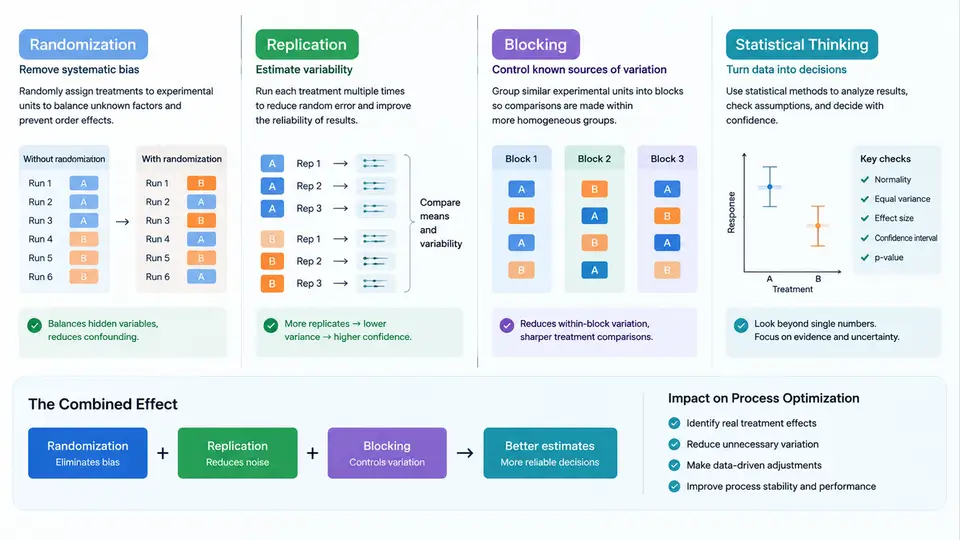
Process optimization rarely fails because engineers lack ideas. It fails because they cannot tell whether an observed improvement is real or simply noise. A reactor yield rises from 82.1% to 83.4% after a temperature adjustment — is that a genuine effect, or normal run-to-run variation? Without a structured way to separate signal from noise, teams either chase phantom improvements or discard real ones. Design of Experiments (DOE) provides that structure. This chapter establishes the three pillars of every valid experiment — randomization, replication, and blocking — and explains why statistical thinking, not intuition, must drive process optimization.
Why One-Factor-at-a-Time Fails
The traditional approach — hold everything constant, vary one factor, observe the result — is intuitive but structurally flawed. Consider a chemical process with three factors: temperature (T), catalyst concentration (C), and residence time (R). The one-factor-at-a-time (OFAT) method tests T at fixed C and R, then C at fixed T and R, and so on. This design cannot detect interactions: situations where the effect of T depends on the level of C. In practice, interactions are the rule, not the exception. A catalyst may only improve yield within a narrow temperature window; outside it, the catalyst is wasted or even harmful. OFAT also wastes resources — it requires more runs than a factorial design to achieve the same precision — and it estimates effects relative to an arbitrary baseline rather than across the full experimental region.
Statistical thinking replaces the question "did the number change?" with "is the change larger than what random variation alone would produce?" That reframing is the foundation of everything that follows.
The Three Pillars of Valid Experiments
Randomization
Randomization means assigning experimental runs to units, time slots, or positions in a way that is not determined by the experimenter's judgment or convenience. Its purpose is to neutralize lurking variables — factors you did not measure or cannot control, such as ambient humidity, operator shift, raw material lot, or equipment warm-up drift. If run order is chosen haphazardly (e.g., all high-temperature runs first), a lurking variable that changes over time becomes confounded with temperature, and no statistical analysis can untangle them.
In practice, randomization is implemented by generating a random permutation of the run order before executing the experiment. For a 2³ factorial design with 8 runs, a random sequence might be: 5, 2, 8, 1, 6, 3, 7, 4. The experimenter then executes runs in that order. Randomization does not eliminate lurking variables; it converts their effect into random error, which the analysis can then account for.
Replication
Replication is the independent repetition of an experimental condition. It serves two critical functions: it provides an estimate of pure error (the inherent variability of the process), and it increases the precision of effect estimates. Without replication, there is no internal yardstick against which to judge whether an observed effect is meaningful.
There is an important distinction between true replication and repeated measurement. Measuring the same batch three times gives three readings but only one independent observation of the process — it captures measurement error, not process error. True replication requires running the condition from scratch: new batch, new setup, new randomization. In a 2³ design with two replicates, you execute 16 runs, not 8 runs measured twice.
Blocking
Blocking is the deliberate grouping of experimental runs into homogeneous subsets, called blocks, to isolate known nuisance variation. If you must run an experiment across two days, or with two different raw material lots, or on two machines, those sources of variation are known and potentially large. Blocking removes their effect from the error term, increasing the sensitivity of the experiment.
The principle is simple: block what you can, randomize what you cannot. Within each block, runs are randomized. Between blocks, the nuisance factor is allowed to vary but is accounted for in the model. A randomized complete block design (RCBD) ensures every treatment appears once in every block, so treatment comparisons are made within blocks, free of the block effect.
Statistical Thinking in Process Optimization
Statistical thinking is a mindset with three commitments. First, variation exists everywhere — in materials, equipment, environment, and measurement. Second, variation must be quantified before it can be reduced. Third, decisions should be based on data, not on the loudest voice in the room.
In process optimization, this translates into a disciplined sequence: define the response variable and how it will be measured; identify the factors and their ranges; choose a design that supports the intended inference; randomize, replicate, and block appropriately; then analyze the results with a model that reflects the design structure. Skipping any of these steps weakens the conclusion.
A concrete example illustrates the payoff. Suppose a team wants to maximize the purity of a crystallized product. They identify three factors: temperature (60–80 °C), antisolvent ratio (1.0–2.0 v/v), and cooling rate (0.5–2.0 °C/min). A 2³ factorial with two replicates and two blocks (two batches of raw material) requires 16 runs. After randomization and execution, the analysis reveals that temperature and antisolvent ratio have significant main effects, but more importantly, their interaction is significant: the benefit of higher antisolvent ratio only materializes at lower temperatures. OFAT would have missed this entirely, because it would have tested antisolvent ratio at a single fixed temperature.
Practical Checklist for Your First Experiment
| Element | Question to Answer | Example |
|---|---|---|
| Response | What is measured, and with what precision? | Purity (%), HPLC, ±0.2% |
| Factors & ranges | Which variables are varied, and over what range? | T: 60–80 °C; Ratio: 1.0–2.0; Rate: 0.5–2.0 |
| Design | What design supports the intended inference? | 2³ factorial, 2 replicates, 2 blocks |
| Randomization | How is run order determined? | Random permutation within each block |
| Replication | How many independent repeats per condition? | 2 true replicates (new batch each time) |
| Blocking | What known nuisance factor should be isolated? | Raw material lot (Lot A vs. Lot B) |
This checklist is not a formality. Each row corresponds to a decision that, if made poorly, can invalidate the entire experiment. The remaining chapters build on these foundations: factorial and fractional factorial designs, response surface methodology, and process optimization techniques all assume that randomization, replication, and blocking are handled correctly. Master these three pillars first, and every subsequent design becomes a variation on a theme you already understand.