1. Industrial document intelligence landsca
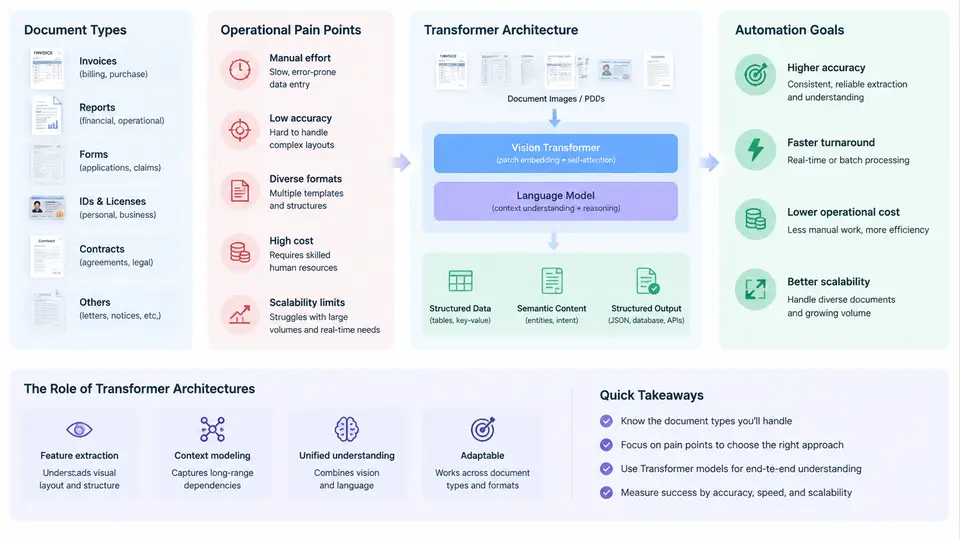
Industrial organizations run on documents. A mid-sized refinery, a regional utility, or a pharmaceutical manufacturer typically maintains tens of thousands of active documents: piping and instrumentation diagrams (P&IDs), equipment datasheets, material safety data sheets (MSDS), maintenance work orders, inspection reports, vendor submittals, purchase orders, calibration certificates, and regulatory filings. These documents are not static archives. They are operational instruments that engineers, planners, compliance officers, and field technicians consult daily to make decisions with safety and financial consequences.
The problem is that most of this content is locked inside unstructured or semi-structured formats. A scanned P&ID is a raster image. A vendor datasheet is a PDF with embedded tables that may or may not have a logical reading order. A maintenance work order is a free-text field in a CMMS (Computerized Maintenance Management System). Extracting reliable, machine-readable information from these sources has historically required either manual data entry or brittle rule-based parsers that break whenever a template changes. This is the operational pain point that Transformer-based document intelligence systems are designed to address.
Document Types and Their Structural Characteristics
Industrial documents fall into several categories, each with distinct structural properties that influence how a document intelligence pipeline must handle them:
- Engineering drawings and diagrams: P&IDs, isometric drawings, electrical single-lines. These are predominantly graphical, with text embedded as annotations, tag numbers, and callouts. Spatial relationships between symbols carry meaning. OCR alone is insufficient; layout and symbol recognition are required.
- Structured forms and datasheets: Equipment datasheets, inspection checklists, calibration records. These have consistent field labels and value regions, but the layout may vary across vendors or revisions. Key-value extraction is the primary task.
- Narrative reports: Incident reports, root cause analyses, environmental impact assessments. These are dense prose with domain-specific terminology, often containing causal claims and regulatory references. Information extraction here means entity recognition, relation extraction, and summarization.
- Transactional documents: Purchase orders, invoices, shipping manifests. These are semi-structured with line items, quantities, dates, and vendor identifiers. Accuracy requirements are high because errors propagate into ERP systems.
- Regulatory and standards documents: OSHA regulations, API standards, ISO procedures. These are long, hierarchically structured, and frequently cross-referenced. Retrieval and question-answering over these corpora is a common requirement.
Each category imposes different constraints on preprocessing, model architecture, and output validation. A system optimized for invoice line-item extraction will perform poorly on P&ID tag recognition, and vice versa. Production systems therefore tend to be modular, with document-type routing as an early pipeline stage.
Operational Pain Points
The pain points that drive investment in document intelligence are consistent across heavy industry:
Manual data entry bottleneck. A single equipment datasheet may contain 200–400 data fields. A human operator transcribing these into an asset management system takes 30–60 minutes per document and introduces typographical errors at a rate of roughly 1–3% per field. At scale, this becomes both a cost center and a data quality risk.
Search and retrieval failure. When a field engineer needs to know the maximum allowable working pressure of a specific heat exchanger, the answer exists in a datasheet somewhere. But keyword search over a document management system often fails because the document is a scanned PDF with no OCR layer, or because the terminology in the query does not match the terminology in the document. Semantic search over embedded representations addresses this, but requires a robust extraction and indexing pipeline.
Compliance and audit overhead. Regulatory audits require demonstrating that inspection intervals, calibration records, and safety procedures are current and complete. Assembling this evidence manually across multiple systems and document repositories is time-consuming and error-prone. Automated extraction and linking of compliance-relevant entities reduces audit preparation from weeks to days.
Knowledge loss. When experienced engineers retire, their ability to interpret ambiguous documents and resolve inconsistencies leaves with them. A document intelligence system that captures structured knowledge and provides context-aware retrieval partially mitigates this loss.
Automation Goals and the Role of Transformer Architectures
The automation goals for industrial document intelligence can be stated concisely: convert unstructured and semi-structured documents into structured, queryable, and linkable data with sufficient accuracy and throughput to support operational decisions. This breaks down into four functional capabilities:
- Layout understanding: Identify document regions (tables, figures, headers, body text) and their reading order.
- Information extraction: Pull specific entities (tag numbers, dates, quantities, equipment names) and their relationships from identified regions.
- Classification and routing: Assign document types and route them to appropriate downstream processes.
- Retrieval and question answering: Enable natural-language queries over the extracted and indexed content.
Transformer architectures are well-suited to all four because their core mechanism—self-attention over sequences—generalizes naturally to the multi-modal inputs found in industrial documents. A document page can be represented as a sequence of text tokens, image patches, and layout coordinates. The Transformer's attention mechanism learns which parts of the page are relevant to each other, regardless of whether those parts are textual, visual, or positional.
This is a significant departure from earlier approaches. Rule-based parsers relied on fixed coordinates or regular expressions, which broke under layout variation. CNN-based document classifiers handled image features but struggled with long-range dependencies across a page. Transformer models such as LayoutLM, Donut, and their industrial derivatives combine text, vision, and layout in a single architecture, enabling end-to-end training on document understanding tasks without hand-crafted feature engineering.
Why this matters in production: A Transformer-based extractor trained on 500 annotated equipment datasheets can generalize to new vendor templates with minimal fine-tuning, whereas a rule-based parser would require explicit reprogramming for each new layout. The economic argument for Transformer architectures is not just accuracy—it is the reduction in maintenance cost as document variability grows.
Production System Architecture: A Reference View
The following diagram illustrates a reference architecture for a Transformer-based industrial document intelligence system. It shows the flow from document ingestion through preprocessing, model inference, and downstream integration, with feedback loops for human review and model retraining.
From Pain Points to Production: What the First Deployment Looks Like
A typical first deployment targets a single high-volume document type with clear extraction requirements. Consider a maintenance organization that processes 2,000 work-order PDFs per month. Each work order contains a header with equipment tag, date, and priority, plus a free-text description of the work performed. The goal is to extract these fields and push them into a CMMS.
The implementation proceeds in stages. First, a layout detection model identifies the header region and the description block. Second, a fine-tuned LayoutLM model extracts the tag number, date, and priority from the header. Third, a named entity recognition (NER) model identifies equipment references and failure modes in the description. Fourth, a validation layer checks that extracted tag numbers match the asset registry and that dates fall within a plausible range. Records that fail validation or fall below a confidence threshold are routed to a human reviewer.
In a representative pilot, such a system might achieve 92–96% field-level accuracy on the header fields and 85–90% on the free-text entities, with a human review rate of 10–15%. The exact numbers depend on document quality, annotation volume, and model selection. The key operational insight is that the system does not need to be perfect—it needs to be accurate enough to reduce manual effort while maintaining a reliable fallback for uncertain cases.
Practical guidance: Start with a document type that has high volume, consistent structure, and clear downstream consumers. Measure baseline manual processing time and error rate before deployment. Use those baselines to set realistic accuracy targets and to quantify ROI after go-live.
What Comes Next
This chapter has established the landscape: the document types, the operational pain points, the automation goals, and the architectural role of Transformer models in production systems. Subsequent chapters will examine the specific architectures—LayoutLM, Donut, DETR, and their variants—in detail, along with the data engineering, training, evaluation, and deployment practices required to build and maintain these systems at industrial scale.