1. Vehicle intrusion and deformation measur
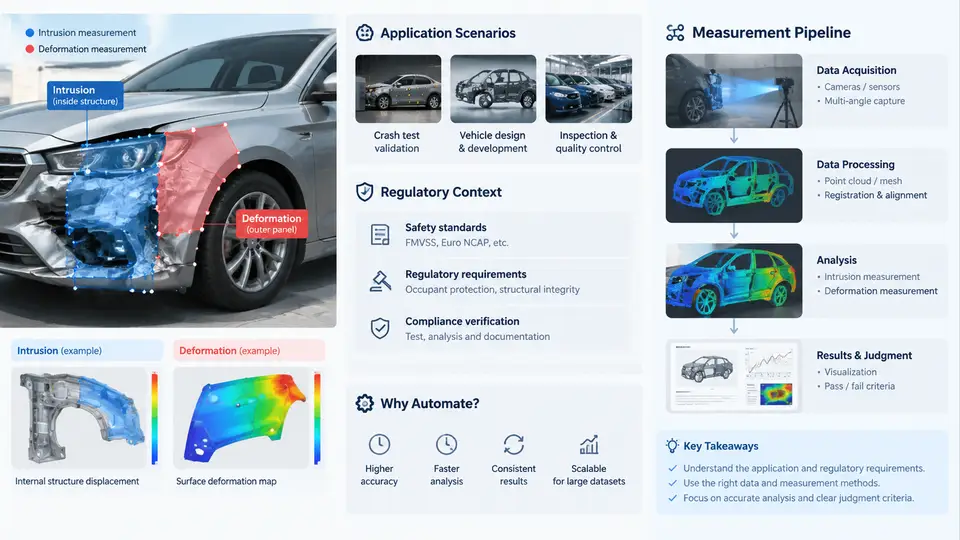
Vehicle intrusion and deformation measurement is the discipline of quantifying how far a vehicle's occupant compartment is displaced, crushed, or penetrated during a crash event. In regulatory and consumer-testing language, intrusion typically refers to the residual displacement of a structural or interior surface relative to its pre-impact position, while deformation describes the overall geometric change of the body structure. The two are related but not interchangeable: a door inner panel may show 120 mm of intrusion while the surrounding B-pillar deforms in a complex three-dimensional pattern that no single intrusion number captures.
This chapter establishes the vocabulary, the regulatory and consumer-rating context, and the engineering reasons why manual measurement is being replaced by automated pipelines built on Python, photogrammetry, and structured point-cloud processing.
Why Intrusion Measurement Matters
Intrusion is a direct proxy for occupant injury risk. When the occupant compartment loses survival space, the restraint system has less room to manage occupant kinematics, and contact with interior surfaces becomes more likely. In FMVSS 208 (occupant crash protection) and FMVSS 214 (side impact protection), intrusion thresholds and structural performance criteria determine whether a vehicle passes. In the Euro NCAP and C-NCAP protocols, intrusion values feed directly into the structural score and into the assessment of whether the occupant compartment remained stable.
Typical measurement targets include:
- Footwell and toe pan intrusion — measured along the vehicle X-axis (longitudinal), often the largest single intrusion value in a frontal offset test.
- Dash panel and steering column displacement — relevant to lower-extremity and chest injury metrics.
- Door inner panel and B-pillar intrusion — the primary structural metric in side impact and pole tests.
- Seat track and occupant compartment residual space — used to verify that the seat did not detach or displace excessively.
Each target has a defined reference direction. In this course, unless stated otherwise, the coordinate convention follows the vehicle body frame: X positive forward, Y positive to the left, Z positive upward, with the origin at the vehicle datum. Intrusion is reported as a positive magnitude along the direction of impact, so a footwell intruding rearward in a frontal crash is reported as a positive X-direction intrusion value. Any change of reference frame must be stated explicitly, because mixing frames is one of the most common sources of erroneous results.
Regulatory and Consumer-Testing Context
The measurement workflow is shaped by the test protocol. A frontal offset test (e.g., 40% overlap at 64 km/h) produces different deformation patterns than a full-width rigid barrier test or a side MDB impact. The protocol defines the impact configuration, the instrumentation, and the post-test measurement requirements. In practice, engineers must satisfy three layers of requirements simultaneously:
| Layer | Typical Requirement | Measurement Implication |
|---|---|---|
| Homologation (FMVSS / UN ECE) | Pass/fail intrusion limits at defined points | Point-based, repeatable, traceable to datum |
| Consumer rating (Euro NCAP / C-NCAP) | Intrusion values contributing to star score | Higher spatial resolution, documented uncertainty |
| Internal engineering targets | Margin to regulatory limit, CAE correlation | Full-field deformation, repeatability across builds |
The regulatory layer demands defensible, traceable numbers. The consumer layer demands enough spatial coverage to characterize the compartment. The internal layer demands data that can be correlated with CAE models and compared across multiple test builds. Manual measurement with tape measures and plumb lines struggles to satisfy all three simultaneously, which is the core motivation for automation.
The Automation Rationale
Manual intrusion measurement is labor-intensive, operator-dependent, and difficult to audit. A typical post-crash survey might involve dozens of measurement points, each requiring the operator to locate a reference feature, hold a measurement device, and record a value. Repeatability between operators can easily exceed 5–10 mm, which is significant when a regulatory limit is 150 mm and an engineering margin is 20 mm.
Automated measurement addresses these weaknesses through three mechanisms:
- Dense spatial sampling. Photogrammetry or structured-light scanning captures thousands of points across the deformed surface, not just a handful of hand-picked locations. This reveals deformation gradients that point measurements miss.
- Deterministic registration. The deformed scan is aligned to a pre-impact reference model using a fixed algorithm, so the same input always produces the same output. Operator judgment is removed from the alignment step.
- Traceable computation. Intrusion values are computed from registered point sets with documented parameters, making every number reproducible and auditable.
Python is a natural fit for this pipeline because the ecosystem provides mature libraries for point-cloud processing (Open3D, NumPy), registration (ICP variants), mesh handling (trimesh), and reporting (pandas, matplotlib). A single script can ingest raw scan data, register it, compute intrusion at defined targets, and emit a structured report — replacing a multi-hour manual process with a repeatable computation.
From Raw Scan to Intrusion Value: The Conceptual Pipeline
Before writing any code, it is worth understanding the conceptual data flow. The figure below shows the essential stages and the decisions that govern each one.
The pipeline is deliberately modular. Each stage has a defined input, a defined output, and a small number of parameters that the engineer must choose. The registration stage is the most consequential: if the deformed scan is not aligned correctly to the reference model, every downstream intrusion value is wrong, often by tens of millimeters. The residual check shown as a feedback loop is therefore not optional — it is the primary quality gate.
What This Course Covers
Over the following chapters, we will build this pipeline incrementally in Python. We will start with coordinate frames and reference model preparation, then move to point-cloud preprocessing, registration algorithms (including point-to-point and point-to-plane ICP), target-point definition, intrusion computation, uncertainty estimation, and automated reporting. Each stage will be implemented with concrete code, tested against synthetic and representative data, and evaluated with explicit acceptance criteria.
The goal is not merely to produce numbers, but to produce numbers that are defensible: traceable to a reference frame, reproducible across runs, and accompanied by a clear statement of uncertainty. That standard is what separates a useful automated measurement system from a script that happens to output a CSV file.