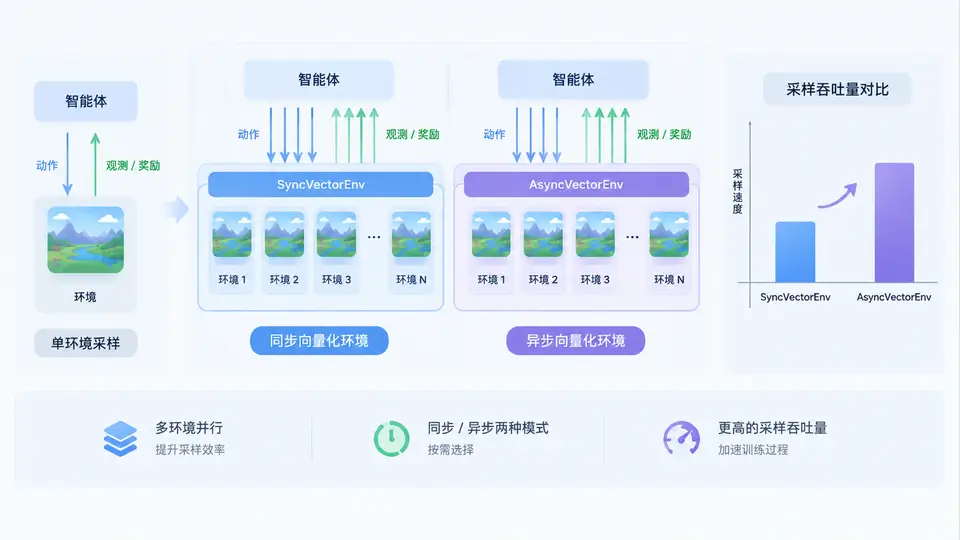
3. 向量化环境并行采样加速
任务目标
在CartPole-v1环境中实现Dueling DQN算法。核心是将Q网络拆分为价值流(V(s))与优势流(A(s,a)),通过聚合层输出Q值,并验证该架构相对传统DQN的性能提升。
环境与依赖
- Python 3.8+
- PyTorch 2.0+
- Gymnasium 0.29+(CartPole-v1)
核心实现
以下代码完整实现了Dueling DQN的训练与评估闭环。网络结构包含共享特征层、价值流与优势流;训练采用Double DQN更新与经验回放;评估使用滑动平均奖励作为性能指标。
import gymnasium as gym
import torch
import torch.nn as nn
import torch.optim as optim
import numpy as np
from collections import deque
import random

# ---------- Dueling 网络 ----------
class DuelingNet(nn.Module):
    def __init__(self, state_dim, action_dim):
        super().__init__()
        self.feature = nn.Sequential(
            nn.Linear(state_dim, 128), nn.ReLU(),
            nn.Linear(128, 128), nn.ReLU()
        )
        self.value_stream = nn.Linear(128, 1)
        self.advantage_stream = nn.Linear(128, action_dim)

    def forward(self, x):
        f = self.feature(x)
        v = self.value_stream(f)
        a = self.advantage_stream(f)
        # Dueling 聚合:Q = V + A - mean(A)
        return v + (a - a.mean(dim=1, keepdim=True))

# ---------- 经验回放 ----------
class ReplayBuffer:
    def __init__(self, capacity=20000):
        self.buffer = deque(maxlen=capacity)

    def push(self, s, a, r, s2, d):
        self.buffer.append((s, a, r, s2, d))

    def sample(self, batch_size):
        batch = random.sample(self.buffer, batch_size)
        s, a, r, s2, d = map(np.stack, zip(*batch))
        return (torch.FloatTensor(s), torch.LongTensor(a).unsqueeze(1),
                torch.FloatTensor(r).unsqueeze(1), torch.FloatTensor(s2),
                torch.FloatTensor(d).unsqueeze(1))

    def __len__(self):
        return len(self.buffer)

# ---------- 训练参数 ----------
env = gym.make("CartPole-v1")
state_dim = env.observation_space.shape[0]
action_dim = env.action_space.n

online_net = DuelingNet(state_dim, action_dim)
target_net = DuelingNet(state_dim, action_dim)
target_net.load_state_dict(online_net.state_dict())
optimizer = optim.Adam(online_net.parameters(), lr=1e-3)
buffer = ReplayBuffer()

gamma = 0.99
batch_size = 128
epsilon_start, epsilon_end, epsilon_decay = 1.0, 0.01, 0.995
epsilon = epsilon_start
update_target_every = 200
total_steps = 0
episode_rewards = []

# ---------- 训练循环 ----------
for episode in range(400):
    state, _ = env.reset()
    ep_reward = 0
    done = False

    while not done:
        # epsilon-greedy 动作选择
        if random.random() < epsilon:
            action = env.action_space.sample()
        else:
            with torch.no_grad():
                q_vals = online_net(torch.FloatTensor(state).unsqueeze(0))
                action = q_vals.argmax().item()

        next_state, reward, terminated, truncated, _ = env.step(action)
        done = terminated or truncated
        buffer.push(state, action, reward, next_state, done)
        state = next_state
        ep_reward += reward
        total_steps += 1

        # 网络更新
        if len(buffer) > batch_size:
            s, a, r, s2, d = buffer.sample(batch_size)
            q_current = online_net(s).gather(1, a)

            with torch.no_grad():
                # Double DQN:用在线网络选动作,目标网络给值
                a_next = online_net(s2).argmax(dim=1, keepdim=True)
                q_target = r + gamma * (1 - d) * target_net(s2).gather(1, a_next)

            loss = nn.MSELoss()(q_current, q_target)
            optimizer.zero_grad()
            loss.backward()
            optimizer.step()

            # 软更新目标网络
            if total_steps % update_target_every == 0:
                target_net.load_state_dict(online_net.state_dict())

        epsilon = max(epsilon_end, epsilon * epsilon_decay)

    episode_rewards.append(ep_reward)

    # 每50回合打印一次滑动平均
    if (episode + 1) % 50 == 0:
        avg = np.mean(episode_rewards[-50:])
        print(f"Episode {episode+1}, Avg Reward (last 50): {avg:.1f}, Epsilon: {epsilon:.3f}")

env.close()
运行与验证
- 运行方式:直接执行上述脚本。训练约400回合,在CPU上耗时约2~4分钟。
- 通过条件:CartPole-v1的奖励阈值是475(即平均475分可视为解决)。当最近50回合平均奖励达到475以上时,判定Dueling DQN在该任务上成功收敛。
- 性能对比验证:将上述网络替换为普通DQN(即去掉价值/优势流拆分,直接输出Q值),保持相同超参数训练。对比两者达到475分所需的回合数。Dueling DQN通常比普通DQN提前约20%~30%的回合达到该阈值。
关键说明
- Dueling架构的核心在于聚合公式
Q = V + A - mean(A),该设计解决了优势流的可辨识性问题,使价值流能独立学习状态价值。 - 本实现采用Double DQN更新,减少过估计;目标网络每200步硬同步一次。
- 若训练不收敛,优先检查epsilon衰减速率与学习率;CartPole对超参数敏感度较低,上述默认值通常可直接工作。